If You're Curious About These Questions...
You should listen to this audiobook
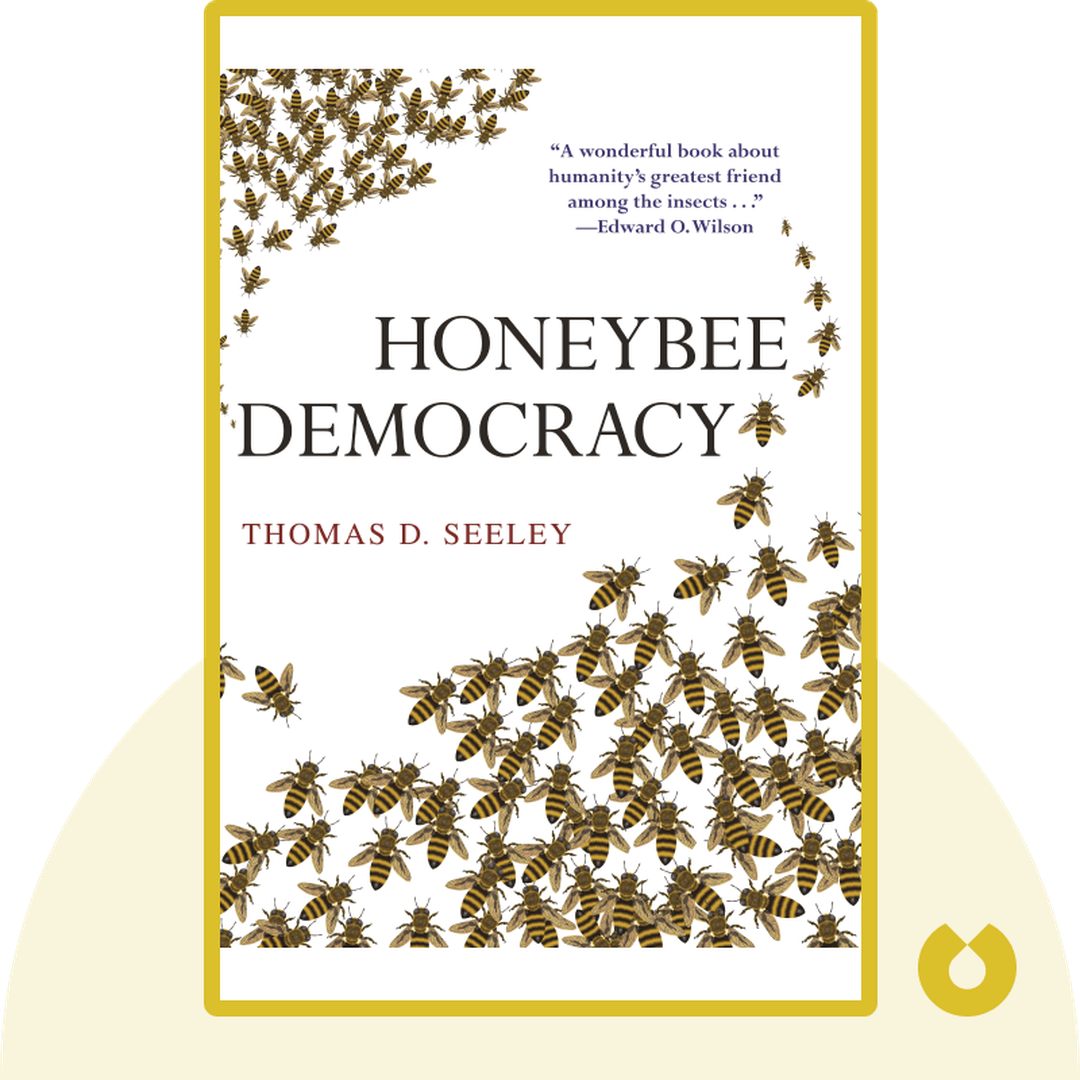
- Did you know that despite her title, the queen bee actually plays no role in deciding where her colony builds its next home?
- Have you ever wondered how thousands of individual bees manage to hold a peaceful, high-stakes debate to reach a life-or-death consensus?
- What's the secret to the honeybee’s collective intelligence that allows them to consistently make better decisions than any single human expert could?
Listen to Honeybee Democracy — Free Audiobook
Loading player...
Key Takeaways from Honeybee Democracy
- Discover how a swarm of 10,000 honeybees acts as a brilliantly organized superorganism to make life-or-death collective decisions.
- Learn how scout bees utilize a unique variation of the waggle dance to communicate, rigorously debate, and agree upon potential new nest sites.
- Understand the exact criteria bees use to evaluate real estate, seeking specific survival traits like a 40-liter capacity and a high, south-facing entrance.
- Find out how a colony prepares for its democratic swarming process, including altering the queen's diet so she is light enough to fly.
- Apply the democratic debating skills of honeybees to human environments, using their highly effective consensus-building methods to run better meetings.
Learning Tools
Reinforce what you learned from Honeybee Democracy
Mind Map
Honeybee Democracy
The Superorganism+
Evaluating Nest Sites+
Democratic Communication+
Executing the Decision+
Lessons for Humans+
Quiz — Test Your Understanding
Question 1 of 7
What unusual observation led scientist Martin Lindauer to suspect that some bees were scouting for a new home rather than foraging for food?
Question 2 of 7
According to the text, what portion of the honeybee colony leaves the hive during the annual swarming event?
Question 3 of 7
Which of the following characteristics is most important to honeybees when selecting a new nest site?
Question 4 of 7
How does a scout bee communicate the quality of a potential nest site to the rest of the swarm?
Question 5 of 7
What surprising behavior do scout bees exhibit that actually helps the swarm make the best collective decision?
Question 6 of 7
How does the swarm ultimately decide that it is time to take flight and move into the chosen nest site?
Question 7 of 7
Which of the following is one of the key lessons humans can learn from honeybee decision-making?
Honeybee Democracy — Full Chapter Overview
- 1Recommendation
- 2Every year, honeybees select a new nest site through a complex democratic process.
- 3A honeybee hive works together as one brilliantly organized unit.
- 4Honeybees carefully assess potential nest sites to find the best new home.
- 5Scout bees share news of possible nest sites and gradually build agreement.
- 6Honeybees rarely make mistakes when choosing a new nest site.
- 7When it’s time to move, a honeybee swarm acts with remarkable unity.
- 8Honeybees’ democratic decision-making process has a lot to teach us.
- 9Final summary
Honeybee Democracy Summary & Overview
Honeybee Democracy (2010) traces the fascinating story of how bees decide where to build their new hive. Using highly evolved skills, like independent research and community debate, the bees’ deeply democratic decision-making process is a model we can all learn from.
Who Should Listen to Honeybee Democracy?
- Popular science enthusiasts with a fondness for insects
- Politics buffs who want to learn about democratic systems
- Anyone and everyone who thinks bees are cool
Books Similar to Honeybee Democracy
Readers who enjoyed this also liked these titles.