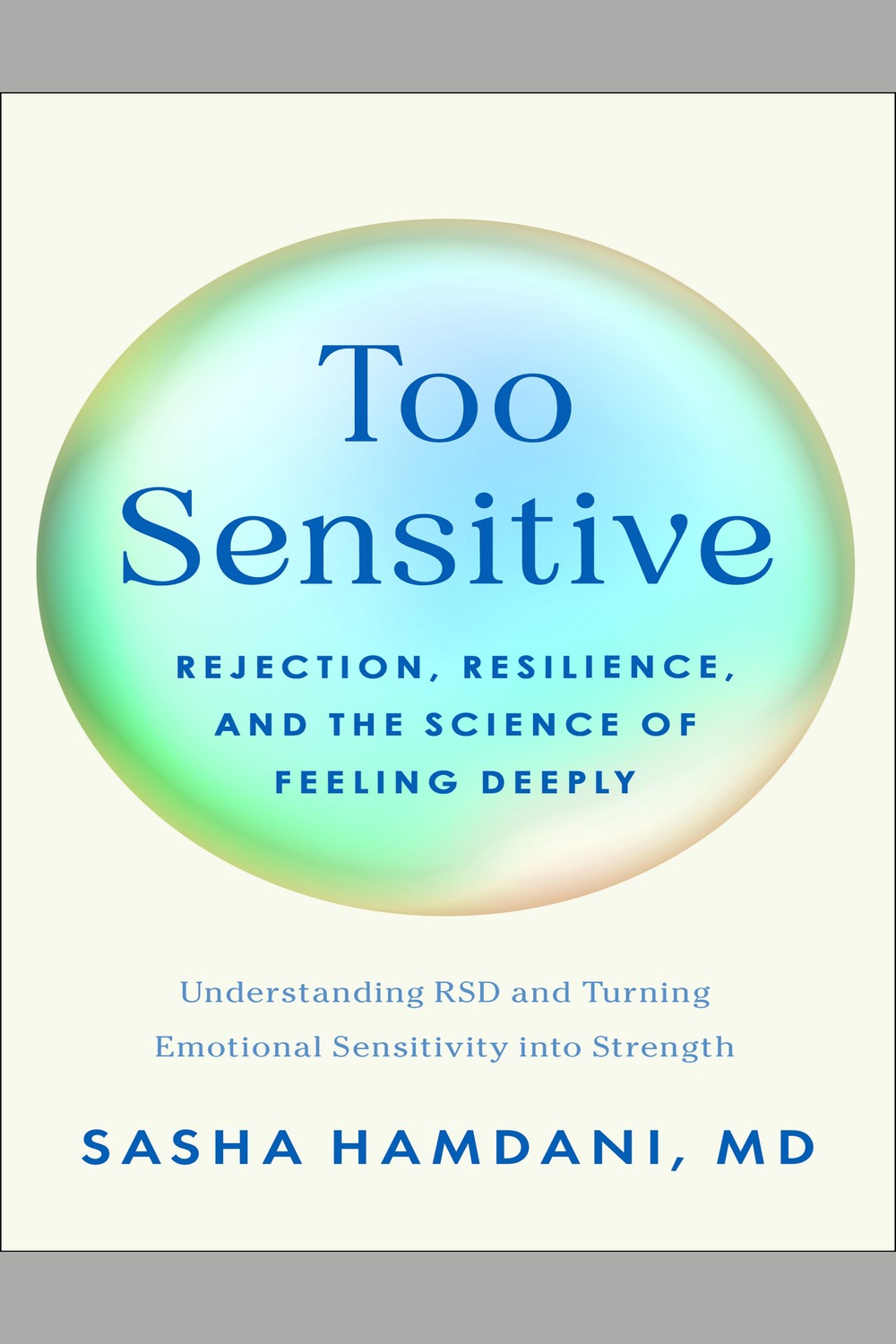
Too Sensitive: Rejection, Resilience, and the Science of Feeling Deeply audiobook cover - Why can an unanswered text, mild criticism, or ambiguous look feel like an emergency? Psychiatrist Sasha Hamdani connects rejection sensitivity to the brain and body, then offers practical tools for turning emotional overwhelm into self-awareness, steadier relationships, and resilience.
Theme Song

Too Sensitive: Rejection, Resilience, and the Science of Feeling Deeply

Why can an unanswered text, mild criticism, or ambiguous look feel like an emergency? Psychiatrist Sasha Hamdani connects rejection sensitivity to the brain and body, then offers practical tools for turning emotional overwhelm into self-awareness, steadier relationships, and resilience.

Sasha Hamdani, MD

4.5 / 5(408 ratings)
Start ListeningDownloadQR code that opens AudiobookHub on the App StoreTry free on iPhoneScan to start in 5 seconds

If You're Curious About These Questions...

You should listen to this audiobook

Listen to Too Sensitive: Rejection, Resilience, and the Science of Feeling Deeply — Cinematic Audio Edition

Loading player...

Key Takeaways from Too Sensitive: Rejection, Resilience, and the Science of Feeling Deeply

Learning Tools

Reinforce what you learned from Too Sensitive: Rejection, Resilience, and the Science of Feeling Deeply

Mind Map

Too Sensitive
Understanding Rejection Sensitive Dysphoria (RSD)+
Biology and Physical Toll+
CALM Tools: Mind Strategies+
CALM Tools: Action Strategies+
Navigating Life Contexts+
Acceptance & Continued Support+

Quiz — Test Your Understanding

Question 1 of 10
How does Sasha Hamdani reframe Rejection Sensitive Dysphoria (RSD) in the book?
  • A. As a rare genetic disorder requiring lifelong medication.
  • B. As a stand-alone diagnosis recently added to the American diagnostic manual.
  • C. As the nervous system treating social danger as a survival threat, rather than a moral failure.
  • D. As a conscious behavioral choice used to manipulate interpersonal dynamics.
Question 2 of 10
According to Hamdani, why can social rejection feel bodily real rather than metaphorical?
  • A. The anterior cingulate cortex participates in processing both social and physical pain.
  • B. Dopamine signals directly stimulate the body's peripheral pain receptors.
  • C. The prefrontal cortex completely shuts down during an emotional surge.
  • D. Overactive adrenal glands cause random muscle spasms.
Question 3 of 10
What was the key breakthrough for Hamdani's patient Emma regarding her emotional crashes at work?
  • A. She quit her job to avoid the toxic workplace environment.
  • B. She started tracking her symptoms to prepare for vulnerable periods in her menstrual cycle.
  • C. She realized she needed to permanently suppress her emotions using logic.
  • D. She confronted her boss about their lack of constructive feedback.
Question 4 of 10
What is the purpose of the twenty-five-item self-assessment provided in the book?
  • A. To provide an official clinical diagnosis of borderline personality disorder.
  • B. To act as a reflective tool to reveal frequency, severity, and patterns of reactions.
  • C. To determine exactly which medication a patient should be prescribed.
  • D. To measure a person's objective professional competence.
Question 5 of 10
When using the "Yield to Self-Compassion" tool, how does acknowledging pain and responding kindly help during an emotional trigger?
  • A. It guarantees the other person will apologize for triggering the reaction.
  • B. It indulges the emotional response so the individual can withdraw from relationships entirely.
  • C. It prevents shame from extending the stress cycle.
  • D. It permanently turns off the brain's threat detection system.
Question 6 of 10
Which tool is described as potentially the most protective during a Rejection Sensitive Dysphoria (RSD) surge?
  • A. Challenge Negative Thoughts
  • B. Implement I Statements
  • C. Delay Reaction
  • D. Reframe for Resilience
Question 7 of 10
How does the book suggest handling the intense desire for reassurance in a relationship when faced with uncertainty?
  • A. Practice internal validation by naming the discomfort and waiting before making the other person responsible for it.
  • B. Immediately confront the partner to demand clarification so the nervous system can relax.
  • C. End the relationship preemptively before the feeling of abandonment gets worse.
  • D. Overshare with friends to generate consensus on the partner's behavior.
Question 8 of 10
When navigating old family wounds, what crucial distinction does Hamdani encourage listeners to make regarding their relatives?
  • A. The distinction between care and responsibility.
  • B. The distinction between loyalty and isolation.
  • C. The distinction between truth and gaslighting.
  • D. The distinction between genetics and environment.
Question 9 of 10
In the workplace, Daniel interpreted a neutral request to discuss his proposal as evidence he would be fired. Why is remote communication particularly prone to this kind of misinterpretation?
  • A. Remote employees are typically monitored more harshly by management.
  • B. It removes facial and contextual cues, leaving the threat system to invent them.
  • C. Written text always carries a naturally aggressive tone.
  • D. Email servers frequently delay positive feedback, causing unnecessary anxiety.
Question 10 of 10
What role does medication sometimes play in managing Rejection Sensitive Dysphoria, according to Hamdani?
  • A. It acts as a dedicated cure that replaces the need for behavioral skills entirely.
  • B. It lowers the intensity of emotional reactions enough for learned strategies to take hold.
  • C. It guarantees emotional perfection by completely blocking dopamine receptors.
  • D. It is an FDA-approved, stand-alone treatment specifically for RSD.

Too Sensitive: Rejection, Resilience, and the Science of Feeling Deeply — Full Chapter Overview

Too Sensitive: Rejection, Resilience, and the Science of Feeling Deeply Summary & Overview

Too Sensitive is psychiatrist Sasha Hamdani’s compassionate guide to rejection sensitive dysphoria, or RSD: intense emotional pain triggered by actual or perceived criticism, failure, exclusion, or rejection. Drawing on clinical work, neuroscience, and her own experiences, Hamdani explains why an apparently minor interaction can activate a full-body threat response.

The book examines dopamine and norepinephrine, the amygdala, the prefrontal cortex, the limbic system, chronic stress, and hormonal changes. It also shows how rejection sensitivity can influence self-worth, intimate relationships, friendships, family dynamics, education, and professional life.

Its practical center is the twelve-part CALM YOUR MIND toolkit. These strategies help readers question distorted thoughts, name emotions, ground the body, practice self-compassion, understand triggers, communicate clearly, establish boundaries, and pause before reacting. Hamdani’s central message is that sensitivity is not a character defect. With support and practice, it can be managed without suppressing the empathy, creativity, and emotional awareness that often accompany it.

Who Should Listen to Too Sensitive: Rejection, Resilience, and the Science of Feeling Deeply?

  • People who experience intense reactions to criticism, silence, exclusion, mistakes, or ambiguous social cues
  • People with ADHD, emotional dysregulation, hormonal sensitivity, anxiety, or persistent approval-seeking patterns
  • Partners, relatives, educators, managers, and clinicians seeking a compassionate framework for understanding emotional sensitivity

About the Author: Sasha Hamdani, MD

Sasha Hamdani, MD, is a board-certified psychiatrist specializing in ADHD, rejection sensitivity, and emotional regulation. She created FocusGenie, wrote Self-Care for People with ADHD, delivered a widely viewed TEDx talk about focus, and shares accessible mental-health education with an international audience of more than two million followers.

🎧
Listen in the AppOffline playback & background play
Get App
Too Sensitive: Rejection, Resilience, and the Science of Feeling DeeplyTheme Song
NOW PLAYING
Too Sensitive: Rejection, Resilience, and the Science of Feeling Deeply

Too Sensitive: Rejection, Resilience, and the Science of Feeling Deeply

Theme Song
0:000:00