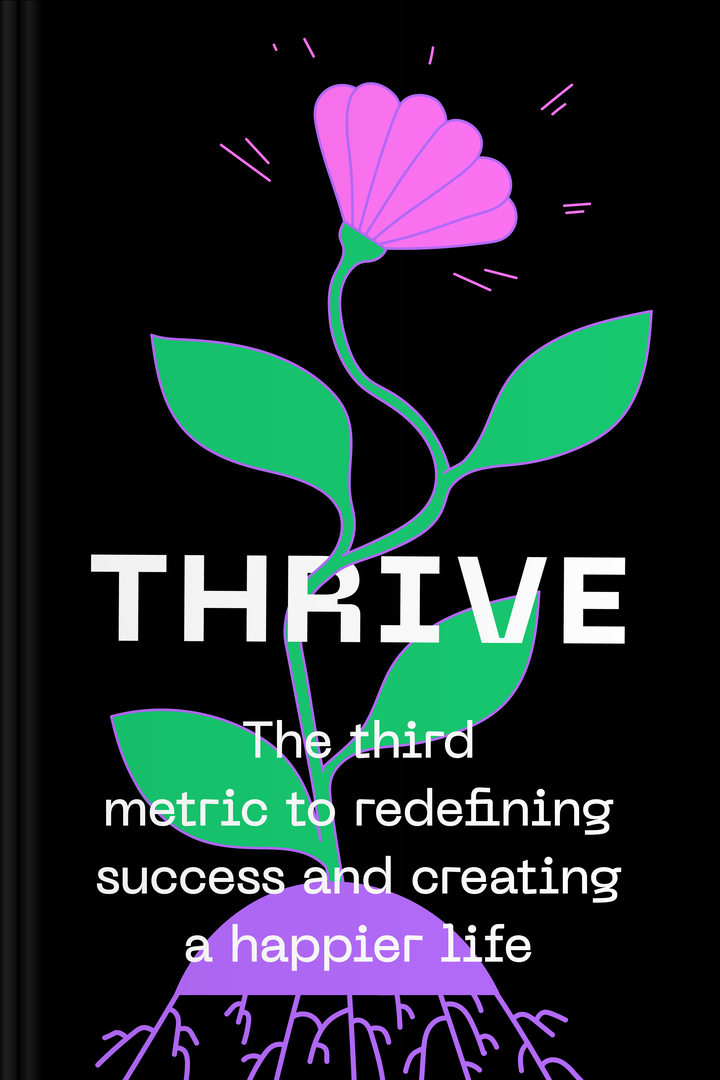
Thrive audiobook cover - If success has started to cost too much—your sleep, your health, your relationships—this gentle guide offers a calmer definition: one that protects well-being, cultivates wisdom, makes space for wonder, and brings more meaning through giving.

Thrive

If success has started to cost too much—your sleep, your health, your relationships—this gentle guide offers a calmer definition: one that protects well-being, cultivates wisdom, makes space for wonder, and brings more meaning through giving.

Arianna Huffington

4.4 / 5(5 ratings)
Start ListeningDownloadQR code that opens AudiobookHub on the App StoreTry free on iPhoneScan to start in 5 seconds

If You're Curious About These Questions...

You should listen to this audiobook

Listen to Thrive — Free Audiobook

Loading player...

Key Takeaways from Thrive

Learning Tools

Reinforce what you learned from Thrive

Mind Map

Thrive
The Illusion of Traditional Success+
The Third Metric+
Pillar 1: Well-Being+
Pillar 2: Wisdom+
Pillar 3: Wonder+
Pillar 4: Giving+

Quiz — Test Your Understanding

Question 1 of 8
According to the author, what constitutes the "third metric" of success that should be added to money and power?
  • A. Productivity, efficiency, networking, and ambition
  • B. Well-being, wisdom, wonder, and giving
  • C. Health, wealth, happiness, and fame
  • D. Meditation, technology, serendipity, and focus
Question 2 of 8
What personal event served as a wake-up call for Arianna Huffington to redefine her view of success?
  • A. She was fired from The Huffington Post by her board of directors.
  • B. She lost a major investment during the 2008 financial crisis.
  • C. She collapsed in her office and shattered her cheekbone due to exhaustion.
  • D. She realized she was spending too much time on her smartphone instead of with her family.
Question 3 of 8
How does the book suggest we should seek "wisdom" in the modern information age?
  • A. By utilizing search engines to gather as much knowledge as possible.
  • B. By turning inward, listening to our intuition, and learning from personal experiences.
  • C. By avoiding negative experiences and focusing only on positive daily wins.
  • D. By disconnecting entirely from the modern world and living in isolation.
Question 4 of 8
According to the book, how do social media algorithms negatively impact our sense of "wonder"?
  • A. They display too much negative news, causing widespread anxiety.
  • B. They connect us with too many strangers, overwhelming our social capacities.
  • C. They personalize our experiences based on what we already like, preventing serendipity.
  • D. They take up too much of our time, leaving no room for sleep or exercise.
Question 5 of 8
What is "time famine" as described in the text?
  • A. The condition of feeling constantly stressed about time due to rushing from place to place.
  • B. A modern workplace policy that strictly limits the duration of employee breaks.
  • C. The period of the day when people are least productive and most distracted.
  • D. The realization that we spend too much time on social media and not enough time working.
Question 6 of 8
How did Starbucks CEO Howard Schultz demonstrate the business value of generosity and giving back?
  • A. He donated 50% of the company's profits to Superstorm Sandy relief efforts.
  • B. He provided healthcare coverage for all workers, including part-timers, even during financial trouble.
  • C. He mandated that all employees spend one hour a day volunteering in their local communities.
  • D. He offered free coffee to any customer who proved they had helped a neighbor in need.
Question 7 of 8
What did a Stanford study reveal about the relationship between well-being and productivity?
  • A. Athletes on a swim team performed significantly better when they had slept well the night before.
  • B. Employees who meditated for 10 minutes a day closed 50% more sales than those who didn't.
  • C. Students who disconnected from their smartphones scored higher on standardized tests.
  • D. Nurses who worked shorter shifts were able to diagnose infections more accurately.
Question 8 of 8
What specific daily practice does the author highly recommend to reduce stress and improve focus?
  • A. Writing in a gratitude journal for 20 minutes.
  • B. Taking a 30-minute walk in nature without any electronic devices.
  • C. Sitting down for ten minutes to practice meditation and quiet the thoughts.
  • D. Reading one chapter of a book related to your professional field.

Thrive — Full Chapter Overview

Thrive Summary & Overview

Many people chase the modern definition of success—money, status, constant productivity—only to feel exhausted, anxious, and strangely dissatisfied. This narration invites listeners to reconsider what “making it” truly means, and to choose a version of success that supports health, steadiness, and a more peaceful inner life.

Drawing on Arianna Huffington’s wake-up call and the idea of a “Third Metric,” the chapters explore practical ways to set boundaries, rebuild life-giving habits like sleep and reflection, listen to intuition with more honesty, rediscover wonder through nature and art, and experience the deep happiness that comes from giving.

Who Should Listen to Thrive?

  • People who look “successful” on paper but feel depleted, stressed, or disconnected from themselves.
  • Professionals who want healthier boundaries with work, technology, and achievement pressure.
  • Listeners who want practical, gentle practices for well-being, clarity, meaning, and a calmer definition of success.

About the Author: Arianna Huffington

Arianna Huffington is a media entrepreneur and author who has spoken widely about redefining success beyond money and power. After a personal health scare, she began advocating for well-being, sleep, and a more sustainable way to live and work—ideas often framed as a “Third Metric” for a truly thriving life.

🎧
Listen in the AppOffline playback & background play
Get App