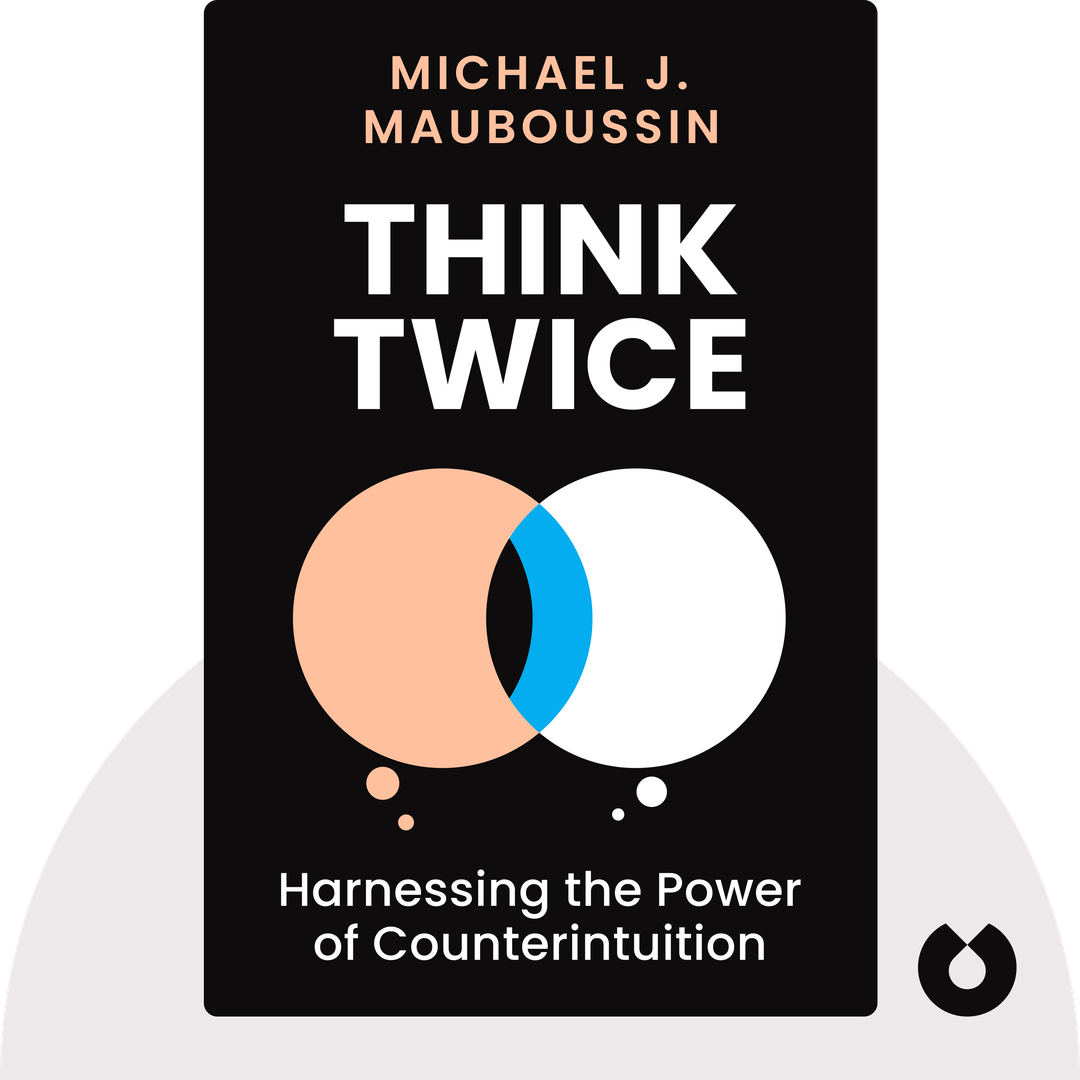
If You're Curious About These Questions...
You should listen to this audiobook
- Have you ever wondered why even the most seasoned experts consistently fail to predict the future, and what hidden factors they’re missing?
- Did you know that your most 'reliable' gut instincts might actually be leading you into a trap when making high-stakes decisions?
- What if you could master a simple mental shift that allows you to see past your own biases and predict outcomes with much higher accuracy?
Listen to Think Twice — Free Audiobook
Loading player...
Key Takeaways from Think Twice
- Discover why brilliant minds often make catastrophic errors by relying too heavily on ingrained mental shortcuts and default assumptions.
- Learn how to overcome the naturally optimistic 'inside view' by using broader statistical data and comparable scenarios to ground your decisions.
- Master a four-step framework for less biased thinking by identifying reference classes and analyzing outcome distributions before predicting results.
- Understand how cognitive traps like the anchoring heuristic, availability bias, and cognitive dissonance create tunnel vision that warps your objective judgment.
- Find out how to actively counter tunnel vision by seeking out dissenting voices, explicitly considering alternatives, and recognizing the hidden power of incentives.
Learning Tools
Reinforce what you learned from Think Twice
Mind Map
Think Twice
The Problem with Default Thinking+
Inside vs. Outside View+
Tunnel Vision & Mental Shortcuts+
The Solution: Thinking Twice+
Quiz — Test Your Understanding
Question 1 of 5
Why do highly intelligent people, such as the Nobel laureates at Long Term Capital Management, frequently make poor decisions?
Question 2 of 5
According to the text, what characterizes the 'inside view' of decision-making?
Question 3 of 5
What is the first recommended step to successfully adopt an 'outside view' when making a decision?
Question 4 of 5
The experiment involving a person's phone number and estimating the number of doctors in Manhattan illustrates which cognitive bias?
Question 5 of 5
How does cognitive dissonance contribute to 'tunnel vision' in decision-making?
Think Twice — Full Chapter Overview
- 1Recommendation
- 2The Fall That Changed Everything
- 3A Birthday, A Secret, A Man Across the Street
- 4The Therapist With the Old Name
- 5The Kiss in the Parking Lot
- 6Secrets Grow Teeth
- 7The Closet, the Crutch, the Lie
- 8Caught in the Hallway
- 9Choosing Love in the Open
- 10All In, For Good
Think Twice Summary & Overview
Think Twice (2012) examines the hidden cognitive biases and mental shortcuts that routinely impair our judgment. It also provides concrete steps to counteract ingrained thinking and adopt a clear-eyed approach to making choices.
Who Should Listen to Think Twice?
- Investors looking to avoid costly cognitive biases
- Professionals who want to improve their decision-making
- Students of psychology, economics, and human behavior
Books Similar to Think Twice
Readers who enjoyed this also liked these titles.