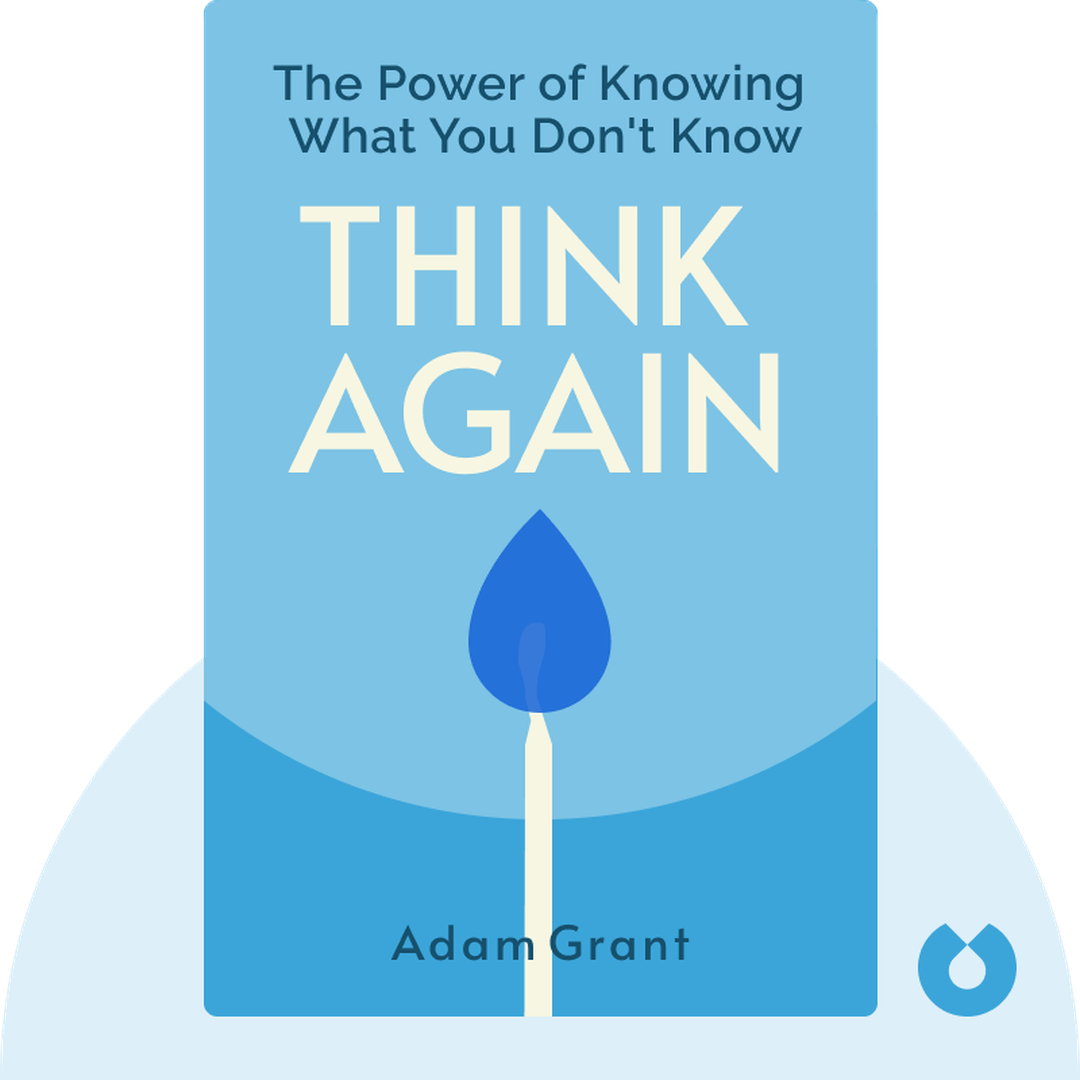
If You're Curious About These Questions...
You should listen to this audiobook
- What's the secret to being more open-minded and adaptable in a rapidly changing world?
- Are you curious about why even the most intelligent and successful people can be blind to their own biases?
- Can you really change someone's mind, or is it a lost cause?
Listen to Think Again — Free Audiobook
Loading player...
Key Takeaways from Think Again
- Understand why changing your mind isn't a betrayal of your identity, but a necessary mental upgrade similar to updating your outdated technology.
- Discover the truth behind the 'first instinct fallacy' and learn why pausing to reconsider your initial assumptions often leads to more accurate decisions.
- Learn to recognize when you slip into preacher, prosecutor, or politician mode, and how shifting into a 'scientist' mindset helps you prioritize truth over your ego.
- Realize that high intelligence does not automatically protect you from emotional bias, making curiosity and humility the true essential traits for evolving your beliefs.
- Master the habit of actively searching for evidence that proves you wrong, a scientific approach that helped trained business founders pivot faster and earn forty times more.
Learning Tools
Reinforce what you learned from Think Again
Mind Map
Think Again
The Value of Rethinking+
Overcoming Blind Spots+
The Art of Persuasion+
Organizational Rethinking+
Personal Identity+
Quiz — Test Your Understanding
Question 1 of 8
According to the text, how can business leaders benefit from thinking more like scientists?
Question 2 of 8
Adam Grant's research on Silicon Valley tech teams revealed that the highest-performing teams experienced which of the following?
Question 3 of 8
Why do the most successful negotiators present fewer arguments in favor of their case rather than piling them on?
Question 4 of 8
What method did Daryl Davis use to successfully encourage Ku Klux Klan members to rethink their racist beliefs?
Question 5 of 8
When Dr. Arnaud Gagneur speaks with vaccine-hesitant parents, what is a key component of his 'motivational interviewing' technique?
Question 6 of 8
What is the 'binary bias' trap that activists often fall into when discussing complex issues like climate change?
Question 7 of 8
What organizational flaw contributed to the NASA Columbia Space Shuttle disaster, according to the text?
Question 8 of 8
The text suggests that to avoid becoming defensive and clinging to invalid opinions, you should define your identity based on what?
Think Again — Full Chapter Overview
- 1Recommendation
- 2In a constantly changing world, it pays to reconsider your views.
- 3You may not realize the limits of your own knowledge.
- 4Top negotiators use three core tactics to shift people’s thinking.
- 5Even the most deeply rooted prejudices can be overturned.
- 6Asking thoughtful questions can guide others to change their own minds.
- 7People are less likely to reconsider when issues are framed in extremes.
- 8Your workplace culture shapes how well teams can rethink.
Think Again Summary & Overview
Think Again (2021) examines the science behind changing your mind – and persuading others to change theirs. It explores the biases and assumptions that we bring to our decision-making, and outlines how individuals and organizations can build a mindset of lifelong curiosity.
Who Should Listen to Think Again?
- Psychology buffs looking for fresh insights
- Sales professionals seeking a new angle
- People managers hoping to improve team performance
Books Similar to Think Again
Readers who enjoyed this also liked these titles.