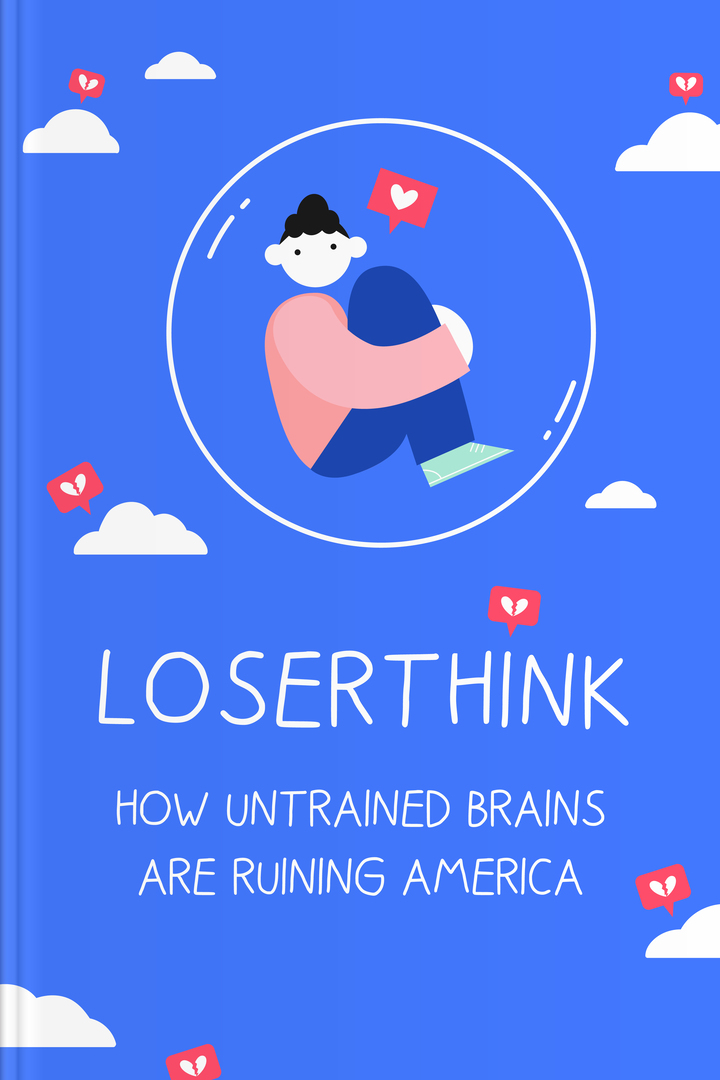
If You're Curious About These Questions...
You should listen to this audiobook
- Have you ever wondered why even the smartest, most well-informed people often fall into mental traps that keep them stuck in cycles of conflict?
- What if you could navigate life’s biggest challenges more effectively by learning to think like a doctor, an engineer, or a philosopher?
- Are you curious about the simple mental shifts that can help you spot—and escape—the invisible habits like 'mind-reading' that cloud your judgment?
Listen to Loserthink — Free Audiobook
Loading player...
Key Takeaways from Loserthink
- Discover why high intelligence doesn't prevent unproductive thinking, and how narrow professional training can quietly trap your mind.
- Learn how to break free from rigid thought patterns by casually sampling unfamiliar disciplines to expand your mental toolkit.
- Recognize the dangerous 'mind-reading' trap during conflicts, and understand why guessing other people's motives leads to false conclusions.
- Master the habit of separating observed facts from personal assumptions to avoid the mistake of labeling people as evil simply because they disagree.
- Find out how to use Occam's razor to cut through unnecessary complexity in heated debates by seeking the simplest explanation first.
Learning Tools
Reinforce what you learned from Loserthink
Mind Map
Loserthink
Concept of Loserthink+
Ego Management+
The Trap of History+
Overcoming Overwhelm+
Communication & Criticism+
Optimism vs. Media Doom+
Personal Priorities+
Quiz — Test Your Understanding
Question 1 of 6
How does the author suggest we should view our ego?
Question 2 of 6
Why does Scott Adams argue that relying too heavily on the idea that "history repeats itself" is a form of loserthink?
Question 3 of 6
According to the author, what is the most effective way to overcome the anxiety of starting a massive life change or project?
Question 4 of 6
What is the primary purpose of the "48-hour rule" proposed by the author?
Question 5 of 6
How does the author view the constant gloom-and-doom predictions about the future presented by the media?
Question 6 of 6
Based on the book's actionable advice, who or what should be your number one priority in life?
Loserthink — Full Chapter Overview
- 1Recommendation
- 2See your ego as a tool, not your identity.
- 3Relying too heavily on history is a clear sign of loserthink.
- 4Loserthink can make projects feel impossible, but microsteps make them doable.
- 5Ask for clarification before criticizing someone for what you think they meant.
- 6The future may not be as bad as you think.
- 7Final summary
Loserthink Summary & Overview
In this warm audio-friendly summary of Scott Adams’s ideas on “loserthink,” you’ll explore how smart, well-informed people can still fall into mental habits that keep them stuck—especially when emotions run high, context is missing, or imagination runs away with the story.
Across seven short chapters, the narration offers supportive ways to notice mental traps like mind-reading, projection, and oversimplifying. You’ll also hear practical prompts—like writing down assumptions, seeking context, and learning from other disciplines—so your thinking can become steadier, more flexible, and more useful in real life.
Who Should Listen to Loserthink?
- Listeners who feel drained by online conflict or polarizing conversations and want clearer, kinder ways to think and respond
- People who value personal growth and want simple tools for spotting mental traps, bias, and overthinking
- Anyone who wants to strengthen decision-making by learning how different fields—like medicine, law, engineering, and philosophy—approach problems
Books Similar to Loserthink
Readers who enjoyed this also liked these titles.