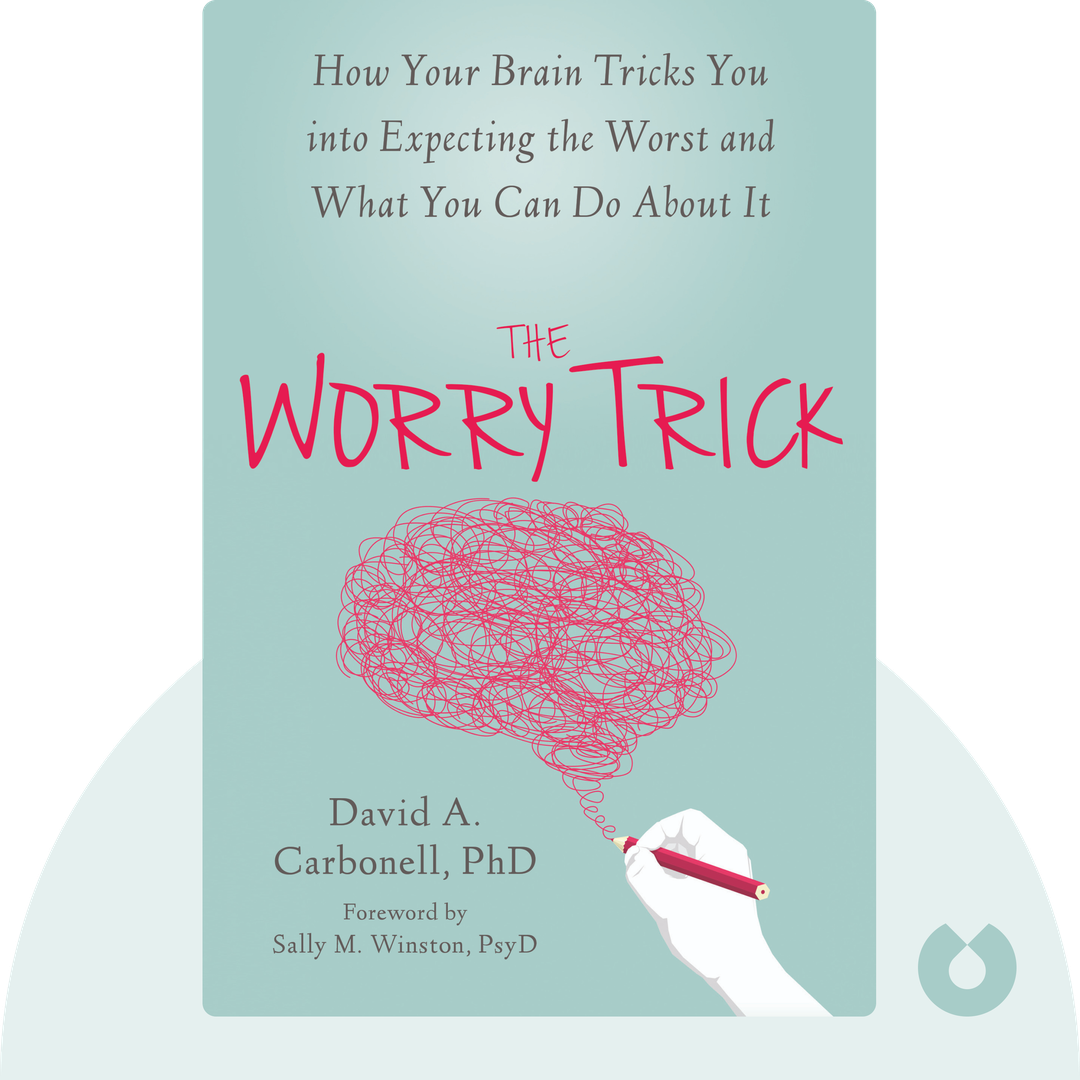
If You're Curious About These Questions...
You should listen to this audiobook
- Have you ever wondered why the harder you try to stop worrying, the more persistent and intrusive those anxious thoughts seem to become?
- What if the secret to overcoming chronic anxiety isn’t about finding better solutions to your problems, but learning how to outsmart the 'trick' your brain is playing on you?
- Are you curious about how a simple shift in your relationship with 'what if' questions could finally strip worry of its power over your daily life?
Listen to The Worry Trick — Cinematic Audio Edition
Loading player...
Key Takeaways from The Worry Trick
- Discover how worry tricks your brain into treating everyday doubts about the future as immediate, present-day dangers.
- Understand why relying on natural instincts like reasoning, arguing, or distracting yourself only validates your anxiety and makes it worse.
- Shift your focus from trying to eliminate worry completely to developing a more manageable, healthier relationship with it.
- Master the counterintuitive approach to overcoming chronic anxiety by doing the exact opposite of what your gut instincts demand.
- Learn to disarm catastrophic thoughts by recognizing the phrase 'what if' as a harmless trigger that simply means 'let's pretend'.
Learning Tools
Reinforce what you learned from The Worry Trick
Mind Map
The Worry Trick
The Core Illusion+
Why Instincts Fail+
Deconstructing 'What If'+
Counter-Intuitive Responses+
Daily Resistance Habits+
Quiz — Test Your Understanding
Question 1 of 8
How does the 'worry trick' cause people to worry more?
Question 2 of 8
According to the text, why do intuitive strategies like reasoning, arguing, and distraction fail to stop worry?
Question 3 of 8
What is the ultimate goal the author suggests for dealing with chronic worry?
Question 4 of 8
What does the text suggest a 'what if' thought actually represents?
Question 5 of 8
How does the author suggest you handle worry, using the metaphor of an argumentative dinner guest?
Question 6 of 8
What is the purpose of scheduling a specific 'worry appointment' in your calendar?
Question 7 of 8
What specific technique does the text recommend when doing breathing exercises for worry?
Question 8 of 8
During the suggested mindfulness meditation, what should you do when your focus is interrupted by anxious thoughts?
The Worry Trick — Full Chapter Overview
- 1Recommendation
- 2How worry tricks you into making yourself worry even more
- 3Ignore your instincts and work on changing your relationship with worry
- 4Learn how your worries announce themselves as they enter your mind
- 5Take time to play along with and humor your worries
- 6Three easy exercises to build resistance to worry
The Worry Trick Summary & Overview
The Worry Trick (2016) is a no-nonsense guide to dealing with worry and anxiety. Drawing from acceptance and commitment therapy and cognitive behavioral therapy, it breaks down where worry comes from and offers concrete steps on how to face and ultimately overcome it.
Who Should Listen to The Worry Trick?
- Anyone who deals with chronic worry
- Psychologists looking to deepen their knowledge of anxiety
- Students of the human condition
Books Similar to The Worry Trick
Readers who enjoyed this also liked these titles.