If You're Curious About These Questions...
You should listen to this audiobook
- Did you know that a simple shift in how you analytically process your thoughts can stop a worry spiral before it even begins?
- What if you could reclaim your headspace for the things you actually enjoy by making just a few tiny, logical adjustments to your perspective?
- Have you ever wondered why your brain treats minor inconveniences like major catastrophes, and how you can retrain it to see the difference?
Listen to How Not to Worry — Free Audiobook
Loading player...
Key Takeaways from How Not to Worry
- Understand how worry, anxiety, and stress form a toxic feedback loop that weakens your immune system and robs you of the headspace needed for rational decisions.
- Discover why your brain struggles to differentiate between life-threatening predators and stressful everyday events, triggering an unnecessary fight-or-flight response.
- Identify the hidden root causes behind your anxiety, from deep-seated childhood conditioning and painful memories to the frustrating fear of the unknown.
- Learn to empower your rational neocortex to successfully rein in the primitive and emotional parts of your brain that are evolutionarily hardwired to worry.
- Master the 'stop before you spiral' mindset to break out of the stress cycle, reclaim your creative inspiration, and finally enjoy the present moment.
Learning Tools
Reinforce what you learned from How Not to Worry
Mind Map
How Not to Worry
The Worry Cycle+
Root Causes+
The Brain's Role+
3-Step Roadmap+
Tools & Mindset Shifts+
Quiz — Test Your Understanding
Question 1 of 10
According to the text, what is the relationship between worry, anxiety, and stress?
Question 2 of 10
Why is stress so common in today's modern world, according to our evolutionary hardwiring?
Question 3 of 10
What does the author illustrate with the example of Formula 1 drivers during a pitstop?
Question 4 of 10
Which part of the brain is responsible for problem-solving, accurately assessing the world, and keeping worries in check?
Question 5 of 10
During the 'Awareness' step of tackling worries, how is 'anticipatory stress' defined?
Question 6 of 10
If you find yourself agonizing over the highly unlikely chance of a plane crash or a shark attack, which type of worry are you experiencing?
Question 7 of 10
When taking action against 'helpful worries,' what strategy is recommended based on Stephen R. Covey's insights?
Question 8 of 10
Why can the human imagination so easily trigger feelings of worry and stress?
Question 9 of 10
According to a study in the Journal of Personality and Social Psychology, what is a surprising benefit of being an optimistic person who overestimates their own influence?
Question 10 of 10
Which of the following behaviors is identified as a surefire way to boost your worries by making your problems seem insurmountable?
How Not to Worry — Full Chapter Overview
- 1Recommendation
- 2Worry, anxiety, and stress form a cycle that can harm your health.
- 3Whether it comes from past experiences or fear of the unknown, face the source of your worries.
- 4Your rational brain tries to rein in worries from your primitive and emotional brain.
- 5Awareness is the first of three steps to help you tackle your worries rationally.
- 6Analyze your worries to understand their root cause.
- 7The final step in tackling worry is taking action and focusing on outcomes you can influence.
- 8Your imagination is a powerful tool that can both spark and ease worry.
- 9Change your personal worry triggers, stop trying to please everyone, and learn to ask for help.
- 10Final summary
How Not to Worry Summary & Overview
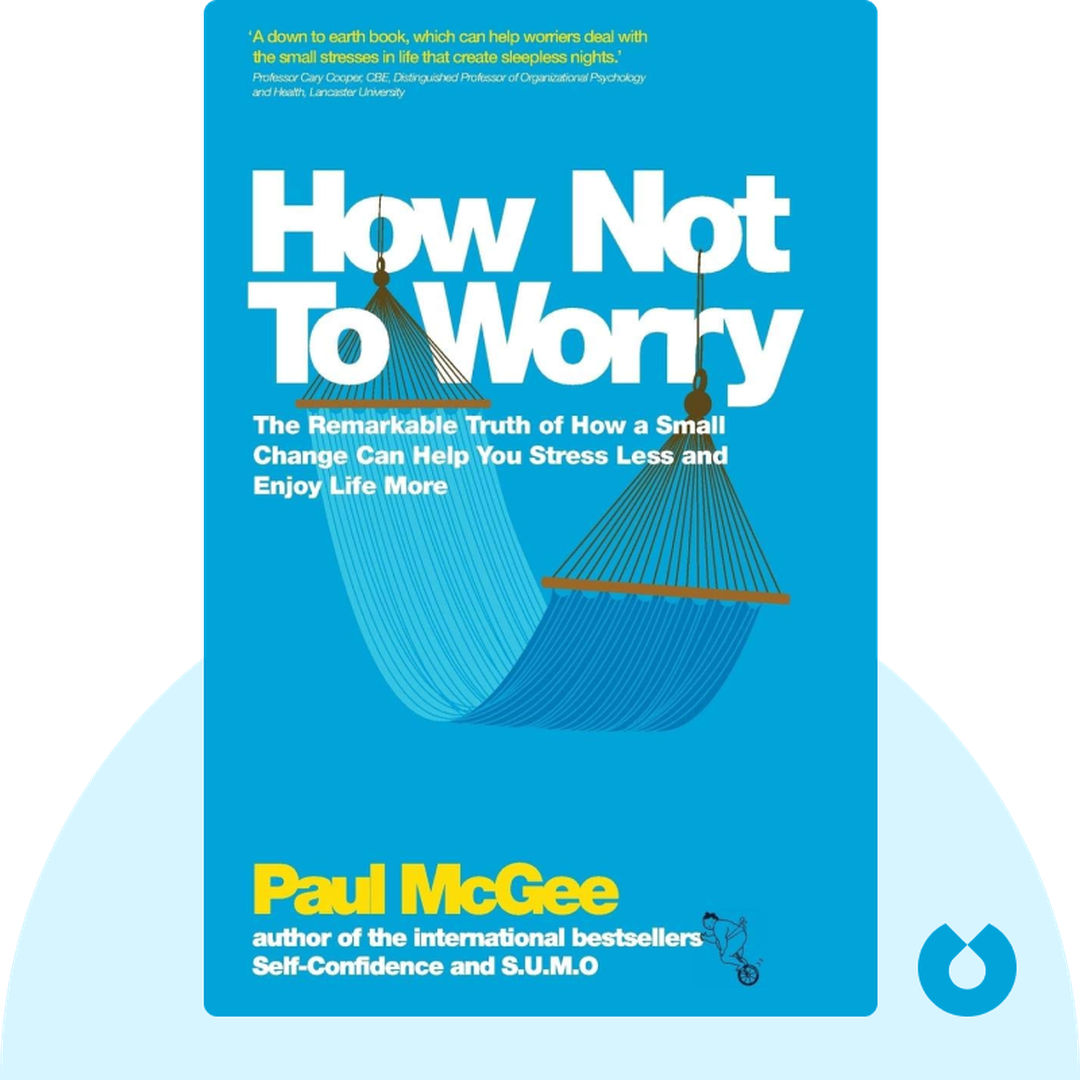
How Not to Worry (2012) is a practical and accessible roadmap to defeating anxiety, stress and worry. Logical and clearly laid out, life coach Paul McGee’s approach is all about small changes that make a big difference. He shows that by thinking analytically, you can start dealing with worries rationally and free up valuable headspace for more pleasurable pursuits.
Who Should Listen to How Not to Worry?
- Serial worriers and the terminally stressed out
- Life and performance coaches
- Psychology buffs
Books Similar to How Not to Worry
Readers who enjoyed this also liked these titles.