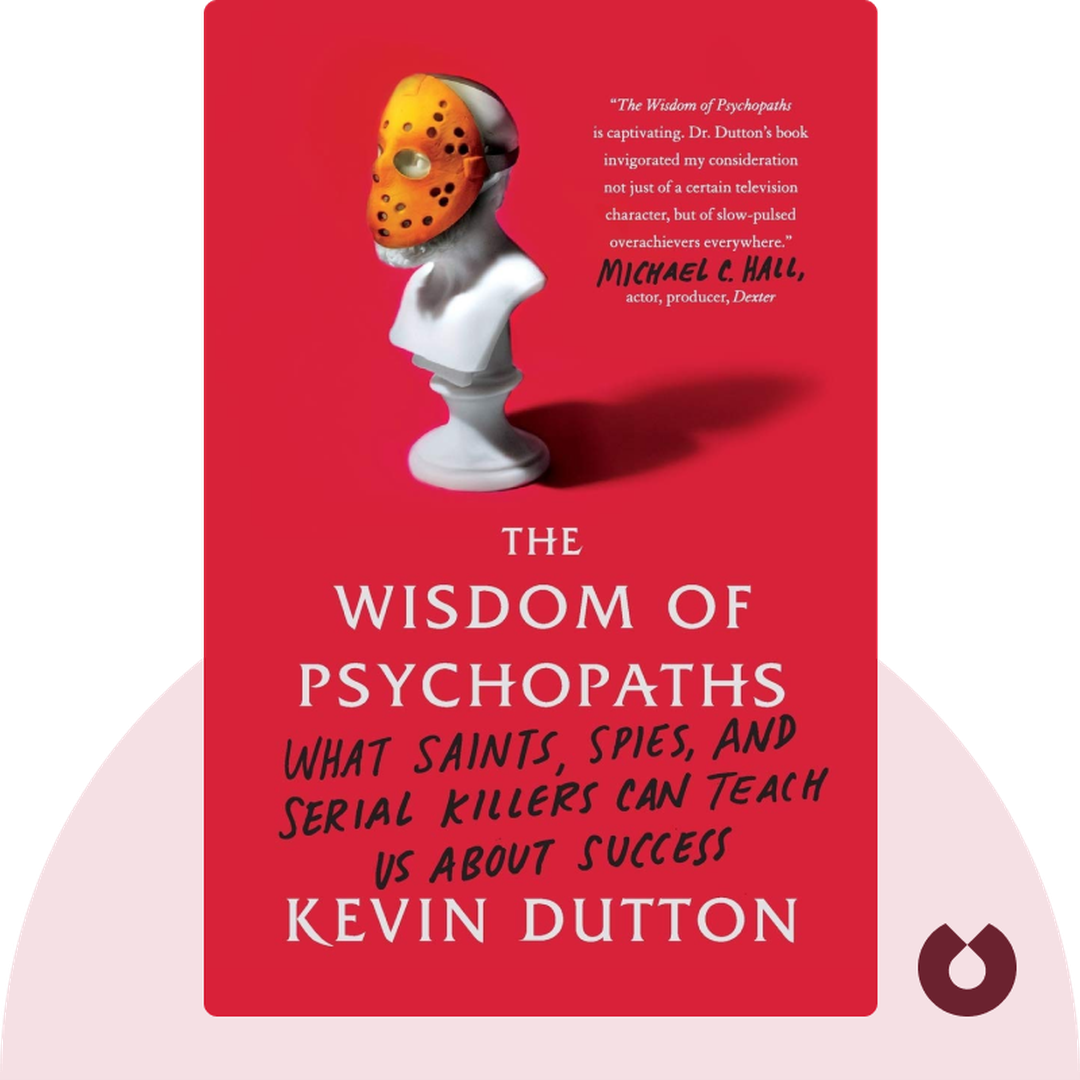
The Wisdom of Psychopaths
Start ListeningDownload Try free on iPhoneScan to start in 5 seconds
Categories:
If You're Curious About These Questions...
You should listen to this audiobook
- Did you know that some of the most successful politicians and CEOs share the same core personality traits as individuals in maximum-security prisons?
- What if you could learn to 'dial up' specific psychopathic qualities to become more fearless, focused, and effective in your professional life?
- Are you curious about why certain psychopathic traits are actually considered the secret to success in high-stakes professions like surgery and finance?
Listen to The Wisdom of Psychopaths — Cinematic Audio Edition
Loading player...
Key Takeaways from The Wisdom of Psychopaths
- Discover why charismatic leaders and top executives often share the same advantageous psychological traits—like fearlessness and craftiness—as ruthless criminals.
- Understand how a biological lack of fear allows psychopaths to confidently take bold risks and achieve remarkable success without worrying about failure.
- Learn how to make cool, highly rational decisions by adopting the utilitarian mindset of a psychopath, completely free from paralyzing emotional interference.
- Master the art of taking immediate action by embracing the psychopathic tendency to bypass overthinking and execute decisions without the burden of regret.
- Explore how superficial charm and mental agility serve as powerful tools that successfully mask inner flaws and propel people into high-status societal roles.
Learning Tools
Reinforce what you learned from The Wisdom of Psychopaths
Mind Map
The Wisdom of Psychopaths
The Psychopathic Mindset+
Environments of Success+
Lessons for Personal Advancement+
Quiz — Test Your Understanding
Question 1 of 9
According to the text, why are psychopaths often successful in high-level positions like executives or surgeons?
Question 2 of 9
How do psychopaths typically differ from non-psychopaths when faced with a moral dilemma, such as the 'trolley problem'?
Question 3 of 9
What drives psychopaths to take immediate action rather than overthinking the potential consequences of a situation?
Question 4 of 9
According to research mentioned in the text, what distinguishes successful executives with psychopathic traits from convicted criminal psychopaths?
Question 5 of 9
What psychological state do psychopaths naturally share with Zen masters?
Question 6 of 9
In the experiment involving 'fear sweat,' how did the psychopaths react compared to the non-psychopaths?
Question 7 of 9
According to the text, how are psychopathic traits manifesting in younger generations (referred to as 'Generation Me')?
Question 8 of 9
What is the key difference between a 'functional' psychopath (like a successful lawyer) and a 'criminal' psychopath?
Question 9 of 9
What happened when the author of the book underwent transcranial magnetic stimulation to temporarily simulate a psychopath's brain activity?
The Wisdom of Psychopaths — Full Chapter Overview
- 1Recommendation
- 2Psychopaths are often charming, intelligent, and fearless.
- 3Psychopaths make cool, rational decisions; emotions and morals don’t play a role.
- 4Psychopaths don’t just think about doing things – they take action.
- 5Certain psychopathic traits are more common in executives and politicians than in convicted criminals.
- 6Living in the present – what psychopaths share with Zen masters.
- 7Psychopathic traits are especially useful in stressful, chaotic settings.
- 8“Generation Me”: Psychopathic traits are more common among younger generations.
- 9Developing psychopathic traits can be useful for getting ahead.
- 10Functional psychopaths can switch their behavior depending on the situation.
- 11Final summary
The Wisdom of Psychopaths Summary & Overview
Not all psychopaths are locked away in maximum-security prisons and mental hospitals. Many of them live among us, in the midst of society. Indeed, a great number of highly successful political and financial leaders exhibit psychopathic traits. This book investigates why they are so successful, what makes them different from psychopathic criminals and what all of us can learn from them.
Who Should Listen to The Wisdom of Psychopaths?
- Anyone with a general interest in psychology, criminology or popular science
- Anyone who wants to find out what we can learn from psychopaths and which of their traits could be useful in our professional lives
Books Similar to The Wisdom of Psychopaths
Readers who enjoyed this also liked these titles.