If You're Curious About These Questions...
You should listen to this audiobook
- How did a completely unfounded psychological theory about 'superpredators' in the 1990s lead to dozens of US states passing harsher sentencing laws for juveniles?
- Why might widely celebrated, seemingly empowering concepts like 'power posing' and 'grit' actually distract us from solving deep-rooted structural inequalities?
- What are the hidden dangers of relying on positive psychology and implicit bias tests to solve severe, complex issues like military PTSD and systemic racism?
Listen to The Quick Fix — Cinematic Audio Edition
Loading player...
Key Takeaways from The Quick Fix
- Popular psychology frequently promotes oversimplified 'quick fixes' for complex social issues, distracting society from making necessary, long-term structural changes.
- Flawed psychological theories can cause severe real-world harm, as seen when the debunked 'superpredator' myth led to unjust legal reforms and deepened racial divides.
- Many highly publicized psychological studies fail to stand up to scientific scrutiny due to data manipulation, highlighting the critical need for study replication and rigorous research practices.
- Emphasizing individual traits like 'grit' or confident body language places an unfair burden on disadvantaged individuals while ignoring crucial systemic factors like poverty and family stability.
- While corporate tools like implicit bias tests are incredibly popular, they lack predictive reliability and often serve as superficial band-aids that ignore explicit discrimination and structural inequality.
Learning Tools
Reinforce what you learned from The Quick Fix
Mind Map
The Quick Fix
The Danger of Pop Psychology+
Debunked Psychological Theories+
Ineffective Interventions+
Flawed Research Practices+
Valid but Limited Tools+
The Path Forward+
Quiz — Test Your Understanding
Question 1 of 8
What was the actual, inadvertent consequence of John DiIulio’s 'superpredator' theory in the 1990s?
Question 2 of 8
According to Dana Carney, a coauthor of the original power pose study, why did the study produce false positives?
Question 3 of 8
Why is the US Army's adoption of the Comprehensive Soldier Fitness (CSF) program criticized in the book?
Question 4 of 8
What is the main flaw in Angela Duckworth’s concept of 'grit' as the secret to success, according to the text?
Question 5 of 8
According to the book, what is the primary limitation of the Implicit Association Test (IAT) used by companies like Google?
Question 6 of 8
What practice does the book suggest researchers use to prevent manipulating data mid-study or changing theories after the fact?
Question 7 of 8
How does the book view the concept of 'nudging' (choice architecture)?
Question 8 of 8
What overarching message does the author convey about solving complex societal problems?
The Quick Fix — Full Chapter Overview
- 1Recommendation
- 2Flawed psychology can cause serious harm.
- 3Some well-known psychology studies fail under scientific examination.
- 4When institutions use weak psychological programs, better methods are sidelined.
- 5We tend to exaggerate the role of personal traits and behavior.
- 6Implicit racial bias matters less than you have been told.
- 7Psychologists must rely on replication to verify study results.
- 8Even sound psychology must not be oversold.
- 9We must accept human complexity and abandon the dream of simple cures.
The Quick Fix Summary & Overview
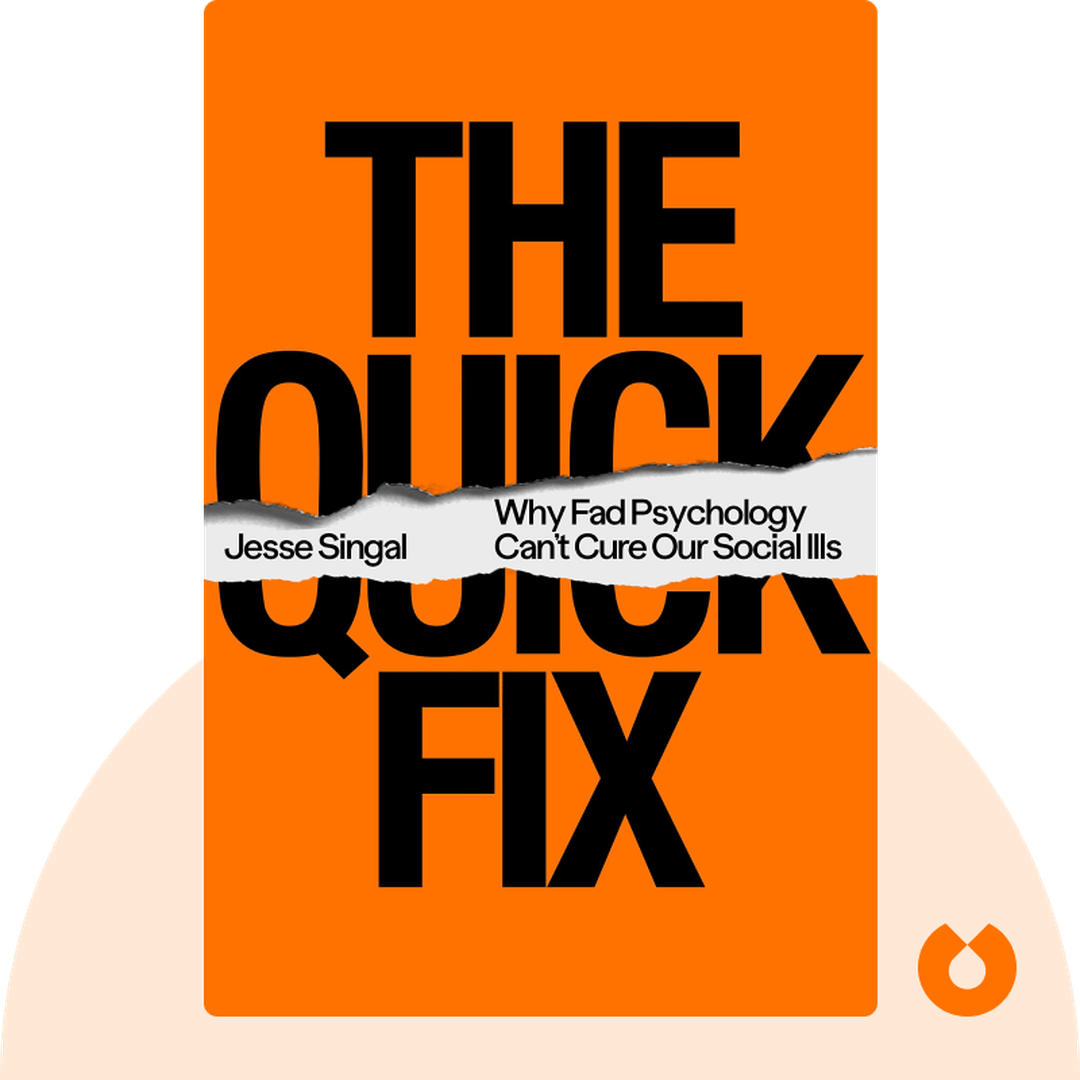
The Quick Fix (2021) is a skeptical study of recent trends in behavioral psychology. Academic studies and TED talks may appear to make a convincing case for the power of positive thinking or the impact of implicit bias, but sometimes the evidence just isn’t there. In a complex world, the explanations for human behavior are often more nuanced than some modern psychologists would have you believe.
Who Should Listen to The Quick Fix?
- Psychology skeptics
- Those interested in societal problems and human behavior
- Anyone who has ever viewed a TED talk
Books Similar to The Quick Fix
Readers who enjoyed this also liked these titles.