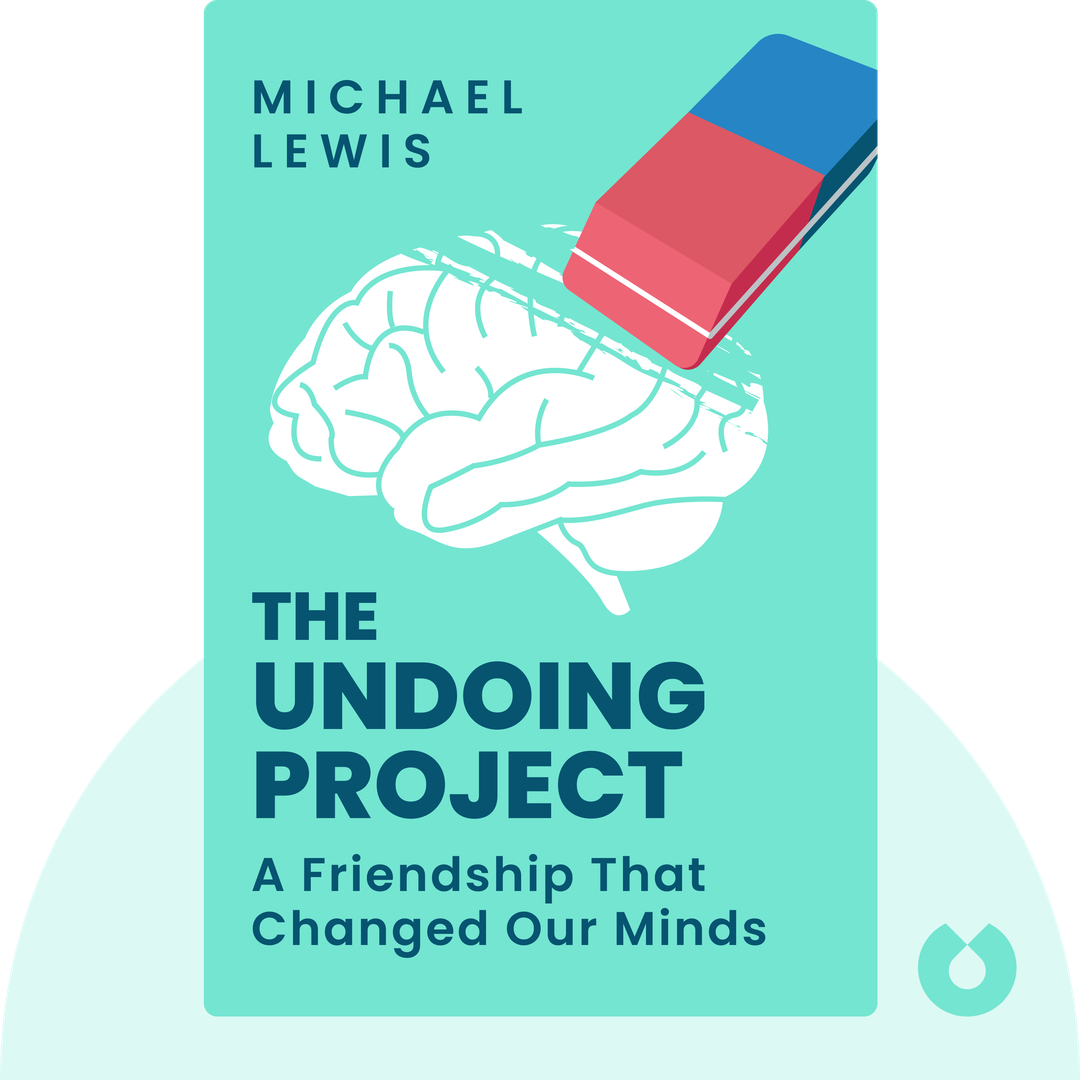
If You're Curious About These Questions...
You should listen to this audiobook
- Did you know that your brain is systematically hardwired to make irrational choices, even when you are convinced you’re being logical?
- Have you ever wondered why experts are so often wrong, and how two psychologists discovered the hidden biases that trick us all?
- What if you could master the 'undoing' of your own mind’s errors to make smarter, more informed decisions in every area of your life?
Listen to The Undoing Project — Free Audiobook
Loading player...
Key Takeaways from The Undoing Project
- Discover why our brains rely on mental shortcuts, known as heuristics, and how they can lead us to see false patterns and make systematic errors.
- Learn how subjective biases like the 'halo effect' cloud human judgment, and why behavior-focused assessments are far more accurate than relying on stereotypes.
- Understand the groundbreaking concept of prospect theory, which reveals that our decisions are heavily driven by a deep-seated aversion to loss rather than pure logic.
- Explore how the framing of a situation completely alters our choices, and learn to recognize when a scenario is presented as a gain or a loss to make more objective decisions.
- Recognize how intensely emotions influence our reaction to extreme probabilities, and learn to identify irrational hopes and fears to make more balanced choices.
Learning Tools
Reinforce what you learned from The Undoing Project
Mind Map
The Undoing Project
Foundations of the Research+
Cognitive Biases & Heuristics+
Prospect Theory+
Emotion & Probability+
Quiz — Test Your Understanding
Question 1 of 5
What did Daniel Kahneman's early work with the Israeli military reveal about assessing recruits?
Question 2 of 5
According to Kahneman and Tversky's research, what is a common consequence of relying on the "representativeness" heuristic?
Question 3 of 5
How does "prospect theory" challenge classical economic theory regarding human decision-making?
Question 4 of 5
What key insight about human behavior was demonstrated by the "Asian Disease Problem"?
Question 5 of 5
According to the text, how do humans typically react to very remote probabilities, such as a one-in-a-billion chance?
The Undoing Project — Full Chapter Overview
- 1Recommendation
- 2The Error Behind the Expert
- 3Danny Kahneman, the Outsider
- 4Amos Tversky, the Insider
- 5The Collision of Two Minds
- 6Heuristics, Biases, and the Mind’s Shortcuts
- 7Prediction, War, and the Limits of Certainty
- 8Prospect Theory and the Shape of Risk
- 9Medicine, Policy, and the Spread of the Ideas
- 10The Friendship Begins to Fracture
- 11The Afterlife of a Shared Mind
The Undoing Project Summary & Overview
The Undoing Project (2016) transports you into the intriguing minds of two revolutionary psychologists: Daniel Kahneman and Amos Tversky. This gripping narrative reveals their journey to reshape our understanding of human decision-making and how unseen biases are influencing us at every turn.
Who Should Listen to The Undoing Project?
- Psychology enthusiasts fascinated by human decision-making
- Fans of biographies that explore notable collaborations
- Students of behavioral economics and cognitive sciences
Books Similar to The Undoing Project
Readers who enjoyed this also liked these titles.