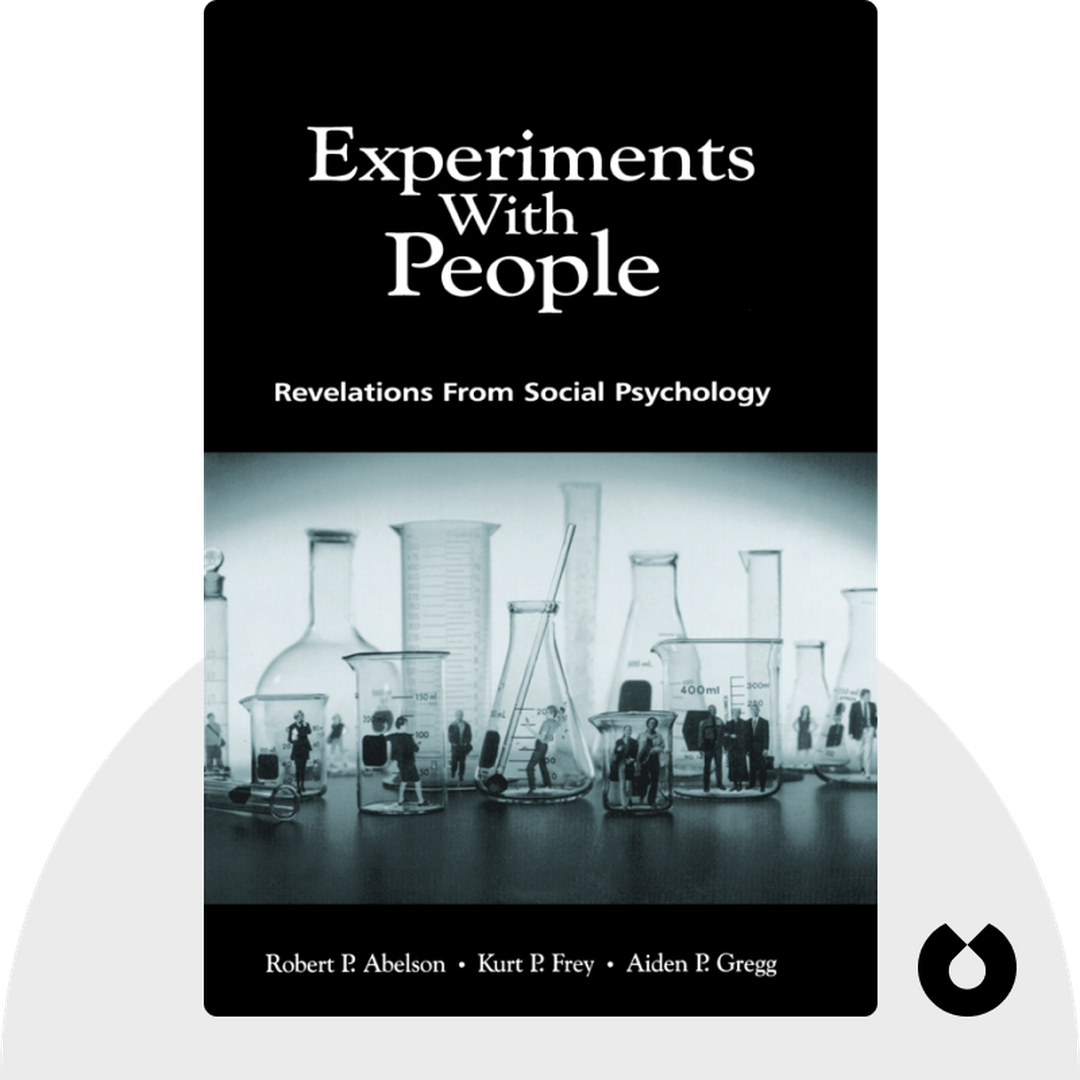
Experiments With People
Start ListeningDownload Try free on iPhoneScan to start in 5 seconds
Categories:
If You're Curious About These Questions...
You should listen to this audiobook
- Have you ever wondered why a crowd of people might stand by during an emergency, and what truly determines whether a stranger will step in to help?
- Did you know that your most 'rational' decisions are often driven by hidden psychological triggers you aren't even aware of?
- What if you could uncover the secret reasons behind why we conform to others, even when we know they’re wrong?
Listen to Experiments With People — Free Audiobook
Loading player...
Key Takeaways from Experiments With People
- Discover why introspection often fails to reveal your true motives and how your present beliefs secretly distort your memories of past events.
- Understand how the sacrifices you make for a goal can cause you to overvalue the reward, trapping you in doomed projects and the sunk cost fallacy.
- Learn how the simple framing of a choice—such as using positive rather than negative language—dramatically influences the decisions people make every day.
- Recognize how situational pressures, like simply being in a hurry, dictate human behavior far more than deep-seated character traits or moral beliefs.
- Find out why relying on willpower to block out stress often backfires, and how doing the exact opposite of your intended action can sometimes yield the best results.
Learning Tools
Reinforce what you learned from Experiments With People
Mind Map
Experiments With People
Self-Awareness & Memory+
Valuation & Choices+
The Power of Situation+
Cognitive Misjudgments+
Conformity & Group Identity+
Destructive Group Behaviors+
Attraction & Prejudice+
Persuasion & Authority+
Altruism & Love+
Quiz — Test Your Understanding
Question 1 of 10
Based on the Nisbett and Bellows study about rating a hypothetical job applicant named 'Jill', what does the experiment reveal about human introspection?
Question 2 of 10
How did participants in the 1951 Aronson and Mills study react after enduring an embarrassing initiation to join a dull discussion group?
Question 3 of 10
What was the primary finding of the 1973 Darley and Batson study involving theology students encountering a person in need?
Question 4 of 10
According to Daniel Gilbert's 1993 study involving true and false statements about a defendant, how do our mental processes typically handle new information?
Question 5 of 10
What does the 1990 study by Hoffman and Hirst regarding the fictional alien races (Ackmians and Orinthians) suggest about gender stereotypes?
Question 6 of 10
In Solomon Asch's 1955 study on matching lines, what significantly reduced the participants' tendency to conform to the group's incorrect answers?
Question 7 of 10
Edward Diener’s 1976 Halloween study demonstrated the concept of 'deindividuation.' What effect did this phenomenon have on the trick-or-treaters?
Question 8 of 10
Theodore Mita’s 1977 study involving pictures of women's faces demonstrated the 'exposure effect.' What did this study reveal about attraction and preference?
Question 9 of 10
In Festinger and Carlsmith's 1959 study, participants experienced cognitive dissonance after lying to someone that a tedious experiment was actually fun. How did they resolve this dissonance?
Question 10 of 10
Based on Arthur Aron's 1991 study where participants sorted descriptions into 'me' or 'not-me' categories, how do these psychological experiments define love?
Experiments With People — Full Chapter Overview
- 1Recommendation
- 2People often misunderstand their inner lives.
- 3We value things we’ve sacrificed for and those shown in a positive light.
- 4Situational factors often shape our behavior more than character traits do.
- 5Our mental processes lead us to misjudge certain situations.
- 6We accept fiction as reality to help us cope with the world around us.
- 7Group loyalty and pressure strongly influence our behavior.
- 8Groups can enable people’s bad behavior.
- 9Attraction and prejudice are driven by subconscious factors.
- 10People can be easily influenced – even to commit evil acts.
- 11Altruism and love really do exist.
- 12Final summary
Experiments With People Summary & Overview
Experiments With People (2003) is a survey of social psychology throughout the twentieth century, and everything we have come to learn from it. These blinks will teach you about yourself, the hidden sides of human nature, why we make the choices we do and how altruistic humans really are.
Who Should Listen to Experiments With People?
- Students of psychology and the social sciences
- Impulsive people looking to include more rationality in their daily lives
- Highly social people interested in the intricacies human nature
Books Similar to Experiments With People
Readers who enjoyed this also liked these titles.