If You're Curious About These Questions...
You should listen to this audiobook
- Have you ever wondered if you’re truly the master of your garden, or if plants have evolved clever ways to manipulate your deepest human desires?
- Did you know that our quest for sweetness, beauty, and intoxication has fundamentally reshaped both human history and the evolution of the natural world?
- What if the plants we think we’ve 'domesticated' are actually using us to ensure their own survival and global expansion?
Listen to The Botany of Desire — Free Audiobook
Loading player...
Key Takeaways from The Botany of Desire
- Discover how plants actively manipulate humans to ensure their own survival by appealing to our four basic desires: sweetness, beauty, intoxication, and control.
- Learn the true story of Johnny Appleseed, a savvy pioneer who capitalized on genetic diversity and the frontier's desire for sweet cider to spread apple trees across North America.
- Understand why modern supermarkets offer so few apple varieties, as commercial markets have sacrificed historical diversity to prioritize superficial beauty and intense sweetness.
- Find out why botanists are fighting to preserve the genetic diversity of crops, which provides the crucial natural defenses needed to fight off modern diseases and pests.
- Explore the profound evolutionary power of botanical beauty, and see how the deep-seated human obsession with flowers drove extreme economic frenzies like Holland's tulipmania.
Learning Tools
Reinforce what you learned from The Botany of Desire
Mind Map
The Botany of Desire
Core Premise+
Sweetness (The Apple)+
Beauty (The Tulip)+
Intoxication (Cannabis)+
Control (The Potato)+
Quiz — Test Your Understanding
Question 1 of 7
What is the central premise of 'The Botany of Desire' regarding the relationship between humans and plants?
Question 2 of 7
Why did John Chapman (Johnny Appleseed) plant apple seeds rather than transplanting established European trees?
Question 3 of 7
According to the text, what has been the primary consequence of the modern apple market's focus on beauty and sweetness?
Question 4 of 7
What historical event is used to demonstrate the extreme human desire for botanical beauty?
Question 5 of 7
How did the government's prohibition of marijuana inadvertently affect the plant's cultivation?
Question 6 of 7
What surprising discovery did researchers make about the human brain while studying the effects of cannabis?
Question 7 of 7
How did the introduction of the potato to Europe satisfy the human desire for control?
The Botany of Desire — Full Chapter Overview
- 1Recommendation
- 2As humans profit from plants, plants likewise profit from humans.
- 3Johnny Appleseed delivered apples and cider across the American frontier.
- 4Today, apple diversity has decreased, and now only two qualities matter: beauty and sweetness.
- 5Beautiful flowers are irresistible; they capture our attention, and they can even sometimes ruin us.
- 6Cannabis fulfills our desire for intoxication, and prohibition has made it even stronger today.
- 7Cannabis research has taught us much about the human brain.
- 8The potato meets our desire for control – even more now that we directly control its genes.
The Botany of Desire Summary & Overview
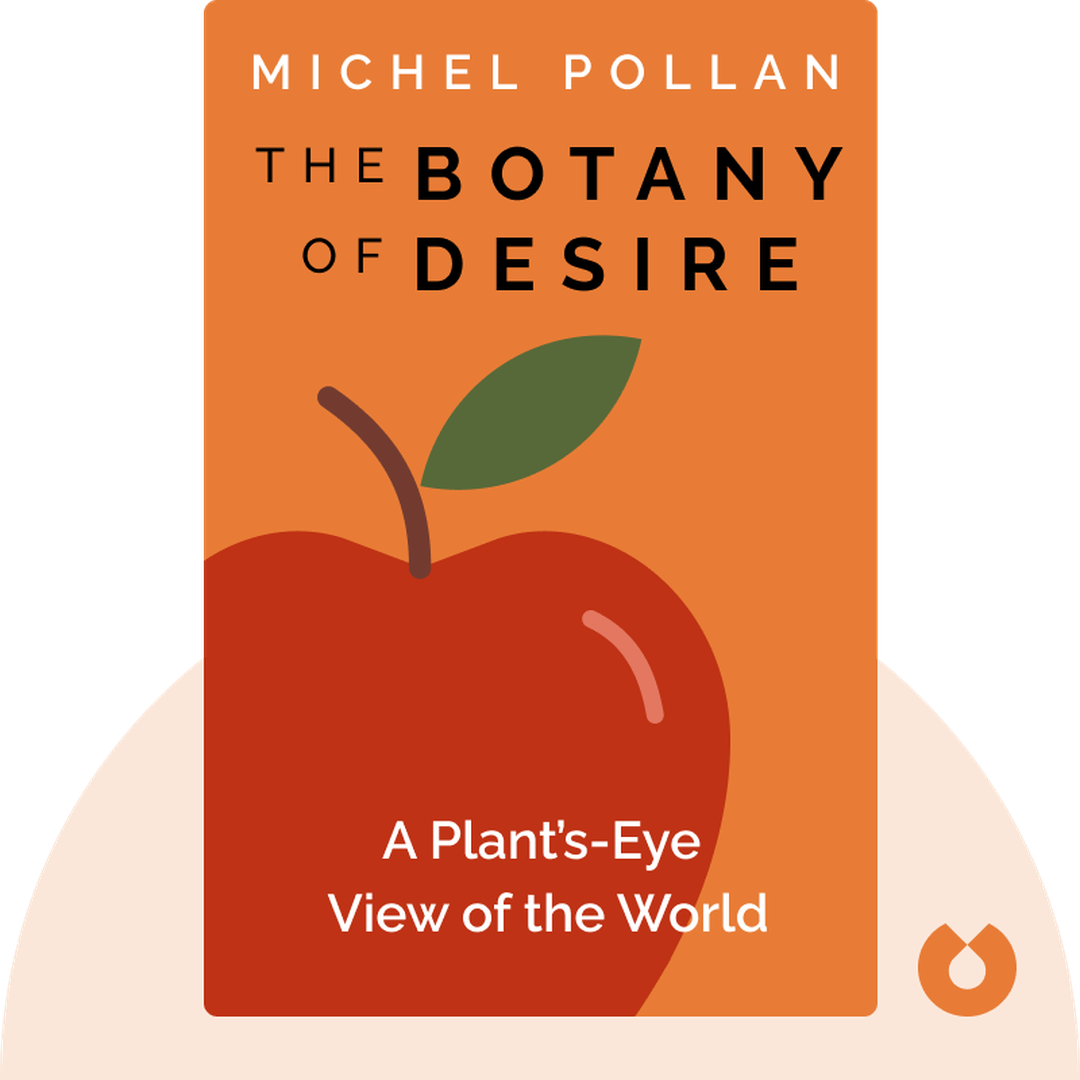
The Botany of Desire (2001) explores the complex and fascinating relationship between humans and plants. In these blinks, we’ll see how plants manipulate humans by taking advantage of our four basic desires for sweetness, beauty, intoxication and control, and how, in turn, we help plants reproduce and even grow stronger.
Who Should Listen to The Botany of Desire?
- Gardeners curious about our relationship with plants
- People interested in botany
- All readers with an interest in anthropology
Books Similar to The Botany of Desire
Readers who enjoyed this also liked these titles.