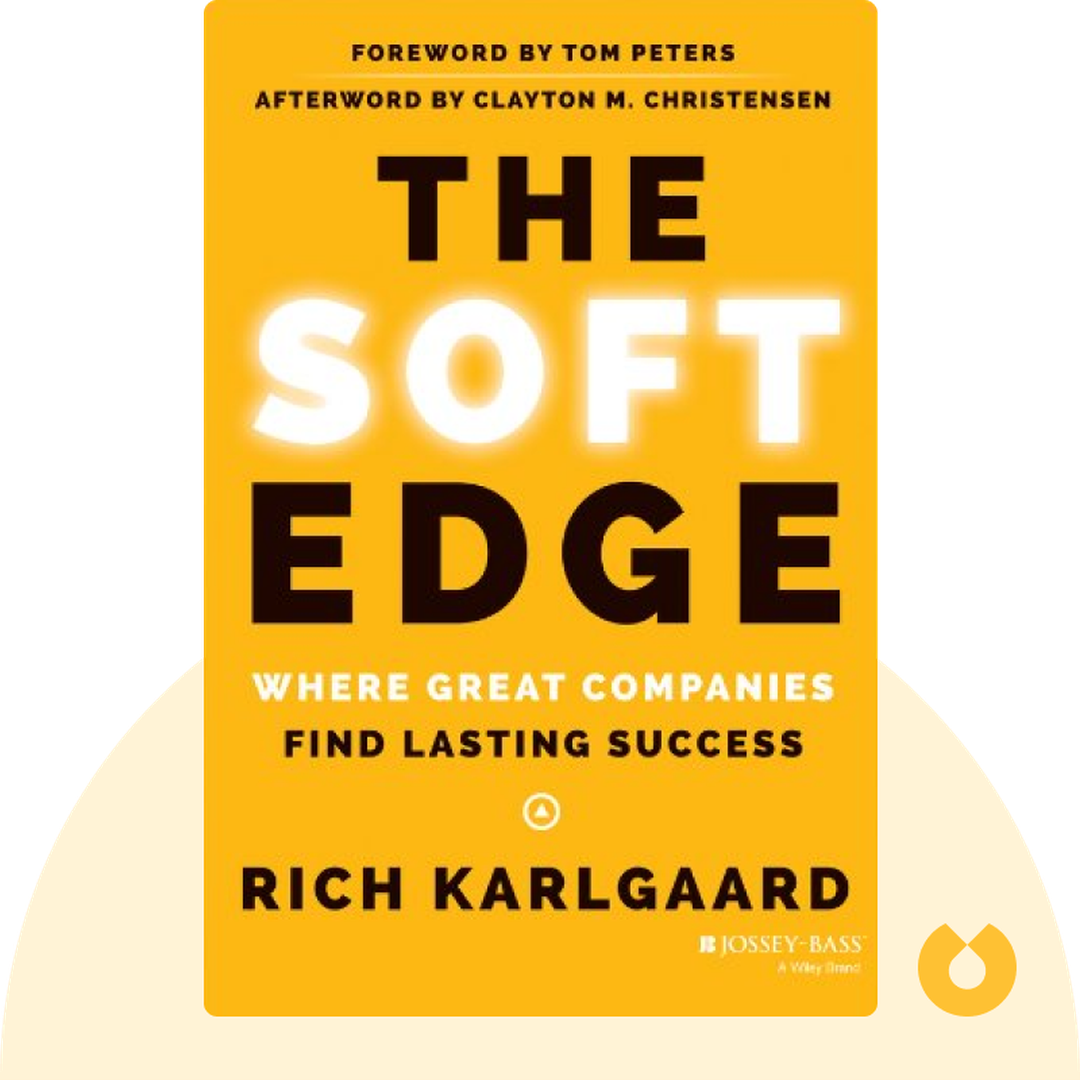
If You're Curious About These Questions...
You should listen to this audiobook
- Have you ever wondered why focusing strictly on data and logic might actually be the very thing holding your business back from long-term greatness?
- What’s the secret to building a company that doesn’t just survive, but thrives with relentless passion and creativity?
- What if you could master the elusive 'soft edge' of leadership to stay ahead of your competitors in an ever-changing market?
Listen to The Soft Edge — Free Audiobook
Loading player...
Key Takeaways from The Soft Edge
- Discover why long-term business success requires moving beyond strategy and execution to cultivate a 'soft edge' built on meaningful human connections.
- Understand why establishing deep internal and external trust impacts your corporate reputation far more than the actual quality of your products or services.
- Learn how to cultivate your company's 'smarts' by empowering employees to learn from mistakes, prioritizing continuous improvement, and borrowing ideas from outside industries.
- Find out how scaling down to small groups using the 'two-pizza rule' dramatically reduces development time and boosts team productivity.
- Master the five foundational pillars of the soft edge—trust, smarts, teams, taste, and story—to give your brand deeper purpose and an unquantifiable competitive advantage.
Learning Tools
Reinforce what you learned from The Soft Edge
Mind Map
The Soft Edge
The Business Triangle+
Pillar 1: Trust+
Pillar 2: Smarts+
Pillar 3: Teams+
Pillar 4: Taste+
Pillar 5: Story+
Competitive Advantage+
Quiz — Test Your Understanding
Question 1 of 8
According to the book, a successful business is likened to a triangle. What are the three foundational elements that make up this triangle?
Question 2 of 8
What is the primary difference between a company's 'hard edge' and its 'soft edge'?
Question 3 of 8
According to the Edelman Trust Barometer mentioned in the text, how does trust impact a business?
Question 4 of 8
How did the Mayo Clinic demonstrate the 'smarts' pillar through lateral thinking?
Question 5 of 8
What is the 'two-pizza' rule implemented by Amazon's CEO Jeff Bezos?
Question 6 of 8
Why do people generally prefer familiar product designs, according to research in aesthetics?
Question 7 of 8
When crafting a company's 'story,' what advice does the book offer?
Question 8 of 8
In today's fast-paced business environment, why is the 'soft edge' considered the ultimate differentiator between competitors?
The Soft Edge — Full Chapter Overview
- 1Recommendation
- 2Successful firms rest solidly on three core essentials: a strategy, a hard edge, and a soft edge.
- 3Trust is an essential component of the soft edge.
- 4A company needs smarts to keep pace with rapidly evolving ideas and technologies.
- 5Teams drive learning, productivity, and innovation most effectively when they’re small and diverse.
- 6Taste blends function, form, and meaning, giving customers a strong, authentic emotional connection to a valued brand.
- 7A company derives its purpose from its story.
- 8The soft edge is what sets you apart from competitors.
The Soft Edge Summary & Overview
This book (2014) is about the “soft edge” – that is, the human side – of business. If you don’t want to be left foundering in the wake of your competitors, your company needs something more – more creativity and flexibility, more passion. The soft edge is the wellspring of such attributes. Your company’s soft edge might seem elusive at first, but remember: finding it is absolutely critical for long-lasting success.
Who Should Listen to The Soft Edge?
- Entrepreneurs and people working in start-ups
- Managers, CEOs and other business leaders
- Anyone who wants to understand more about the human side of business
Books Similar to The Soft Edge
Readers who enjoyed this also liked these titles.