Theme Song
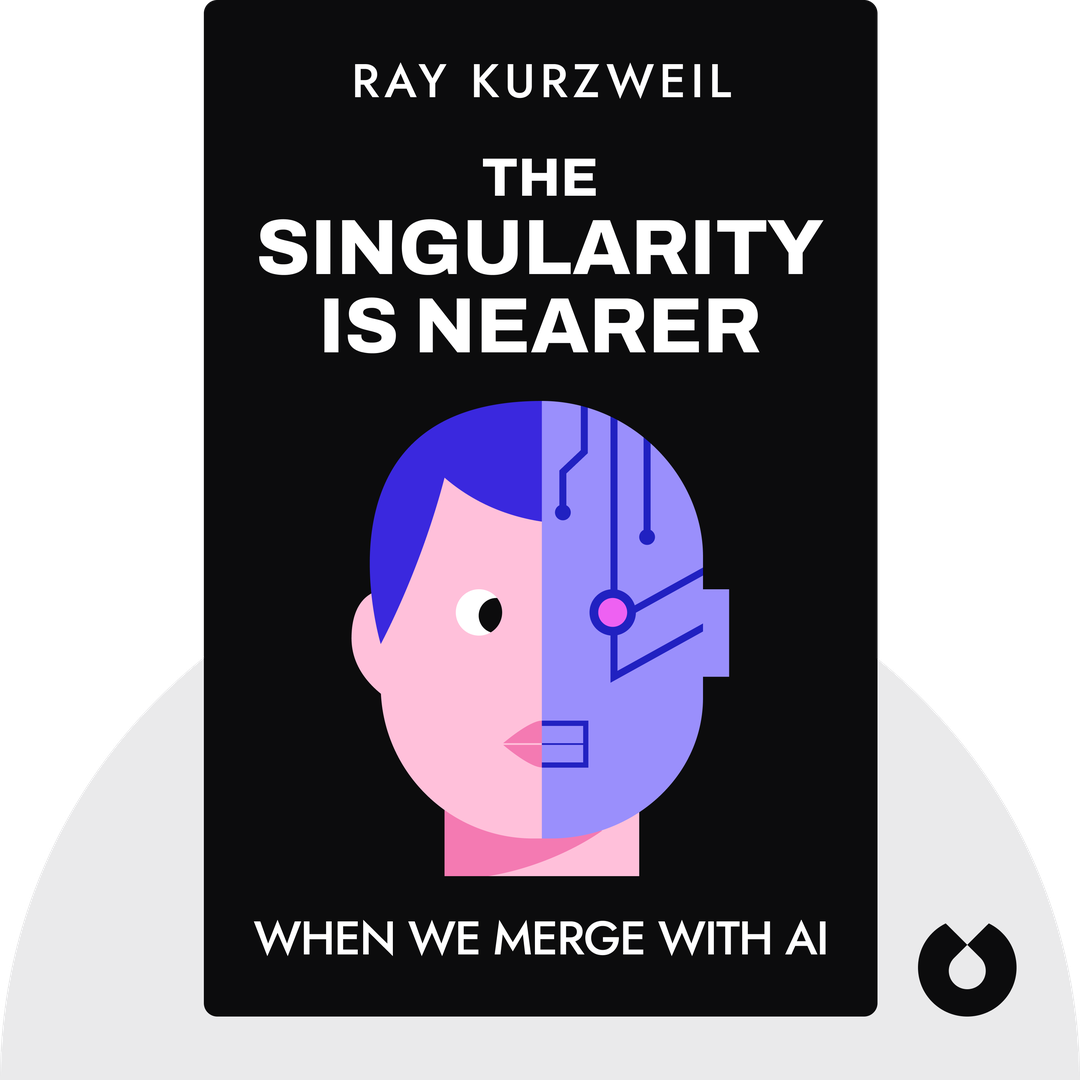
The Singularity Is Near
Start ListeningDownload Try free on iPhoneScan to start in 5 seconds
Categories:
If You're Curious About These Questions...
You should listen to this audiobook
- How will microscopic robots known as 'foglets' eventually allow humans to completely alter their physical appearance in a matter of seconds?
- What is the 'Singularity' predicted for the year 2045, and how will it enable humans to merge with artificial intelligence to achieve virtual immortality?
- Why could a malfunction in self-replicating medical nanobots pose a catastrophic threat capable of destroying all biomass on Earth in mere hours?
Listen to The Singularity Is Near — Cinematic Audio Edition
Loading player...
Key Takeaways from The Singularity Is Near
- Driven by the Law of Accelerating Returns, technological evolution is moving exponentially faster, leading to supersmart computers that will soon design superior technologies themselves.
- By moving beyond traditional silicon chips to utilize carbon nanotubes and DNA, future computers will gain the immense processing power required to reverse-engineer the human brain by 2030.
- Microscopic nanobots and viral gene therapies will soon patrol our bloodstreams to cure diseases, repair damaged DNA, and eliminate the need for traditional organ transplants.
- Humanity will gradually merge with artificial intelligence as we replace our biological organs with highly efficient synthetic versions and use brain-computer interfaces to instantly download information.
- Around the year 2045, the 'Singularity' will arrive, marking an era where human and machine intelligence become indistinguishable, offering virtual immortality if we can avoid the catastrophic risks of rogue nanobots.
Learning Tools
Reinforce what you learned from The Singularity Is Near
Mind Map
The Singularity Is Near
Law of Accelerating Returns+
Hardware Revolution+
Artificial Intelligence+
Medical Revolution+
The Cyborg Evolution+
The Singularity (2045)+
Existential Risks+
Quiz — Test Your Understanding
Question 1 of 10
What does the 'Law of Accelerating Returns' refer to in the context of the book?
Question 2 of 10
According to the text, what is the primary advantage of DNA computing over traditional silicon-based computers?
Question 3 of 10
How do scientists predict they will achieve true artificial intelligence by the year 2030?
Question 4 of 10
How will nanobots revolutionize medical treatments like cancer therapy?
Question 5 of 10
What role will viruses play in the future of gene therapy?
Question 6 of 10
Why will therapeutic cloning vastly improve organ transplantation?
Question 7 of 10
What is a defining characteristic of the hypothetical 'body 3.0' projected for the late 2030s?
Question 8 of 10
What is one expected outcome of integrating neurochips and nanobots into the human brain?
Question 9 of 10
What event does the author predict will occur around the year 2045?
Question 10 of 10
What is described as the most likely worst-case scenario regarding advanced nanobot technology?
The Singularity Is Near — Full Chapter Overview
- 1Recommendation
- 2Evolution is accelerating. Each breakthrough builds on the last and moves faster than before.
- 3Computers are advancing rapidly in speed and processing power. DNA computing is close.
- 4In the next few decades, computers will learn to do everything humans can do, only better.
- 5Nanobots will become the new doctors. Inside our bodies, they’ll cure illness and repair damage.
- 6Genetic disease will become a thing of the past. Gene therapy will routinely repair damage.
- 7No more donor organs or risky surgery. In the future, we’ll grow our own from our own cells.
- 8Ready to become bionic? Man, woman, or something in between — the choice will be yours.
- 9Artificial intelligence and human intelligence will merge, making humans supersmart.
- 10Around 2045, the world will change beyond recognition. The singularity will have arrived.
- 11A future run by sentient robots won’t be perfect. Nanobots could malfunction and wreak havoc on Earth.
- 12Final summary
The Singularity Is Near Summary & Overview
The Singularity Is Near (2005) shows how evolution is drawing ever closer to a dramatic new phase, in that by 2029, computers will be smarter than humans, and not just in terms of logic and math. This event will not only profoundly change how we live but also pose serious questions about humanity’s future.
Who Should Listen to The Singularity Is Near?
- People curious about the intersection of people and technology
- Programmers, inventors or anyone fascinated by artificial intelligence
- Science fiction fans
Books Similar to The Singularity Is Near
Readers who enjoyed this also liked these titles.