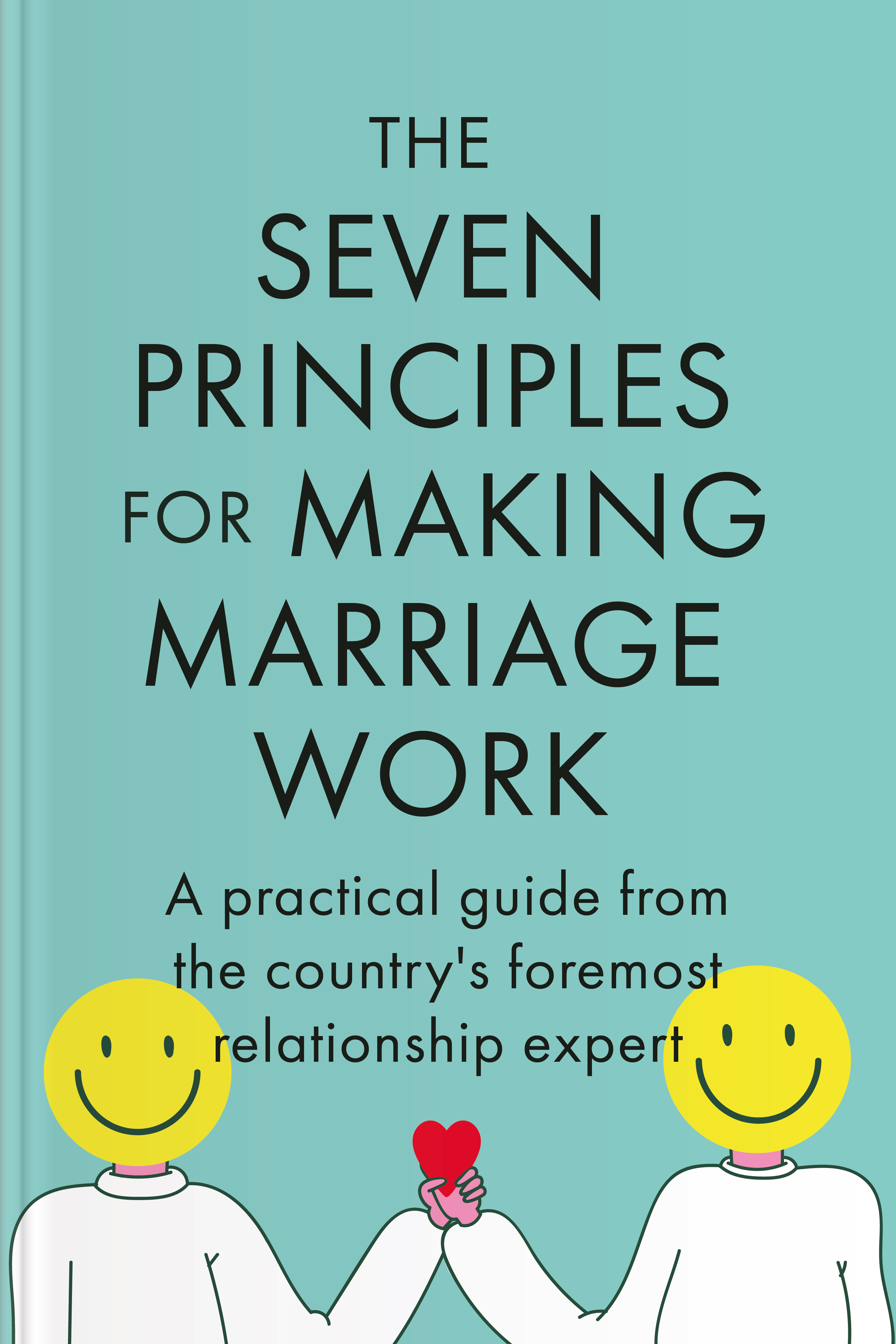
The Seven Principles for Making Marriage Work audiobook cover - Marriage doesn’t need to be perfect to be strong—when couples learn to soften conflict, stay curious about each other, and build daily habits of respect and connection, even tough seasons can become a doorway to deeper trust and lasting love.

The Seven Principles for Making Marriage Work

Marriage doesn’t need to be perfect to be strong—when couples learn to soften conflict, stay curious about each other, and build daily habits of respect and connection, even tough seasons can become a doorway to deeper trust and lasting love.

John M. Gottman

4.4 / 5(5 ratings)
Start ListeningDownloadQR code that opens AudiobookHub on the App StoreTry free on iPhoneScan to start in 5 seconds

If You're Curious About These Questions...

You should listen to this audiobook

Listen to The Seven Principles for Making Marriage Work — Free Audiobook

Loading player...

Key Takeaways from The Seven Principles for Making Marriage Work

Learning Tools

Reinforce what you learned from The Seven Principles for Making Marriage Work

Mind Map

The Seven Principles for Making Marriage Work
Principle 1: Build Love Maps+
Principle 2: Nurture Fondness & Admiration+
Principle 3: Turn Toward Each Other+
Principle 4: Accept Influence+
Principle 5: Manage Conflicts+
Principle 6: Overcome Gridlock+
Principle 7: Create Shared Meaning+
Divorce Indicators: The Four Horsemen+
Navigating Common Challenges+
Actionable Conflict Advice+

Quiz — Test Your Understanding

Question 1 of 10
What is a 'love map' in the context of a marriage?
  • A. A physical representation of places a couple has visited together.
  • B. A mental space where sensitive information, aspirations, and life philosophies about a partner are stored.
  • C. A step-by-step guide to resolving perpetual conflicts in a relationship.
  • D. A communication technique used to prevent emotional flooding.
Question 2 of 10
How can couples best assess whether their marriage has a healthy 'fondness and admiration system'?
  • A. By tracking how often they say 'I love you' each week.
  • B. By counting the number of solvable problems they have successfully resolved.
  • C. By evaluating how they recall and speak about their shared past and the early days of their relationship.
  • D. By comparing their current relationship satisfaction to their first year of marriage.
Question 3 of 10
According to the book, what is a crucial way to maintain romance and stability in a marriage?
  • A. Planning extravagant, surprise dates once a month.
  • B. Avoiding all trivial or boring conversations to keep the mystery alive.
  • C. Ensuring that both partners have completely independent social lives.
  • D. Turning toward your partner during brief, everyday interactions and 'bids' for attention.
Question 4 of 10
What did John Gottman's 130-couple study reveal about the role of influence in a marriage?
  • A. Marriages are most successful when neither partner influences the other's decisions.
  • B. There is an 81% chance of divorce when a man refuses to share power and let his partner influence him.
  • C. Wives who refuse to let their husbands influence them are the primary cause of marital gridlock.
  • D. Couples who share power equally experience higher rates of emotional flooding.
Question 5 of 10
What is a key characteristic of 'perpetual problems' in a marriage?
  • A. They account for about 69% of marital conflicts and often have no real solution.
  • B. They are usually caused by a lack of a fondness and admiration system.
  • C. They are minor issues that can easily be solved by waking up ten minutes earlier.
  • D. They are guaranteed to eventually destroy a marriage if not completely eradicated.
Question 6 of 10
When a couple feels 'gridlocked' by a recurring problem, what should their primary goal be?
  • A. To eradicate the problem completely by forcing a compromise.
  • B. To seek professional counseling to assign blame accurately.
  • C. To convert the conflict into a dialogue and understand the underlying hopes being disrespected.
  • D. To ignore the problem until the emotional flooding subsides permanently.
Question 7 of 10
Which of the 'four horsemen of the apocalypse' is described as the most toxic because it involves mocking behavior designed to make a partner feel small?
  • A. Criticism
  • B. Defensiveness
  • C. Stonewalling
  • D. Contempt
Question 8 of 10
What is the primary difference between a 'complaint' and 'criticism' (the first horseman)?
  • A. A complaint is made in private, while criticism is made in public.
  • B. A complaint focuses on a specific failure, whereas criticism attacks a partner's character.
  • C. A complaint is a sign of a failing marriage, while criticism is normal and healthy.
  • D. A complaint leads to stonewalling, while criticism leads to contempt.
Question 9 of 10
How does the book suggest a couple should handle conflicts involving parents-in-law?
  • A. The couple should always defer to the in-laws' parenting advice to keep the peace.
  • B. The couple should limit contact with their in-laws to once a year to avoid tension.
  • C. The husband or wife must emphasize to their parents that their spouse and new family are now their priority.
  • D. The spouse who is being criticized by the in-laws should confront them directly without their partner.
Question 10 of 10
According to Principle Seven, what is required to build a sense of 'shared meaning' in a marriage?
  • A. Having identical career aspirations and hobbies.
  • B. Agreeing on every single detail of how to raise children and manage finances.
  • C. Ensuring both partners share the exact same religious and political beliefs.
  • D. Being familiar with each other's values and agreeing on the roles each plays in the relationship.

The Seven Principles for Making Marriage Work — Full Chapter Overview

The Seven Principles for Making Marriage Work Summary & Overview

This warm, practical summary draws from Dr. John Gottman’s relationship research to explore why some marriages unravel while others grow stronger over time. It gently names the patterns that predict disconnection, and then offers a clear path back to closeness through seven steady, learnable principles.

Across these chapters, listeners are guided to strengthen friendship, repair conflict more effectively, navigate gridlock with compassion, and create shared meaning through rituals, goals, and values. The emphasis is not on perfection, but on small, consistent choices that help partners feel safe, known, and supported.

Who Should Listen to The Seven Principles for Making Marriage Work?

  • Couples who want calmer, kinder ways to handle conflict and prevent small resentments from piling up
  • Partners who feel disconnected and want to rebuild friendship, admiration, and daily closeness
  • Anyone curious about Gottman’s research-based warning signs of divorce and the habits that protect long-term love

About the Author: John M. Gottman

John M. Gottman is a psychologist and relationship researcher known for studying couples through detailed observation and for translating those findings into practical principles that support healthier, more resilient marriages.

🎧
Listen in the AppOffline playback & background play
Get App