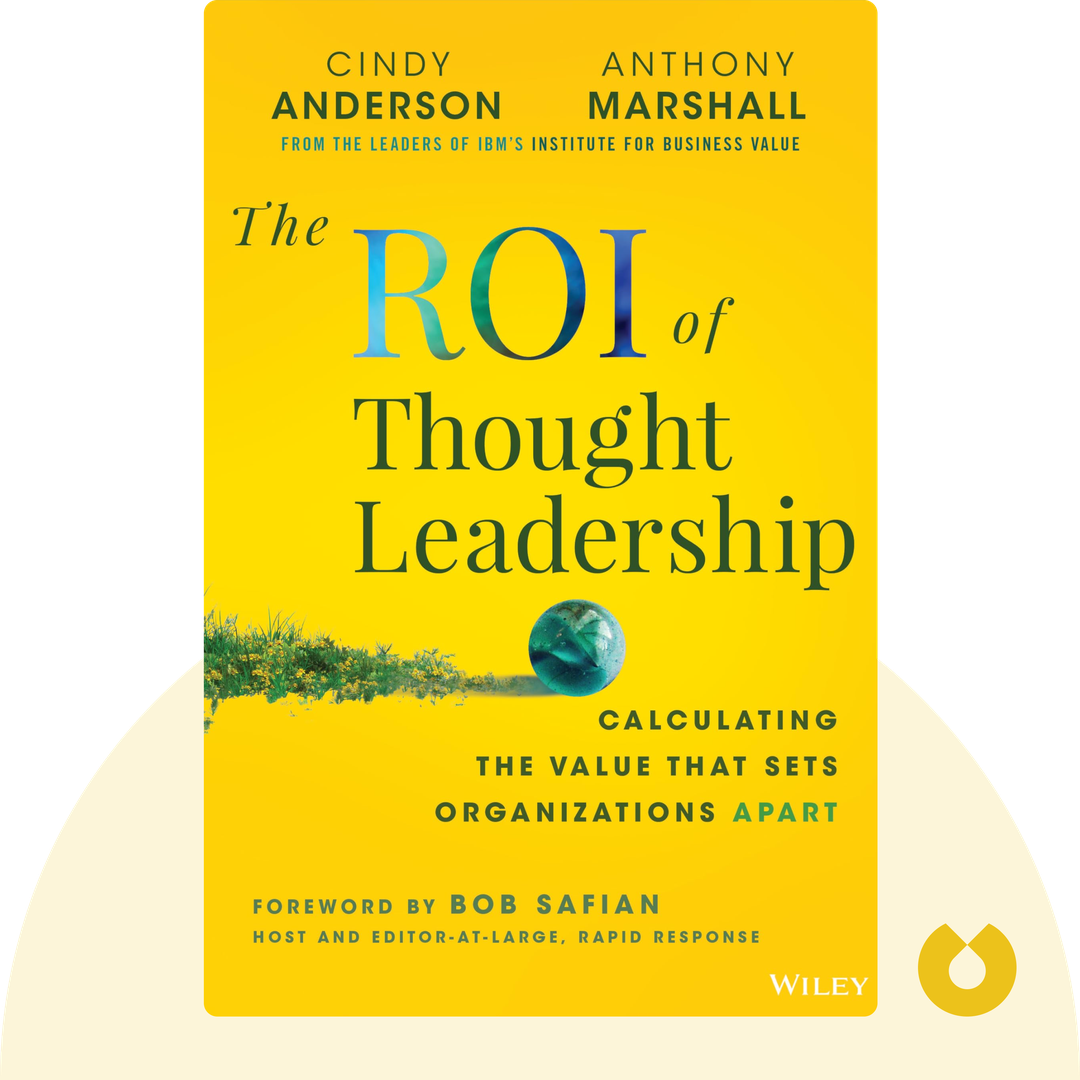
The ROI of Thought Leadership
Start ListeningDownload Try free on iPhoneScan to start in 5 seconds
Categories:
If You're Curious About These Questions...
You should listen to this audiobook
- Did you know that thought leadership influences over $260 billion in global spending every year, and is your strategy designed to capture it?
- What if you could stop guessing the value of your content and finally quantify the exact ROI of your organization's expertise?
- Have you ever wondered why some thought leadership campaigns generate massive financial returns while others simply disappear into the noise?
Listen to The ROI of Thought Leadership — Free Audiobook
Loading player...
Key Takeaways from The ROI of Thought Leadership
- Discover how thought leadership influences $265 billion in annual corporate spending and drives 90 percent of executives to make concrete buying decisions within three months.
- Understand why thought leadership generates an average return on investment of 156 percent, outperforming traditional marketing strategies by up to 1,600 percent.
- Learn how to calculate your organization's specific thought leadership ROI using a straightforward formula that transforms your content from a cost center into a proven revenue driver.
- Find out how slightly improving your client reach from 30 to 33 percent can dramatically boost your overall returns, offering the most accessible way to maximize your profits.
- Master the three controllable levers of value—quality, uniqueness, and reach—and see why original, impartial data is your secret weapon for winning executive trust.
Learning Tools
Reinforce what you learned from The ROI of Thought Leadership
Mind Map
The ROI of Thought Leadership
The Business Value+
Calculating ROI+
The Three Value Levers+
Organizational Archetypes+
The Operating Model+
Quiz — Test Your Understanding
Question 1 of 7
According to the text, what specific characteristic of thought leadership makes executives spend 145 percent more with the producing organization?
Question 2 of 7
When calculating and attempting to boost the ROI of a thought leadership program, which factor does the text identify as the most accessible way to improve returns?
Question 3 of 7
To elevate thought leadership above the noise, organizations must master three fundamental, controllable levers of value. What are they?
Question 4 of 7
In the context of thought leadership archetypes, what is the primary flaw of the 'Narcissist'?
Question 5 of 7
How does the text recommend utilizing Artificial Intelligence (AI) within a thought leadership strategy?
Question 6 of 7
If an organization identifies as a 'Pioneer' archetype—meaning they have high-quality, unique content but struggle with impact—what strategy should they prioritize to see the greatest returns?
Question 7 of 7
When building an effective operating model for thought leadership, what is the crucial role of the governance group (the Strategy Squad)?
The ROI of Thought Leadership — Full Chapter Overview
- 1Recommendation
- 2A billion-dollar opportunity
- 3Compute your specific ROI
- 4The three controllable drivers of value
- 5Grasping your organizational archetype
- 6Crafting an effective operating model
The ROI of Thought Leadership Summary & Overview
The ROI of Thought Leadership (2025) is built on a data-driven calculation showing that thought leadership delivers 156 percent ROI and influences $265 billion in global spending annually. It also gives you practical frameworks to quantify, improve, and maximize returns from your organization’s own thought leadership investments.
Who Should Listen to The ROI of Thought Leadership?
- Chief Marketing Officers seeking to justify thought leadership investments
- Communications executives developing content strategies
- Business consultants looking to quantify their advisory impact
Books Similar to The ROI of Thought Leadership
Readers who enjoyed this also liked these titles.