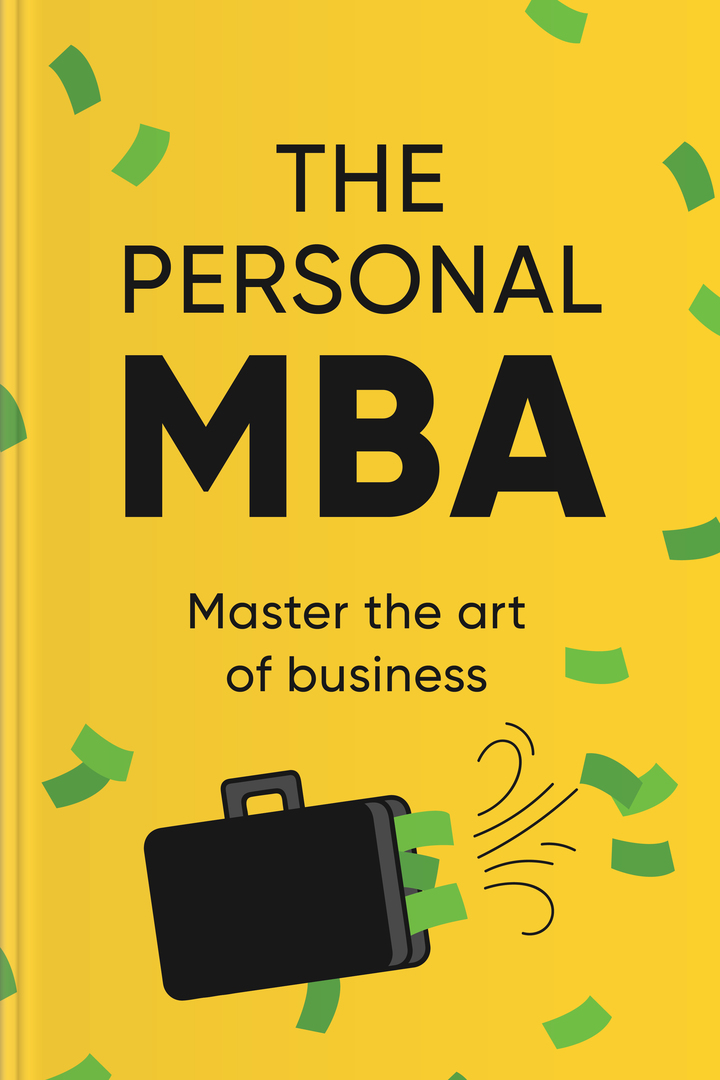
The Personal MBA audiobook cover - This warm, practical guide reframes business as a learnable set of fundamentals—helping anyone move past anxiety, impostor syndrome, and credential pressure, and toward building real value, earning trust, and making sound decisions in work and entrepreneurship.

The Personal MBA

This warm, practical guide reframes business as a learnable set of fundamentals—helping anyone move past anxiety, impostor syndrome, and credential pressure, and toward building real value, earning trust, and making sound decisions in work and entrepreneurship.

Josh Kaufman

4.0 / 5(3 ratings)
Start ListeningDownloadQR code that opens AudiobookHub on the App StoreTry free on iPhoneScan to start in 5 seconds

If You're Curious About These Questions...

You should listen to this audiobook

Listen to The Personal MBA — Free Audiobook

Loading player...

Key Takeaways from The Personal MBA

Learning Tools

Reinforce what you learned from The Personal MBA

Mind Map

The Personal MBA
The MBA Myth+
Value Creation+
Marketing & Sales+
Finance & Leverage+
Negotiation+
Leadership & Communication+
Personal Productivity+

Quiz — Test Your Understanding

Question 1 of 10
What did a 40-year study by researchers from Stanford and the University of Washington conclude about MBA degrees?
  • A. They guarantee a higher starting salary but do not influence long-term promotions.
  • B. There is no correlation between possessing an MBA and long-term career success.
  • C. They are only a worthwhile investment if obtained from one of the top 15 business schools.
  • D. They help entrepreneurs secure significantly more funding from initial investors.
Question 2 of 10
Why does the author argue that you should start a business in a field you are passionate about rather than just chasing a booming industry?
  • A. Passionate founders can easily secure venture capital funding without a formal business plan.
  • B. Booming industries are usually oversaturated with competitors, making it impossible to enter.
  • C. Passion provides the perseverance needed to handle the hundreds of hours of mundane tasks required to set up a business.
  • D. Passionate founders can naturally charge higher prices for their products due to their enthusiasm.
Question 3 of 10
What is the primary risk associated with using leverage in business, as demonstrated by the 2008 recession?
  • A. It dilutes your ownership stake in the company.
  • B. It requires you to pay exorbitant interest rates to investment banks.
  • C. It decreases the overall value of your physical business assets.
  • D. It amplifies your potential losses just as much as it amplifies your potential profits.
Question 4 of 10
According to Harvard professors Nitin Nohria and Paul Lawrence, which of the following is NOT one of the four basic human drives that successful businesses cater to?
  • A. The drive to acquire and collect things.
  • B. The drive to bond with other people.
  • C. The drive to entertain ourselves and escape reality.
  • D. The drive to learn and satisfy curiosity.
Question 5 of 10
When marketing a product, why is it crucial to focus on the product's 'end result'?
  • A. Because customers buy products for the outcomes they hope to attain, such as feeling more desirable.
  • B. Because it is illegal to make false claims about a product's specific manufacturing features.
  • C. Because focusing on features makes the marketing campaign too expensive and complicated.
  • D. Because competitors can easily copy product features, but they cannot copy end results.
Question 6 of 10
How can a salesperson effectively overcome a customer's 'major barrier to purchase' (the fear of making a bad choice)?
  • A. By offering a limited-time discount to create a sense of urgency.
  • B. By aggressively arguing against the customer's standard objections until they concede.
  • C. By shouldering the risk of the transaction through strategies like trial periods or full refunds.
  • D. By showing the customer testimonials of how many other people have bought the product.
Question 7 of 10
According to the book, what is true about the actual discussion phase of a negotiation?
  • A. It is the most difficult and unpredictable part of the entire process.
  • B. It should always be done in person rather than over the phone to ensure dominance.
  • C. It requires you to hide your true intentions and standard objections until the very end.
  • D. It is just the final stage, and the majority of the hard work is already done if you prepared properly.
Question 8 of 10
Based on Harvard psychologist Ellen Langer's Xerox study, what is the most effective way for a leader to get employees to comply with a request?
  • A. Provide a clear reason for why the task needs to be done.
  • B. Offer a small financial incentive for completing the task on time.
  • C. Threaten negative consequences if the task is not completed.
  • D. Micromanage the employee to ensure the task is done exactly as envisioned.
Question 9 of 10
How does the book suggest you should manage your daily productivity to avoid dropping the ball?
  • A. Work continuously for 8 hours to maintain your creative momentum.
  • B. Multitask heavily so you can handle unexpected demands efficiently.
  • C. Work in alignment with your body's natural 90-minute energy cycles.
  • D. Push through your natural energy dips by taking on more challenging tasks.
Question 10 of 10
What actionable advice does the author give regarding the hiring of a new employee?
  • A. Hire the applicant who performs best during the interview process.
  • B. Rely on personality tests to determine if they are a cultural fit for the company.
  • C. Hire someone with an MBA to ensure they have the right theoretical business knowledge.
  • D. Look at their past performance, as it is the best predictor of future performance.

The Personal MBA — Full Chapter Overview

The Personal MBA Summary & Overview

This summary explores a comforting idea: business is not a mysterious world reserved for people with elite degrees. It’s a set of learnable principles—understanding what people need, making a valuable offer, communicating it clearly, delivering consistently, and staying financially healthy.

Along the way, it gently addresses common inner barriers like business anxiety, certification intimidation, and impostor syndrome. It also highlights why real-world practice, customer focus, and self-education can often be more useful than expensive credentials, especially when paired with integrity, clarity, and steady improvement.

Who Should Listen to The Personal MBA?

  • Aspiring entrepreneurs who feel stuck, uncertain, or intimidated by “business culture,” and want a calmer, clearer starting point.
  • Professionals who want practical business fundamentals—marketing, sales, delivery, and financial sense—without needing to pursue an MBA.
  • Creators, freelancers, and small business owners who want to build trust, earn loyal customers, and grow sustainably.

About the Author: Josh Kaufman

Josh Kaufman is a business writer known for explaining business concepts in plain language. His work focuses on practical, real-world fundamentals—helping people learn how businesses function, how value is created, and how individuals can build useful skills through self-education and experience.

🎧
Listen in the AppOffline playback & background play
Get App