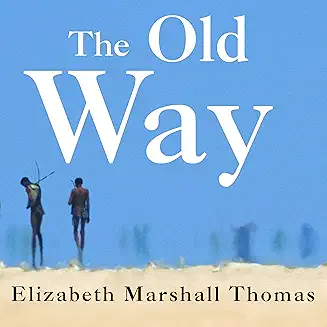
The Old Way: A Story of the First People audiobook cover - In the 1950s, Elizabeth Marshall Thomas travels with her family into the unmapped interior of the Kalahari and meets the Ju/wa Bushmen—people still living by hunting and gathering—then follows their knowledge, social rules, and spiritual life all the way to the modern collapse of the Old Way.

The Old Way: A Story of the First People

In the 1950s, Elizabeth Marshall Thomas travels with her family into the unmapped interior of the Kalahari and meets the Ju/wa Bushmen—people still living by hunting and gathering—then follows their knowledge, social rules, and spiritual life all the way to the modern collapse of the Old Way.

Elizabeth Marshall Thomas

4.0 / 5(3 ratings)
Start ListeningDownloadQR code that opens AudiobookHub on the App StoreTry free on iPhoneScan to start in 5 seconds

If You're Curious About These Questions...

You should listen to this audiobook

Listen to The Old Way: A Story of the First People — Free Audiobook

Loading player...

Key Takeaways from The Old Way: A Story of the First People

Learning Tools

Reinforce what you learned from The Old Way: A Story of the First People

Mind Map

The Old Way
The Expedition & First Contact+
Foundations of the Old Way+
Subsistence & Economy+
Survival & Safety Protocols+
Social Fabric & Culture+
Collapse & Modern Reality+

Quiz — Test Your Understanding

Question 1 of 10
What was the primary goal of Laurence Marshall's expedition into the unmapped region of southwest Africa?
  • A. To discover unexploited gold and diamond reserves.
  • B. To establish a new government outpost for the Tswana people.
  • C. To find and observe isolated hunter-gatherer communities.
  • D. To map the ecological features of the 'blank center' for agricultural development.
Question 2 of 10
According to Thomas, what made human expansion from forest refuges to the savannah possible?
  • A. The development of advanced agricultural techniques.
  • B. Simple but world-changing inventions like digging sticks and ostrich eggshell water containers.
  • C. The domestication of cattle and goats for reliable food sources.
  • D. The invention of specialized war gear and shields to fight predators.
Question 3 of 10
How is the ownership of a n!ore (landholding) determined among the Ju/wa?
  • A. It is established through physical force and defense of boundaries.
  • B. It is bought or traded using livestock and gathered goods.
  • C. It is granted by the eldest male hunter of the community.
  • D. It is a social reality tied to birth, kinship, and community recognition.
Question 4 of 10
How is meat distributed after a successful hunt to prevent 'big-man' dominance?
  • A. The hunter who made the kill distributes it equally among the elders.
  • B. The owner of the arrow that made the kill controls the initial distribution.
  • C. The meat is immediately consumed by the hunting party before returning to camp.
  • D. Women gather the meat and decide on its distribution based on family size.
Question 5 of 10
How does Thomas characterize the gathering of wild plants by Ju/wa women?
  • A. A casual, pastoral wandering to supplement the primary calories provided by hunters.
  • B. Expert labor performed under risk that provides the majority of the community's daily calories.
  • C. A communal activity where all everyday finds are shared equally among the entire camp.
  • D. A task reserved only for the elderly women and children, keeping them safe near the camp.
Question 6 of 10
What is the primary purpose of the hxaro gift exchange system?
  • A. To accumulate personal wealth and establish social hierarchy.
  • B. To trade practical items like digging sticks and poisoned arrows.
  • C. To bind people across long distances and create a safety net that redistributes risk.
  • D. To pay bride service to a prospective wife's family.
Question 7 of 10
What role does the trance dance play in Ju/wa society?
  • A. It serves as a political forum to determine the next leader.
  • B. It acts as a social and spiritual technology to heal sickness and social stress.
  • C. It is a war dance used to intimidate neighboring pastoralists.
  • D. It is a mating ritual meant to pair young men and women.
Question 8 of 10
What happens to the Ju/wa social structure when they are settled at the government post at Tsumkwe?
  • A. The traditional hunting and gathering methods become more efficient and structured.
  • B. The economic system flips, making wage earners the gatekeepers of food, and leading to lethal violence.
  • C. The society becomes completely egalitarian as government rations eliminate the need for hunting.
  • D. Women gain more power as gathering becomes a highly paid commodity in the new economy.
Question 9 of 10
Why does Thomas criticize the 'preservation' myth promoted by conservancy plans?
  • A. It fails to account for the environmental damage caused by traditional hunting.
  • B. It ignores actual caloric needs, forcing people to live inside a frozen image of their culture while they starve.
  • C. It relies on outdated photographic techniques that misrepresent the Ju/wasi.
  • D. It encourages too many tourists, disrupting the spiritual life of the Ju/wa elders.
Question 10 of 10
What does Thomas conclude is the true, enduring core of Ju/wa identity in modern times?
  • A. Their traditional skin clothing and use of bows.
  • B. The exact continuation of the hunter-gatherer lifestyle without agricultural influence.
  • C. The nature of their social relationships, sharing, and kin obligations.
  • D. Their isolation from the modern world and outside economies.

The Old Way: A Story of the First People — Full Chapter Overview

The Old Way: A Story of the First People Summary & Overview

The Old Way is Elizabeth Marshall Thomas’s deeply observed account of the Ju/wa Bushmen (Ju/’hoansi) of Namibia’s Nyae Nyae region—people whose hunter-gatherer life preserved patterns that shaped human evolution. Drawing from her family’s expeditions beginning in 1950, Thomas reconstructs how the Old Way worked: how water determined territory, how roots and meat structured survival, how poison arrows and tracking made hunting possible, and how community rules like sharing and gift exchange kept violence in check.

The book also traces a painful transformation. As Tsumkwe becomes a government hub, hunting is restricted, alcohol and wage labor reshape society, and poverty and violence rise. Thomas argues that what truly defines the Ju/wa is not “primitive technology” but a social culture built on relationships, dignity, and mutual obligation—one the modern world repeatedly misunderstands while claiming to preserve it.

Who Should Listen to The Old Way: A Story of the First People?

  • Listeners interested in human origins, hunter-gatherer life, and how ecology shapes culture.
  • Readers of anthropology and natural history who want lived, field-grounded storytelling instead of abstract theory.
  • Anyone trying to understand the real costs of “development,” conservation policy, and cultural mythmaking.

About the Author: Elizabeth Marshall Thomas

Elizabeth Marshall Thomas (b. 1931) is the author of nine books of fiction and nonfiction, including The Harmless People, Warrior Herdsmen, and The Hidden Life of Dogs. She has written for The New Yorker, National Geographic, and The Atlantic, and lives in New Hampshire.

🎧
Listen in the AppOffline playback & background play
Get App