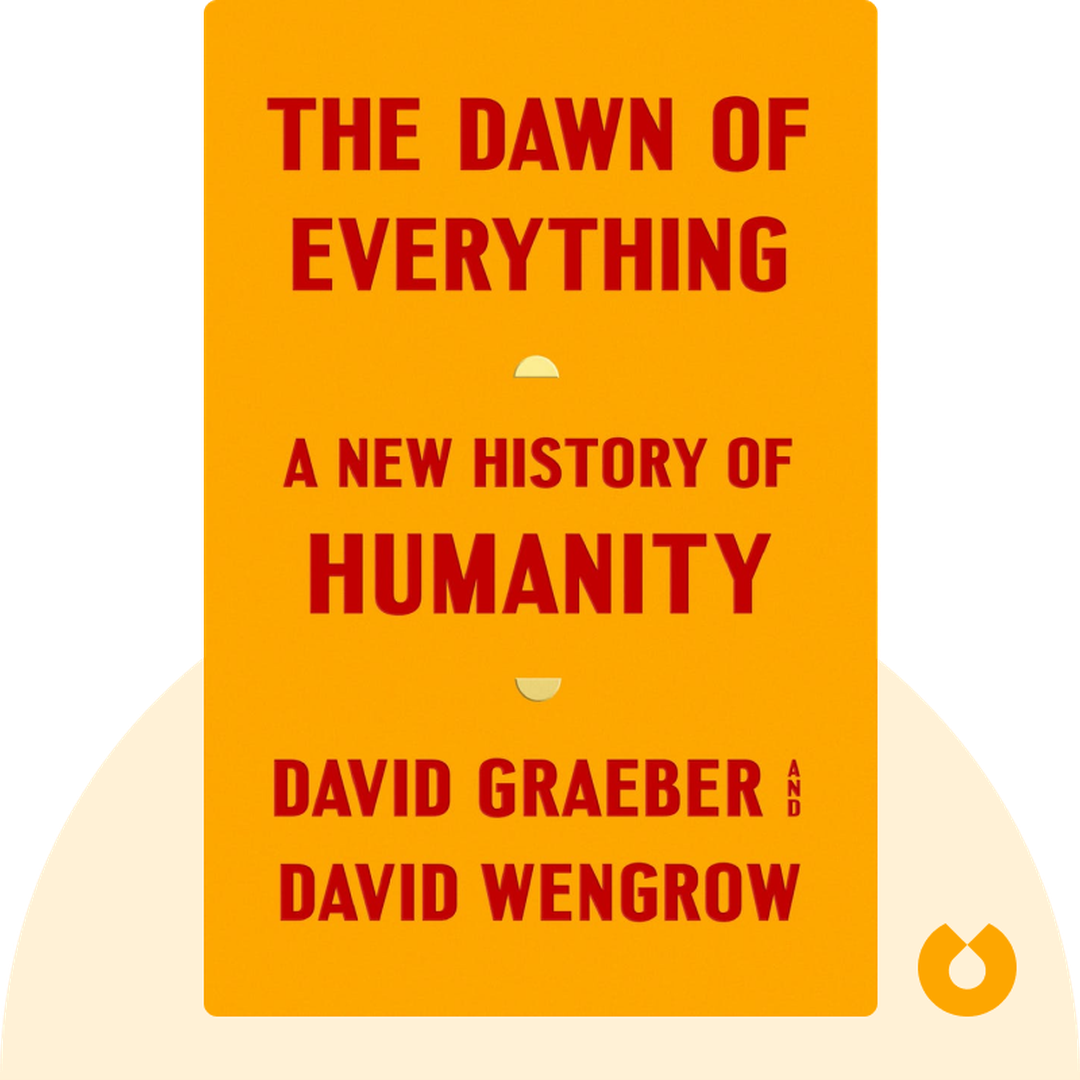
The Dawn of Everything
Start ListeningDownload Try free on iPhoneScan to start in 5 seconds
Categories:
If You're Curious About These Questions...
You should listen to this audiobook
- Have you ever wondered why we’re taught that inequality is the inevitable price of living in a large-scale, modern civilization?
- Did you know that many ancient societies actually spent centuries experimenting with different social structures specifically to avoid being stuck under a single ruler?
- What if the secret to escaping modern bureaucracy is hidden in archaeological discoveries that prove we weren't always destined for kings and states?
Listen to The Dawn of Everything — Cinematic Audio Edition
Loading player...
Key Takeaways from The Dawn of Everything
- Discover why prehistoric humans were not the simple cavepeople we imagine, but rather members of politically complex societies who actively debated their social arrangements.
- Learn why human civilization did not develop in a linear path from primitive equality to modern hierarchy, debunking the popular myths of philosophers like Rousseau and Hobbes.
- Explore how the 'indigenous critique'—led by Native American thinkers like Kandiaronk—exposed European inequality and profoundly shaped Enlightenment theories on wealth and power.
- Understand how conservative European thinkers weaponized the concept of 'civilization' to justify their own systemic poverty and authoritarianism in response to indigenous criticisms.
- Find out how early humans actively used social checks to resist domination and consciously rotated their political structures seasonally, proving their capacity for flexible social organization.
Learning Tools
Reinforce what you learned from The Dawn of Everything
Mind Map
The Dawn of Everything
Myth of Linear Development+
The Indigenous Critique+
Fluidity of Early Societies+
Origins of Inequality+
Cultural Differentiation+
The Truth About Agriculture+
Egalitarian Early Cities+
Formation of the State+
Anti-Authoritarian Backlash+
Quiz — Test Your Understanding
Question 1 of 10
What fundamental flaw do the authors identify in both Jean-Jacques Rousseau's and Thomas Hobbes's theories of human development?
Question 2 of 10
What was the core focus of the 'indigenous critique' articulated by figures like the Huron-Wendat leader Kandiaronk?
Question 3 of 10
What does the example of the Nambikwara community in Brazil demonstrate about early human societies?
Question 4 of 10
According to the text, which of the following is NOT one of the three central freedoms assumed by our distant ancestors?
Question 5 of 10
How do the authors connect the development of private property to the concept of the sacred (such as the Polynesian word 'tabu')?
Question 6 of 10
Why did indigenous communities in California reject practices like chattel slavery and the potlatch?
Question 7 of 10
Which of the following best describes the human transition to agriculture?
Question 8 of 10
What does archaeological evidence reveal about early mega-settlements like Mesopotamian cities and Teotihuacan?
Question 9 of 10
According to the text, what archaeological evidence is regarded as a sure sign that state formation was underway in early societies like ancient Egypt?
Question 10 of 10
What does the history of the North American city of Cahokia illustrate about state formation?
The Dawn of Everything — Full Chapter Overview
- 1Recommendation
- 2Society did not evolve in straight lines.
- 3The “indigenous critique” sparked a wave of Enlightenment ideas that still shape our world today.
- 4Pre-agricultural life was far more diverse than we have been taught about.
- 5Freedoms long taken for granted began eroding as notions of the sacred and private ownership emerged together.
- 6Neighboring cultures often built social institutions as reactions to one another.
- 7As communities settled into farming, their highland neighbors headed firmly in the other direction instead.
- 8When people first gathered in cities, hierarchies did not form right away.
- 9Early kings used spectacular violence to demonstrate their cosmic power and perceived necessity to rule.
- 10The “indigenous critique,” which still exists today in many different forms, emerged through experimentation and reaction over centuries of debate and conflict.
The Dawn of Everything Summary & Overview
The Dawn of Everything (2021) is a reimagining of the history of humanity, based on new discoveries in the worlds of anthropology and archeology. According to the authors, new findings challenge what we thought we knew about hierarchies, inequality, property, and the state.
Who Should Listen to The Dawn of Everything?
- Anyone who’s ever shaken their fist at bureaucracy
- History lovers of all stripes
- Those who want to be Indiana Jones when they grow up
Books Similar to The Dawn of Everything
Readers who enjoyed this also liked these titles.