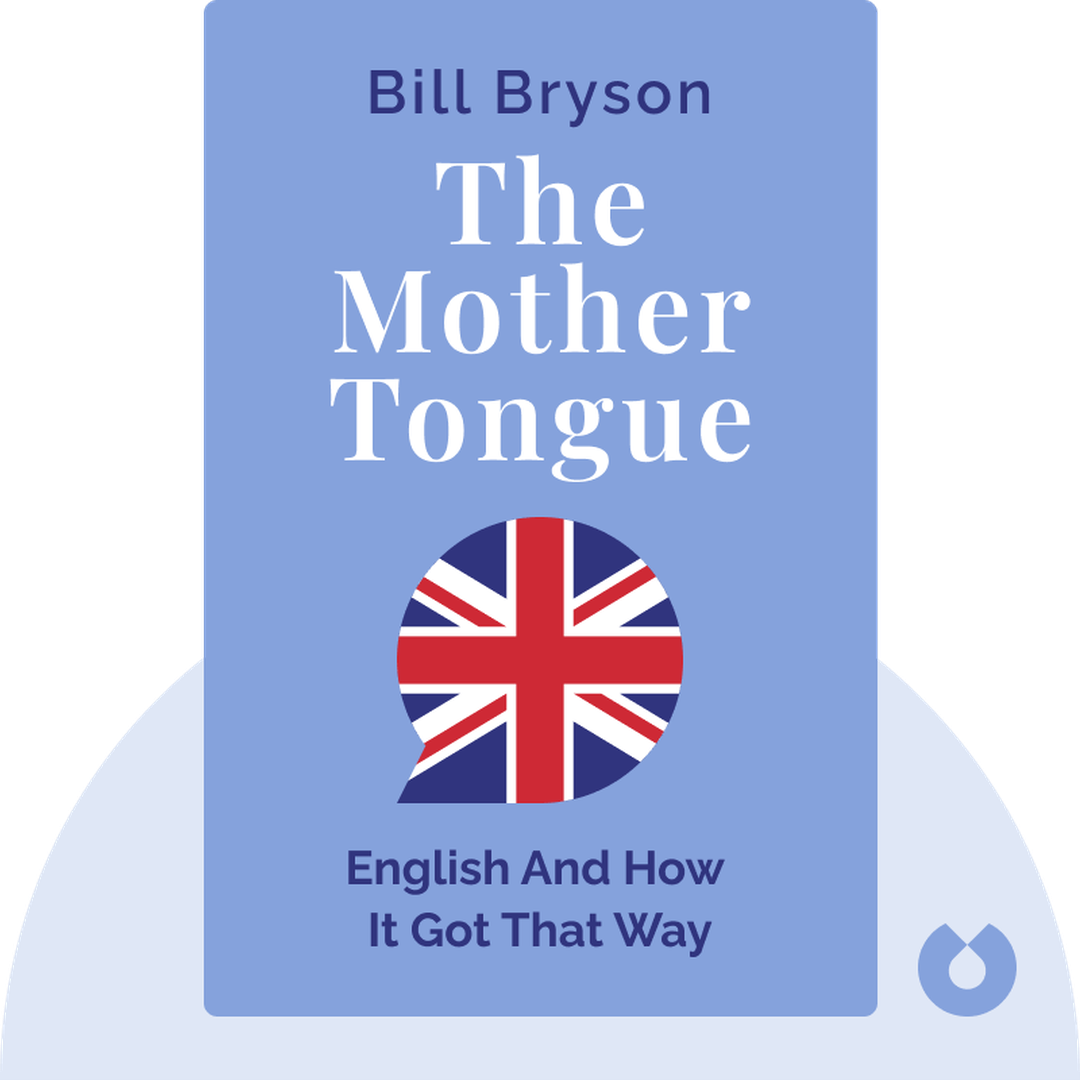
If You're Curious About These Questions...
You should listen to this audiobook
- Did you know that English was once a 'peasant' language that survived centuries of suppression and multiple invasions to become the global powerhouse it is today?
- Have you ever wondered why English spelling is so notoriously chaotic, or how a single language managed to borrow more words from its neighbors than almost any other?
- Are you curious about the secret behind the English language's incredible adaptability and how its 'mongrel' roots actually became its greatest strength?
Listen to The Mother Tongue — Free Audiobook
Loading player...
Key Takeaways from The Mother Tongue
- Discover how scholars traced many of the world's languages back to a single Stone Age parent language, Indo-European, simply by analyzing shared vocabulary.
- Learn how repeated invasions by Germanic tribes, Vikings, and Normans drastically expanded the English language and introduced thousands of new words.
- Understand why English uses different words for living farm animals and cooked meats, a direct result of the French and English linguistic divide established during the Norman conquest.
- Find out how creative figures like Shakespeare and Isaac Newton invented thousands of new words, and how everyday vocabulary constantly evolves through shifting definitions and abbreviations.
- Explore how the English language rapidly adapted to the New World by borrowing Native American names to describe the unfamiliar plants and animals encountered by early settlers.
Learning Tools
Reinforce what you learned from The Mother Tongue
Mind Map
The Mother Tongue
Ancestral Roots+
Invasions & Influences+
Word Evolution & Creation+
The New World Expansion+
History of Surnames+
Profanity & Censorship+
Quiz — Test Your Understanding
Question 1 of 7
How did scholars deduce that the original speakers of the Indo-European language likely began as inland tribes rather than coastal dwellers?
Question 2 of 7
What lasting linguistic effect did the Norman conquest of 1066 have on the English language regarding animals and food?
Question 3 of 7
According to the text, how has the meaning of the word "manufacture" evolved over time?
Question 4 of 7
Which of the following is cited as an oddity in how English prefixes function?
Question 5 of 7
How did the continent of America get its name?
Question 6 of 7
What historical event in 1413 caused English people to permanently adopt and stick to a single surname?
Question 7 of 7
Why did the term "white meat" come into existence in nineteenth-century America?
The Mother Tongue — Full Chapter Overview
- 1Recommendation
- 2Many of the world’s languages ultimately trace back to a single common ancestor language.
- 3Repeated invasions of the British Isles reshaped and broadened the English language.
- 4As English evolved, new words emerged and old ones gained additional meanings over time.
- 5In the New World, words emerged via adaptation, and “America” resulted from a major early misunderstanding.
- 6Our surnames can uncover personal details about our families’ histories.
- 7Words may be entirely acceptable in one century yet become profane obscenities in the next.
The Mother Tongue Summary & Overview
The Mother Tongue (1990) provides a unique and personal look at the history of the English language. You’ll learn how, thanks to its flexibility and adaptability, English has endured and flourished, despite centuries of invasions, uprisings and censorship.
Who Should Listen to The Mother Tongue?
- Historians
- Linguists
- Word lovers
Books Similar to The Mother Tongue
Readers who enjoyed this also liked these titles.