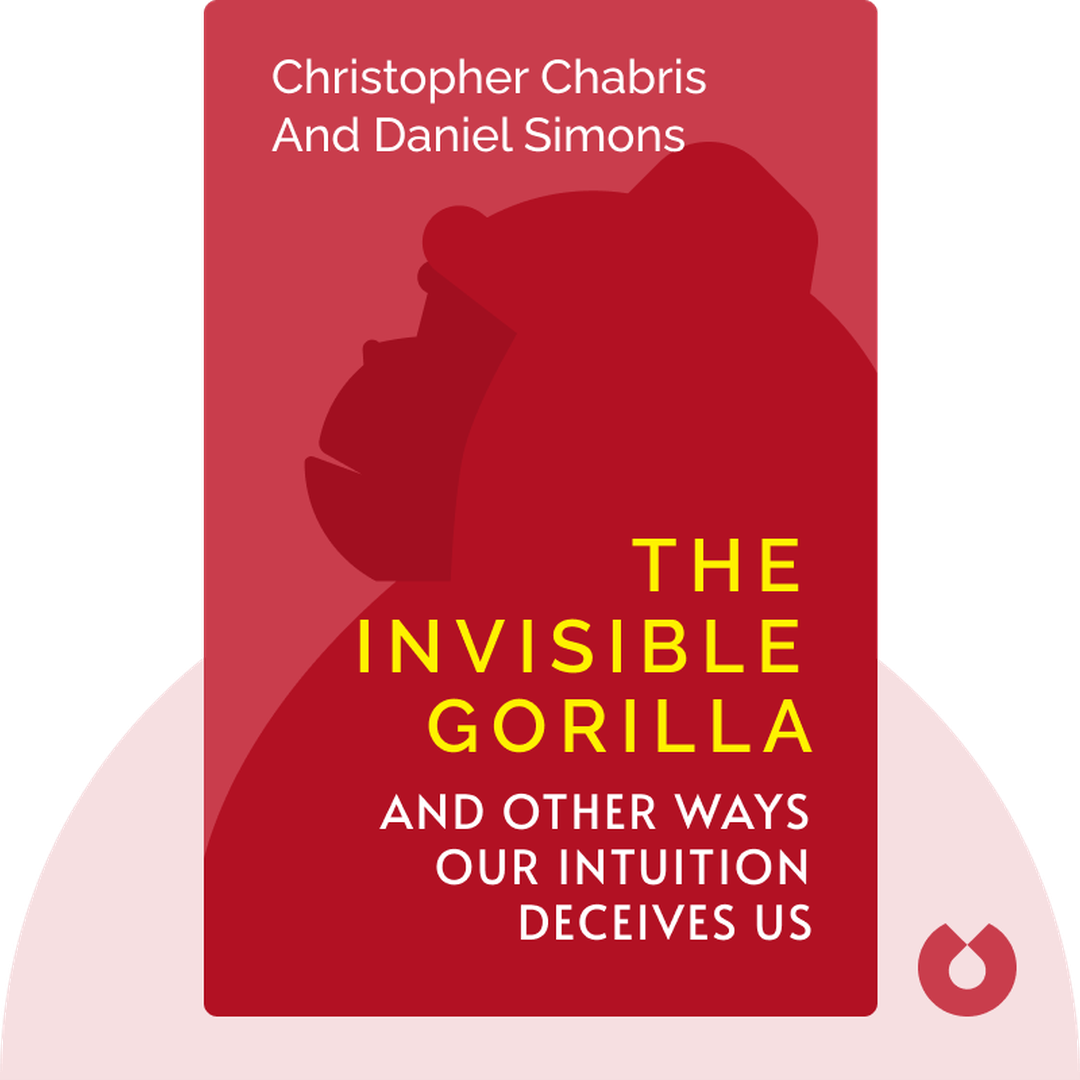
If You're Curious About These Questions...
You should listen to this audiobook
- How is it possible for a trained police officer to completely miss a brutal physical assault happening right next to him?
- Why might you vividly and confidently remember sitting next to a famous celebrity, even if the event actually happened to a friend?
- Why did investors who received updates on their mutual funds only once every five years earn twice the returns of those who checked their investments every month?
Listen to The Invisible Gorilla — Free Audiobook
Loading player...
Key Takeaways from The Invisible Gorilla
- When our attention is intensely focused on a specific task, we suffer from an illusion of attention that causes us to completely miss obvious events right in front of us.
- Human memory does not record perfect, video-like sequences of events, but rather stores general meanings, making us highly susceptible to confidently recalling false memories.
- We frequently mistake outward confidence for actual competence, leading us to incorrectly trust self-assured individuals over those who take the time to verify their facts.
- Familiarity with everyday objects creates an illusion of knowledge, making us falsely believe we deeply understand how things work simply because we interact with them regularly.
- Because human brains are hardwired to seek out patterns, we often falsely perceive causal links and correlations between entirely unrelated events.
Learning Tools
Reinforce what you learned from The Invisible Gorilla
Mind Map
The Invisible Gorilla
The Flaw of Intuition+
Illusion of Attention+
Illusion of Memory+
Illusion of Confidence+
Illusion of Knowledge+
Illusion of Cause+
Illusion of Potential+
Actionable Advice+
Quiz — Test Your Understanding
Question 1 of 8
Why do the authors argue against the common self-help advice to 'go with your gut'?
Question 2 of 8
What does the 'Invisible Gorilla' experiment primarily demonstrate about human attention?
Question 3 of 8
According to the text, why do car drivers frequently collide with motorcycles when turning left?
Question 4 of 8
How does the text describe the way our memory functions, as opposed to how most people believe it functions?
Question 5 of 8
In the study involving the medical appointment video, why did participants place more trust in the doctor who did NOT look up the disease?
Question 6 of 8
What did the experiment involving participants drawing a bicycle demonstrate?
Question 7 of 8
What did the mutual fund experiment by Richard Thaler reveal about the relationship between information and understanding?
Question 8 of 8
What evolutionary argument does the text use to debunk the myth that we only use 10 percent of our brains?
The Invisible Gorilla — Full Chapter Overview
- 1Recommendation
- 2Even though we’re taught to trust it, our intuition often lets us down.
- 3We think we notice more than we do, and that we’re more observant than we really are.
- 4Our memory isn’t as sharp and reliable as we like to think.
- 5Our confidence can easily mislead us.
- 6We assume we understand more than we really do.
- 7We see patterns and causes that aren’t really there.
- 8We cling to a tempting illusion of easily unlocked hidden potential.
The Invisible Gorilla Summary & Overview
The Invisible Gorilla (2010) explores the way our intuition is not the beacon of guiding light we think it is. In fact, it’s often erroneously based on illusions. By debunking some examples of common knowledge, Chabris and Simons argue why our intuition often cannot be trusted.
Who Should Listen to The Invisible Gorilla?
- People interested in the inner workings of the mind
- Psychology students
- Managers who want a new way to approach to decision making
Books Similar to The Invisible Gorilla
Readers who enjoyed this also liked these titles.