If You're Curious About These Questions...
You should listen to this audiobook
- Did you know that the root cause of depression might actually be a physical "fire" burning within your immune system rather than just a chemical imbalance in your brain?
- Have you ever wondered why traditional antidepressants fail for so many people, and how your body's inflammatory response could be the missing piece of the puzzle?
- What if the next major breakthrough in mental health treatment doesn't come from psychology, but from a revolutionary new understanding of how our blood affects our mood?
Listen to The Inflamed Mind — Free Audiobook
Loading player...
Key Takeaways from The Inflamed Mind
- Discover how depression is not solely a mental illness, but a physical condition heavily driven by the body's immune system and widespread inflammation.
- Understand why feeling gloomy during a physical illness is actually an evolutionary defense mechanism designed to conserve your energy for fighting off infections.
- Learn how chronic inflammation occurs when immune cells like macrophages and lymphocytes remain permanently activated, potentially triggering long-term mood disorders.
- Find out how a euphoric side effect from the arthritis drug Remicade revealed that directly reducing bodily inflammation can instantly boost a patient's mood.
- Explore how the centuries-old doctrine of Cartesian dualism has historically hindered modern medicine by artificially separating physical ailments from mental health.
Learning Tools
Reinforce what you learned from The Inflamed Mind
Mind Map
The Inflamed Mind
The Core Hypothesis+
Historical Blindspots+
How Inflammation Affects the Brain+
Evidence & Biomarkers+
Triggers of Chronic Inflammation+
Evolutionary Purpose+
Treatment & Future Outlook+
Quiz — Test Your Understanding
Question 1 of 8
What unexpected side effect of the rheumatoid arthritis drug Remicade helped scientists connect inflammation to mood?
Question 2 of 8
How did René Descartes' philosophy of Cartesian dualism negatively impact modern medicine's approach to depression?
Question 3 of 8
According to the book, what is a major flaw in the widely accepted serotonin theory of depression?
Question 4 of 8
How does bodily inflammation affect the brain, despite the presence of the Blood-Brain Barrier (BBB)?
Question 5 of 8
What happens to the base protein tryptophan in the brain during an inflammatory response?
Question 6 of 8
Which of the following is identified as perhaps the biggest contributor to chronic inflammation and a well-known trigger of depression?
Question 7 of 8
From an evolutionary perspective, why might genes that trigger inflammation and depressive behaviors have been advantageous to our ancestors?
Question 8 of 8
Why aren't anti-inflammatory drugs currently licensed as a standard treatment for depression?
The Inflamed Mind — Full Chapter Overview
- 1Recommendation
- 2Physical illness can leave you feeling depressed, perhaps because inflammation is the cause behind it.
- 3Inflammation is our immune system’s natural response that protects us against infection and disease.
- 4Cartesian dualism’s doctrine has prevented modern medicine from exploring the connections between the mind and body fully.
- 5Since Prozac’s invention in the ’90s, depression treatment has seen no truly major breakthroughs over the decades.
- 6Emerging areas of medical research are revealing promising links between inflammation and depression.
- 7Body-wide inflammation can trigger an inflammatory response in the brain, altering our mood and behavior in significant ways.
- 8Autoimmune disorders, aging, obesity, and stress can all cause chronic inflammation too.
- 9Sensitivity to inflammation and depression might have helped our ancestors survive longer.
- 10Therapies and medications that reduce inflammation offer new hope for depression treatment.
The Inflamed Mind Summary & Overview
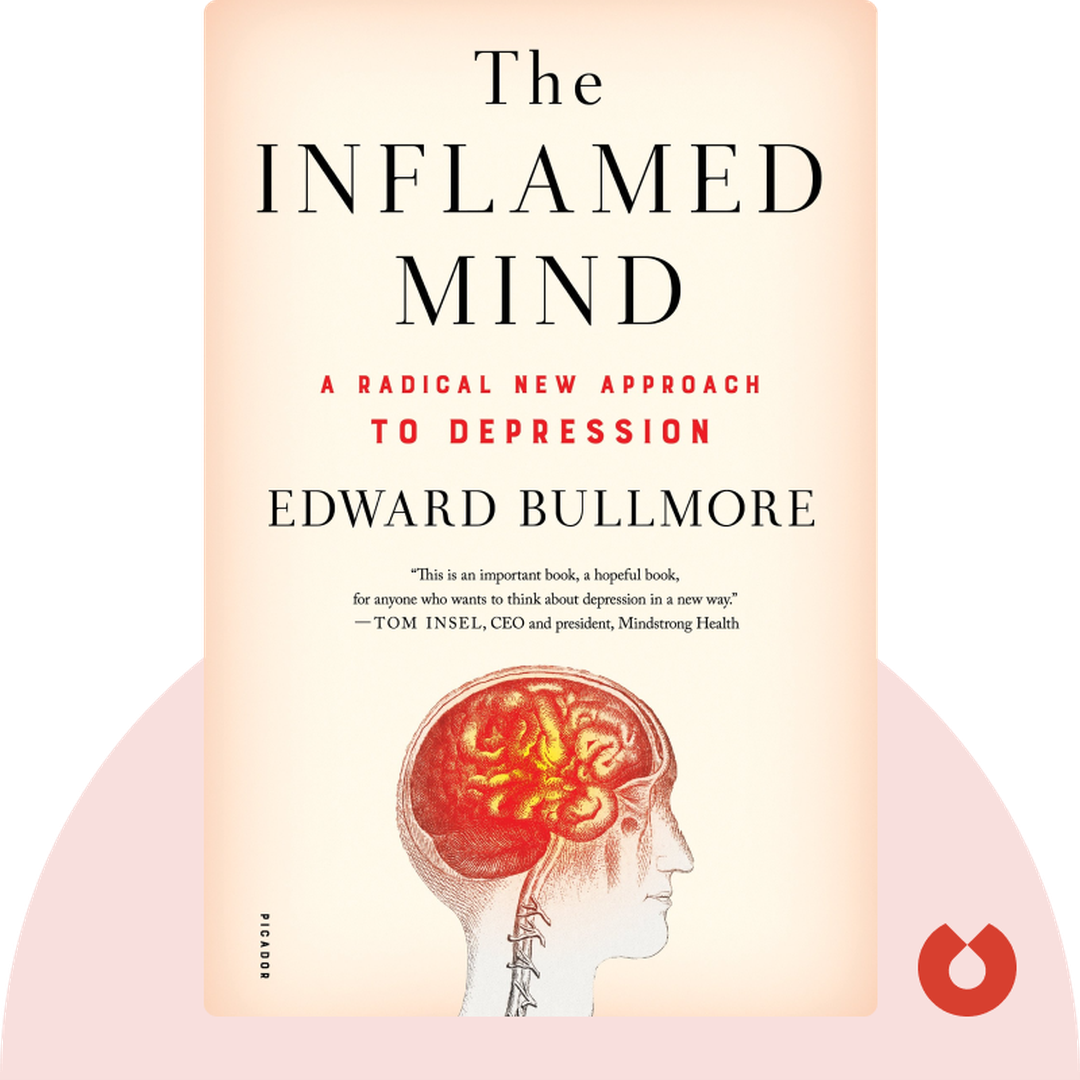
The Inflamed Mind (2018) explains the latest science behind a new theory linking depression to inflammation of the body and brain. Bringing together insights from medicine, psychology and evolutionary theory, psychiatrist Edward Bullmore reveals the complex connections between our immune system and our mental health – and shows how a new holistic understanding of body, mind and brain could revolutionize the way we see and treat depression.
Who Should Listen to The Inflamed Mind?
- Med students, physicians and scientists interested in the mind and brain
- Psychologists and therapists interested in how physical illness affects mental health
- Anyone who has dealt with depression
Books Similar to The Inflamed Mind
Readers who enjoyed this also liked these titles.