Theme Song
If You're Curious About These Questions...
You should listen to this audiobook
- Have you ever wondered why a single bad mood can spiral into weeks of sadness, and what specific neurological 'reset' can turn that downward trend around?
- Did you know that the simple act of making a decision—even a small one—can actually rewire your brain’s circuitry to reduce anxiety?
- What if you could trigger a positive chemical chain reaction in your brain using nothing more than a few science-backed lifestyle tweaks?
Listen to The Upward Spiral — Cinematic Audio Edition
Loading player...
Key Takeaways from The Upward Spiral
- Understand how a communication breakdown between your thinking brain (prefrontal cortex) and feeling brain (limbic system) triggers the downward spiral of depression.
- Discover how worry and anxiety hijack your brain's planning abilities, trapping you in a vicious cycle of focusing only on what could go wrong.
- Learn why depression physically wires your brain to focus on negativity, causing you to misinterpret neutral situations as sad or stressful.
- Find out why your brain's habit center, the striatum, pushes you toward unhealthy coping mechanisms like overeating to compensate for reduced dopamine levels.
- Discover how exercise combats the symptoms of depression on physical, mental, and social levels to help you kickstart a powerful upward spiral.
Learning Tools
Reinforce what you learned from The Upward Spiral
Mind Map
The Upward Spiral
Brain Mechanics of Depression+
The Downward Spiral+
Creating the Upward Spiral+
Quiz — Test Your Understanding
Question 1 of 7
According to the text, what happens in the brain when a person becomes depressed?
Question 2 of 7
How does the text distinguish between worry and anxiety?
Question 3 of 7
Why do depressed individuals often need to repeat bad habits, like comfort eating or gambling, more frequently?
Question 4 of 7
According to the text, how does exercise specifically combat depression on a mental level?
Question 5 of 7
Why is setting specific, manageable goals (like sending five resumes a week) effective in escaping a downward spiral?
Question 6 of 7
Which of the following is recommended as part of good 'sleep hygiene'?
Question 7 of 7
What biological effect does physical social contact, such as hugging or shaking hands, have on the brain?
The Upward Spiral — Full Chapter Overview
- 1Recommendation
- 2How the human brain’s structure explains why people often sink into deep depressions.
- 3Anxiety and worry can trap you in a downward spiral.
- 4Depression drives people to focus on negativity, fueling a downward spiral that bad habits worsen.
- 5Exercise is an excellent way to fight depression and build an upward spiral.
- 6Setting goals and making decisions reduces uncertainty and helps lead you out of a downward spiral.
- 7Improving sleep will help you reduce stress and finally shake off depression.
- 8Practicing daily gratitude and pursuing social interactions activates positive circuits within your brain.
The Upward Spiral Summary & Overview
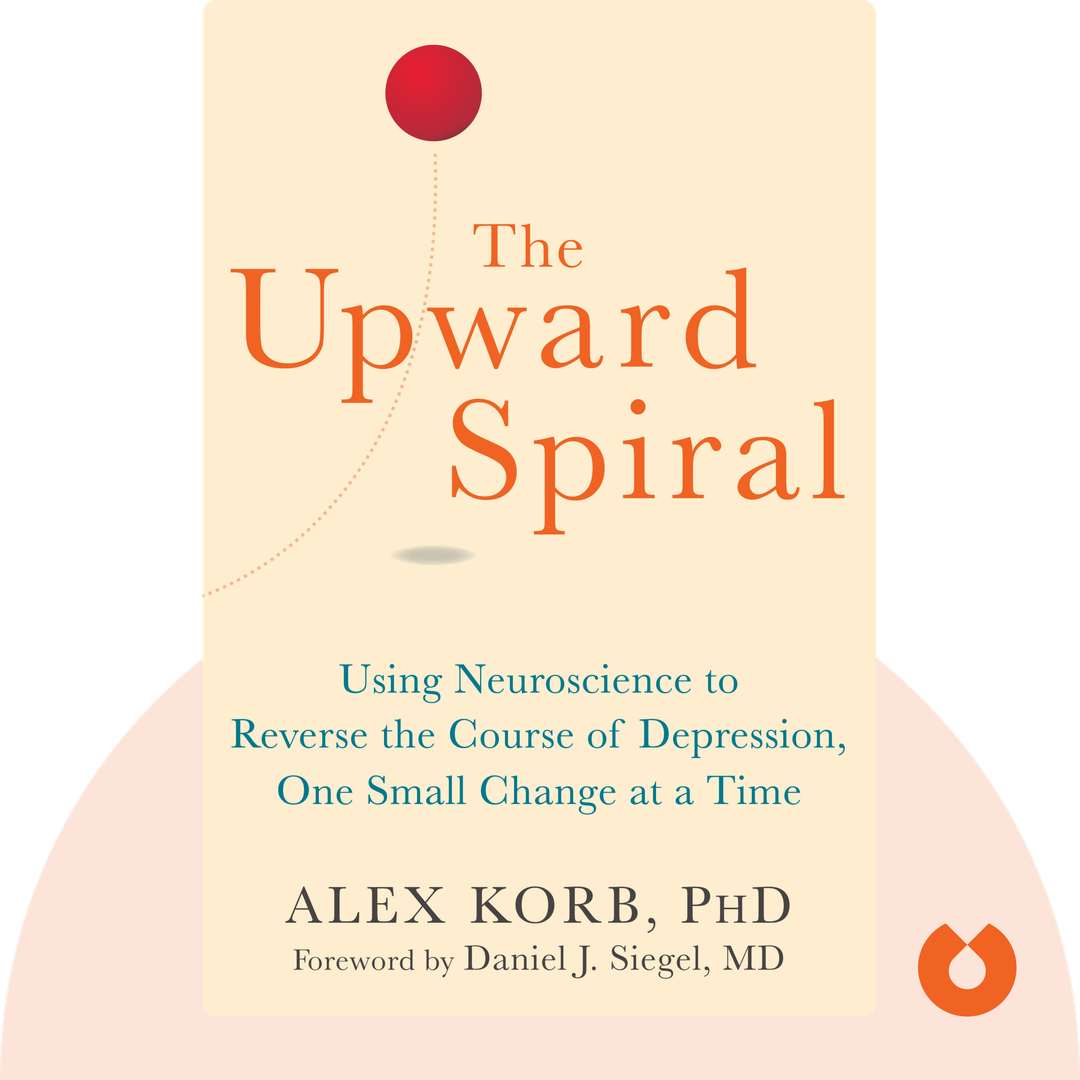
The Upward Spiral (2015) details the ways your brain can fall into a progressively worsening depression and what you can do to reverse the process. These blinks explain the material conditions that cause your mood to slump and offer concrete steps for overcoming depression, anxiety and worry.
Who Should Listen to The Upward Spiral?
- Those who struggle with depression or anxiety
- Laypeople who are interested in neuroscience
- Students who are overwhelmed with their course load
Books Similar to The Upward Spiral
Readers who enjoyed this also liked these titles.