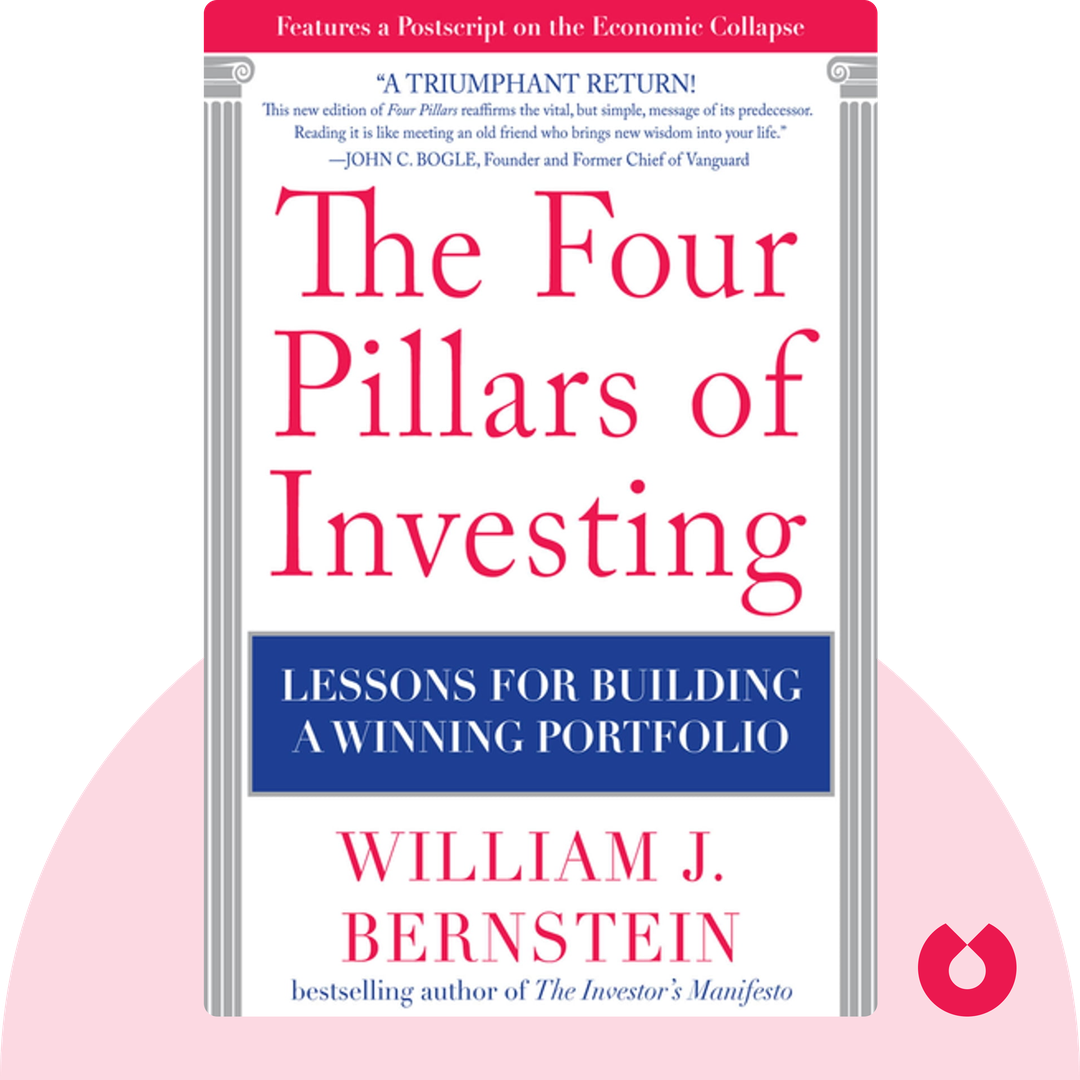
The Four Pillars of Investing
Start ListeningDownload Try free on iPhoneScan to start in 5 seconds
Categories:
If You're Curious About These Questions...
You should listen to this audiobook
- Have you ever wondered why even the most brilliant investors often fail because of a few simple psychological blind spots?
- Did you know that the history of financial markets follows a predictable cycle that could save you from the next big crash?
- What if you could ignore all the market noise and focus on just four fundamental pillars to ensure your lifelong prosperity?
Listen to The Four Pillars of Investing — Free Audiobook
Loading player...
Key Takeaways from The Four Pillars of Investing
- Discover why mastering financial history, rather than relying on complex formulas, is the ultimate key to navigating wild market swings and building long-term wealth.
- Understand why investing in pioneering technologies often yields poor returns unless the invention catches a rare, powerful wave of public enthusiasm.
- Learn to identify the four preconditions of a speculative bubble—new technology, easy credit, historical amnesia, and inexperienced investors—so you can protect your assets.
- Master the psychological discipline of patience to soberly evaluate risk and resist the intoxicating euphoria of repetitive boom-and-bust market cycles.
- Recognize how hidden cognitive biases and innate human irrationality sabotage your financial decisions, empowering you to act in your true self-interest.
Learning Tools
Reinforce what you learned from The Four Pillars of Investing
Mind Map
The Four Pillars of Investing
Pillar 1: Financial History+
Pillar 2: Market Manias & Patience+
Pillar 3: Behavioral Psychology+
Pillar 4: Sound Investment Strategies+
Quiz — Test Your Understanding
Question 1 of 8
According to the text, what is the historical reality of investing in pioneering new technologies?
Question 2 of 8
In the author's analogy comparing technology's diffusion to an old hand pump, what does the spurting, irregular flow at the pump handle represent?
Question 3 of 8
Which of the following is NOT one of the preconditions for a financial bubble identified by economist Hyman Minsky?
Question 4 of 8
How does the psychological bias of 'regret avoidance' negatively impact investors?
Question 5 of 8
Which behavioral mistake involves investors over-focusing on small successes while ignoring bigger failures within their overall strategy?
Question 6 of 8
Why does the author recommend cultivating 'dullness' in your investment approach?
Question 7 of 8
What does the author describe as the 'most liberating investment innovation ever created' for overcoming investor overconfidence?
Question 8 of 8
According to the text, why should investors avoid trying to pick the 'next Microsoft'?
The Four Pillars of Investing — Full Chapter Overview
- 1Recommendation
- 2Pillar one: Those who fail to learn history are condemned to repeat it
- 3Pillar two: Prudent investing is a test of patience.
- 4Pillar three: When it comes to investing, people aren’t as rational as we’d like to think.
- 5Pillar four: With practice, you can learn to tame irrational impulses.
The Four Pillars of Investing Summary & Overview
The Four Pillars of Investing (2002) presents an accessible, evidence-based approach to investing success. The book examines how avoiding emotional biases and impulsive actions enables harnessing the market's wealth-generating power. Bernstein argues that integrating insights from financial science, psychology, and history offers individual investors their best chance at building lifelong prosperity.
Who Should Listen to The Four Pillars of Investing?
- Investors seeking long-term growth
- Those interested in financial psychology
- Readers who enjoy history lessons
Books Similar to The Four Pillars of Investing
Readers who enjoyed this also liked these titles.