If You're Curious About These Questions...
You should listen to this audiobook
- Did you know that the most powerful tool in your investment portfolio—diversification—was once a radical theory that many experts thought was completely wrong?
- Have you ever wondered how a small group of visionary thinkers managed to decode the chaos of the stock market and create the rules that drive the global economy today?
- What’s the secret behind the mathematical revolution that turned Wall Street from a place of 'gut feelings' into the high-tech engine of modern finance?
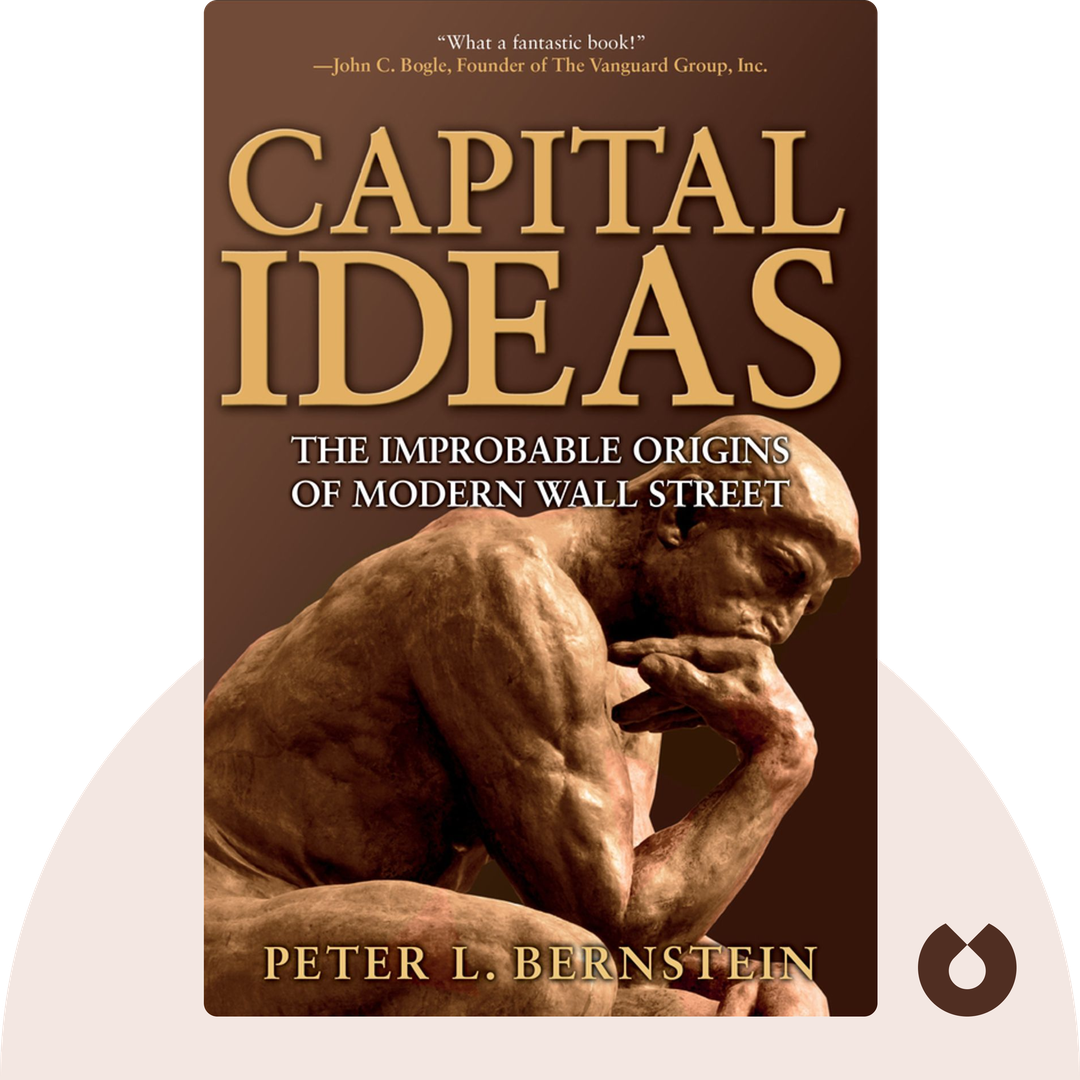
Listen to Capital Ideas — Free Audiobook
Loading player...
Key Takeaways from Capital Ideas
- Discover how a handful of academic pioneers transformed Wall Street from an intuition-based industry into a modern financial powerhouse driven by complex mathematics.
- Understand why precise stock market forecasting is an illusion, as historical research proves that price movements behave randomly and are no more reliable than flipping a coin.
- Learn how Harry Markowitz revolutionized modern investing by showing that effective diversification relies on the strategic mix of your assets, not just the sheer number you own.
- Find out how to streamline your investment strategy into two clear decisions using the Separation Theorem: determining your overall risk tolerance and selecting assets that maximize returns.
- Master the fundamental principles of the Capital Asset Pricing Model (CAPM) to understand why attempting to beat the broader stock market inevitably exposes you to unnecessary risk.
Learning Tools
Reinforce what you learned from Capital Ideas
Mind Map
Capital Ideas
The Illusion of Predictability+
Modern Portfolio Theory+
Efficient Markets & Information+
Defining True Value+
Quantitative Models & Risk+
The Index Fund Revolution+
Portfolio Insurance & Crashes+
Quiz — Test Your Understanding
Question 1 of 8
What did Alfred Cowles discover in the 1930s regarding professional market forecasters?
Question 2 of 8
What was Harry Markowitz's revolutionary insight regarding portfolio diversification?
Question 3 of 8
According to William Sharpe's Capital Asset Pricing Model (CAPM), what constitutes the ultimate 'super-efficient' portfolio?
Question 4 of 8
How did Paul Samuelson define the 'true value' of a stock?
Question 5 of 8
What is the core premise of Eugene Fama's concept of market efficiency?
Question 6 of 8
What did Modigliani and Miller's 'MM Theory' propose about a company's market value?
Question 7 of 8
What major financial innovation did John McQuown and William Fouse develop at Wells Fargo?
Question 8 of 8
Why did Hayne Leland's 'portfolio insurance' strategy ultimately fail during the 1987 stock market crash?
Capital Ideas — Full Chapter Overview
- 1Recommendation
- 2The predictability illusion
- 3The efficient investment portfolio
- 4Information vs. noise
- 5What is real value?
- 6The emergence of the models
- 7The model to rule them all
- 8Insurance for a better future
- 9Final summary
Capital Ideas Summary & Overview
Capital Ideas (1991) presents a journey through the groundbreaking ideas that shaped modern finance. It reveals the brilliant economists and daring financial theorists who transformed Wall Street with concepts like diversification and market efficiency – and highlights the origins of the financial systems we rely on today, offering a deeper understanding of the forces that drive our economy.
Who Should Listen to Capital Ideas?
- Amateur and professional investors
- Economics students
- History buffs
Books Similar to Capital Ideas
Readers who enjoyed this also liked these titles.