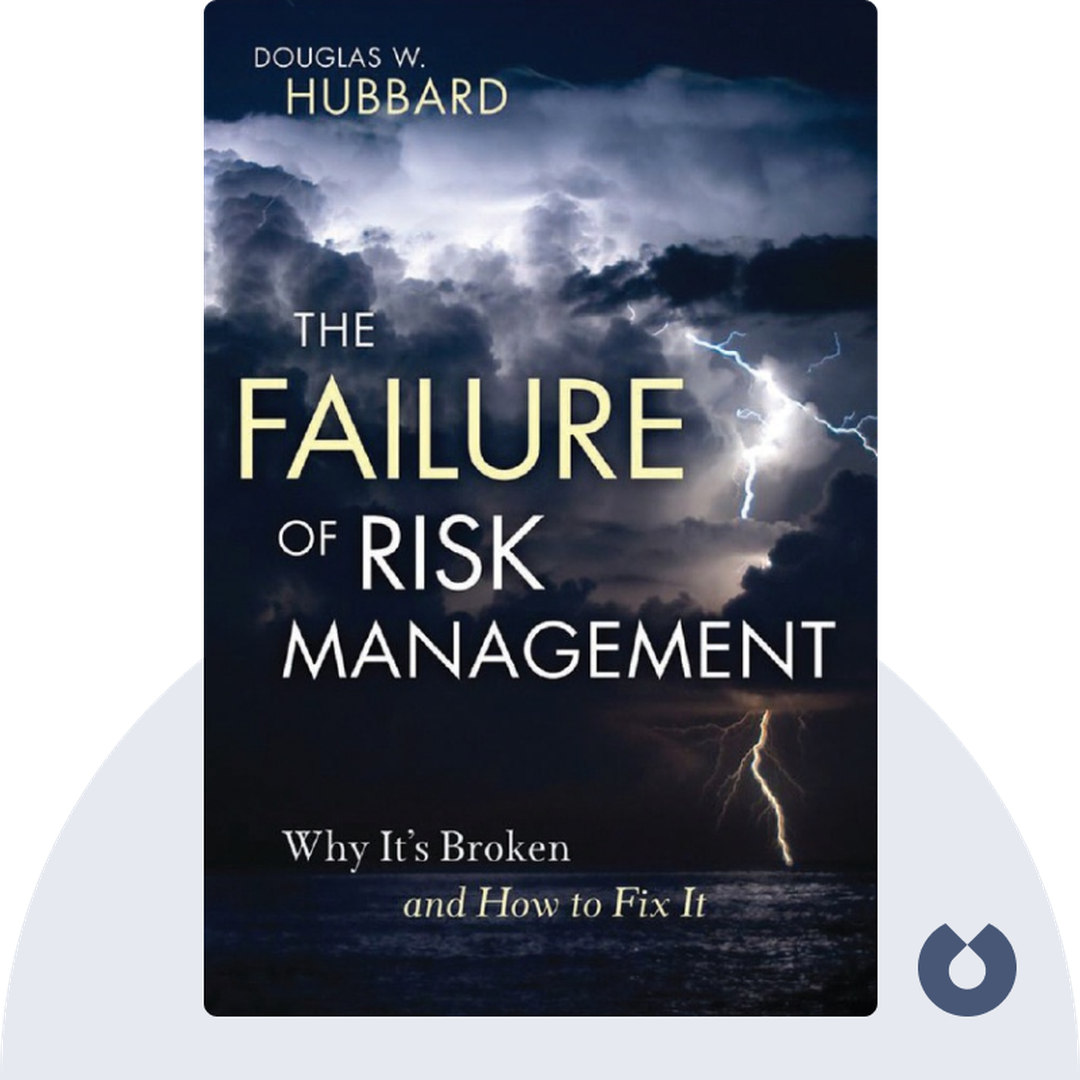
The Failure of Risk Management
Start ListeningDownload Try free on iPhoneScan to start in 5 seconds
Categories:
If You're Curious About These Questions...
You should listen to this audiobook
- Did you know that the most popular risk management tools used by major corporations are often no more effective than using a random number generator?
- What’s the secret to measuring risks that seem impossible to quantify, and why are most traditional experts getting it wrong?
- What if you could replace gut feelings and colored heat maps with a scientifically proven way to predict and mitigate your biggest financial threats?
Listen to The Failure of Risk Management — Cinematic Audio Edition
Loading player...
Key Takeaways from The Failure of Risk Management
- Understand the true definition of risk as the probability and magnitude of an undesirable event, and learn how to effectively use limited resources to decrease these dangers.
- Discover why risk management has become a critical focus for global corporations, driving major companies to hire Chief Risk Officers and actively engage their boards.
- Learn why popular qualitative risk assessments are inherently flawed, as vague labels like 'very likely' are highly subjective and lead to dangerous misinterpretations.
- Find out how common risk scoring methods fail by ignoring the interconnected relationships between risks, such as common mode failures that can trigger multiple disasters simultaneously.
- Recognize the danger of relying exclusively on expert opinions for risk assessment, as psychological studies prove that even seasoned professionals drastically overestimate their own capabilities.
Learning Tools
Reinforce what you learned from The Failure of Risk Management
Mind Map
The Failure of Risk Management
Fundamentals of Risk+
Flaws in Popular Methods+
Calibrating Expert Opinion+
Monte Carlo Simulation+
Calculating Unprecedented Risks+
Valuing Additional Information+
Organizational Strategy+
Quiz — Test Your Understanding
Question 1 of 9
How does the text define 'risk' in a scientific or mathematical context?
Question 2 of 9
According to the text, what is a major flaw of commonly used qualitative descriptions like 'very likely' in risk assessment?
Question 3 of 9
What does the airplane hydraulic tube example illustrate about flawed risk assessment methods?
Question 4 of 9
How does the 'peak end rule' affect an expert's ability to evaluate probability?
Question 5 of 9
What is the primary purpose of 'calibration training' for experts?
Question 6 of 9
How does the Monte Carlo Simulation assess risk?
Question 7 of 9
How can risk managers calculate the probability of an event that has never happened before, such as a specific nuclear disaster?
Question 8 of 9
In risk management, how is the 'expected opportunity loss' calculated?
Question 9 of 9
Why does the author recommend having a dedicated department to review and standardize all risk-related decisions?
The Failure of Risk Management — Full Chapter Overview
- 1Recommendation
- 2Risk management means taking chances wisely.
- 3Risk management matters more and more to companies worldwide.
- 4The most common risk assessment methods don’t work.
- 5Expert opinions are frequently biased.
- 6Calibration training can reduce overconfidence and improve probability estimates.
- 7Use Monte Carlo Simulation to estimate risks as accurately as possible.
- 8Don’t let an apparent lack of data keep you from calculating risk.
- 9Compare your model with real facts and determine the value of additional information.
- 10Use a comprehensive organizational strategy to manage risk efficiently and effectively.
- 11Final summary
The Failure of Risk Management Summary & Overview
The Failure of Risk Management (2009) is a comprehensive guide to the history, methods and myths of risk management. These blinks explain why common methods for managing risk are flawed and how to fix them; they also offer tried and true alternatives for measuring and mitigating risk.
Who Should Listen to The Failure of Risk Management?
- Business owners and investors
- People interested in how risk can be accurately calculated
- Managers from all fields
Books Similar to The Failure of Risk Management
Readers who enjoyed this also liked these titles.