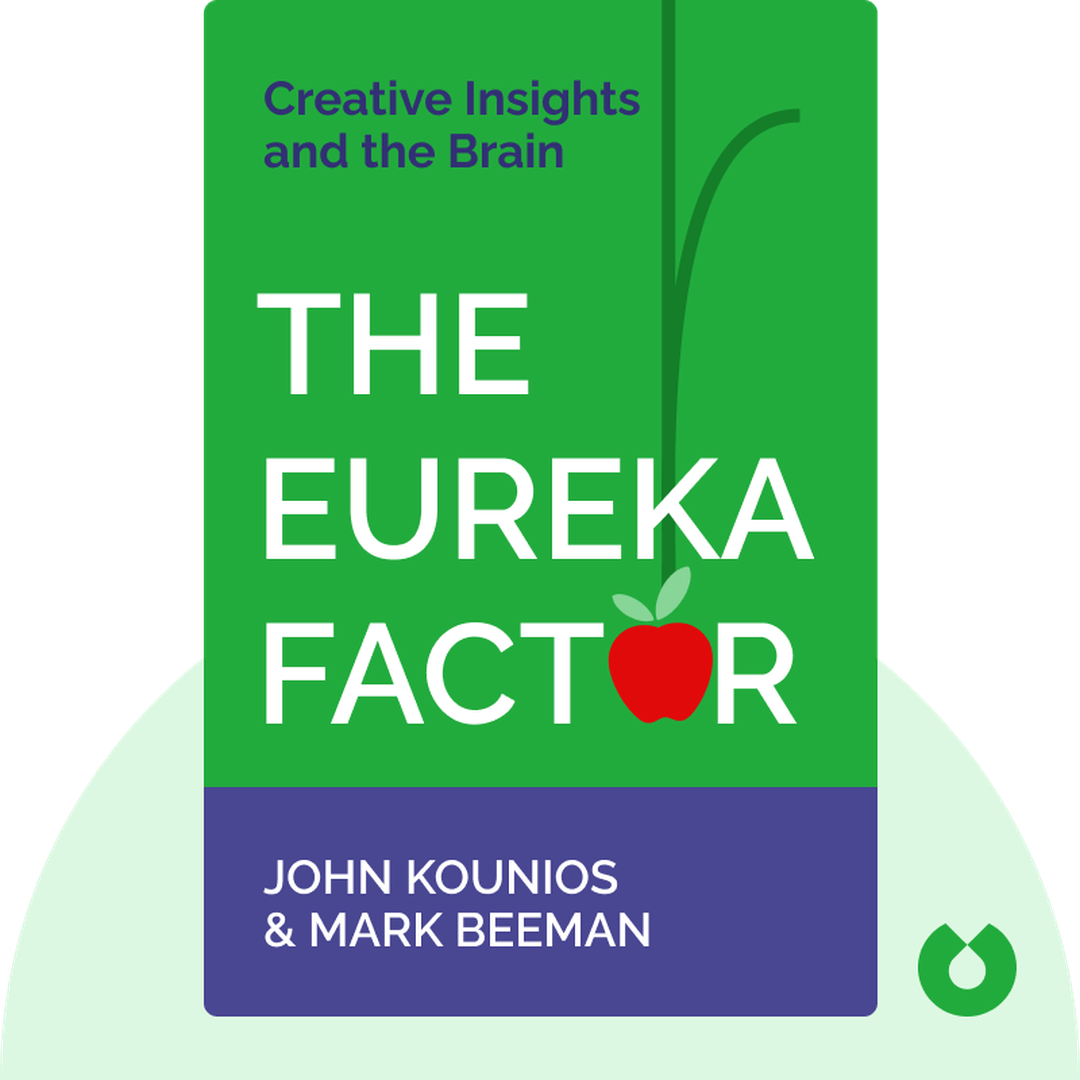
If You're Curious About These Questions...
You should listen to this audiobook
- What if you could learn to trigger those sudden 'aha!' moments exactly when you need them most?
- Did you know that your brain gives off a specific signal just seconds before a breakthrough idea strikes?
- Have you ever wondered why your most brilliant ideas often arrive when you’re not actually thinking about the problem?
Listen to The Eureka Factor — Free Audiobook
Loading player...
Key Takeaways from The Eureka Factor
- Discover how sudden 'aha' moments act as powerful tools that combine years of experience to produce an entirely new perspective on a stubborn problem.
- Learn to overcome 'functional fixedness'—the imaginary rules and perceived mental boundaries that restrict your thinking—to unlock revolutionary solutions.
- Understand why your brain's rational frontal lobe naturally limits creativity, and how sudden neurological sparks in your right hemisphere can override it to drive novel insights.
- Find out why everyday routines like taking a shower create the perfect sensory-restricted environment to eliminate distractions and allow your mind to freely focus on generating ideas.
- Master the art of 'sleep incubation' by allowing your relaxed, subconscious mind the necessary space to naturally play with concepts and solve complex problems while you rest.
Learning Tools
Reinforce what you learned from The Eureka Factor
Mind Map
The Eureka Factor
Nature of Eureka Moments+
The Neuroscience of Insight+
Environmental Catalysts+
Psychological Factors+
Actionable Strategies+
Quiz — Test Your Understanding
Question 1 of 8
What defines an 'aha moment' or 'eureka moment' according to the text?
Question 2 of 8
The story of Christopher Columbus and the egg is used to illustrate which psychological concept?
Question 3 of 8
How does the frontal lobe of the brain relate to insightful thinking?
Question 4 of 8
Why is the shower considered an ideal place for experiencing eureka moments?
Question 5 of 8
According to the text, how do strict deadlines and high-pressure environments affect creativity?
Question 6 of 8
Which mental exercise is recommended to cultivate insightful thinking?
Question 7 of 8
Which type of motivation is most conducive to generating aha moments?
Question 8 of 8
If you wanted to design a physical workspace to induce moments of insight, which features should you include based on the text?
The Eureka Factor — Full Chapter Overview
- 1Recommendation
- 2A eureka moment brings sudden clarity and a burst of insight.
- 3Although aha moments can seem obvious later, they wield revolutionary creative power, deep insight.
- 4Sparks within the brain propel fresh insights and novel ways of thinking and understanding.
- 5Insight arises when diverse concepts converge within the right supportive environment.
- 6Factors such as anxiety stifle insight, while others like intuition aid it.
- 7Insightfulness lives in your genes, yet you can boost insight with the right environment and context.
- 8The right motivation and a shifted environment can truly make you more insightful.
The Eureka Factor Summary & Overview
The Eureka Factor (2015) looks at the remarkable phenomena of insights and creativity, and how the two are intertwined. By laying out the latest scientific research, it sheds light on how insights work, including what supports and hinders them. In addition, it provides powerful advice on how everyone can train themselves to have more eureka moments.
Who Should Listen to The Eureka Factor?
- Anyone hoping to have more “aha moments” in their life
- Curious thinkers interested in the origins of creativity
Books Similar to The Eureka Factor
Readers who enjoyed this also liked these titles.