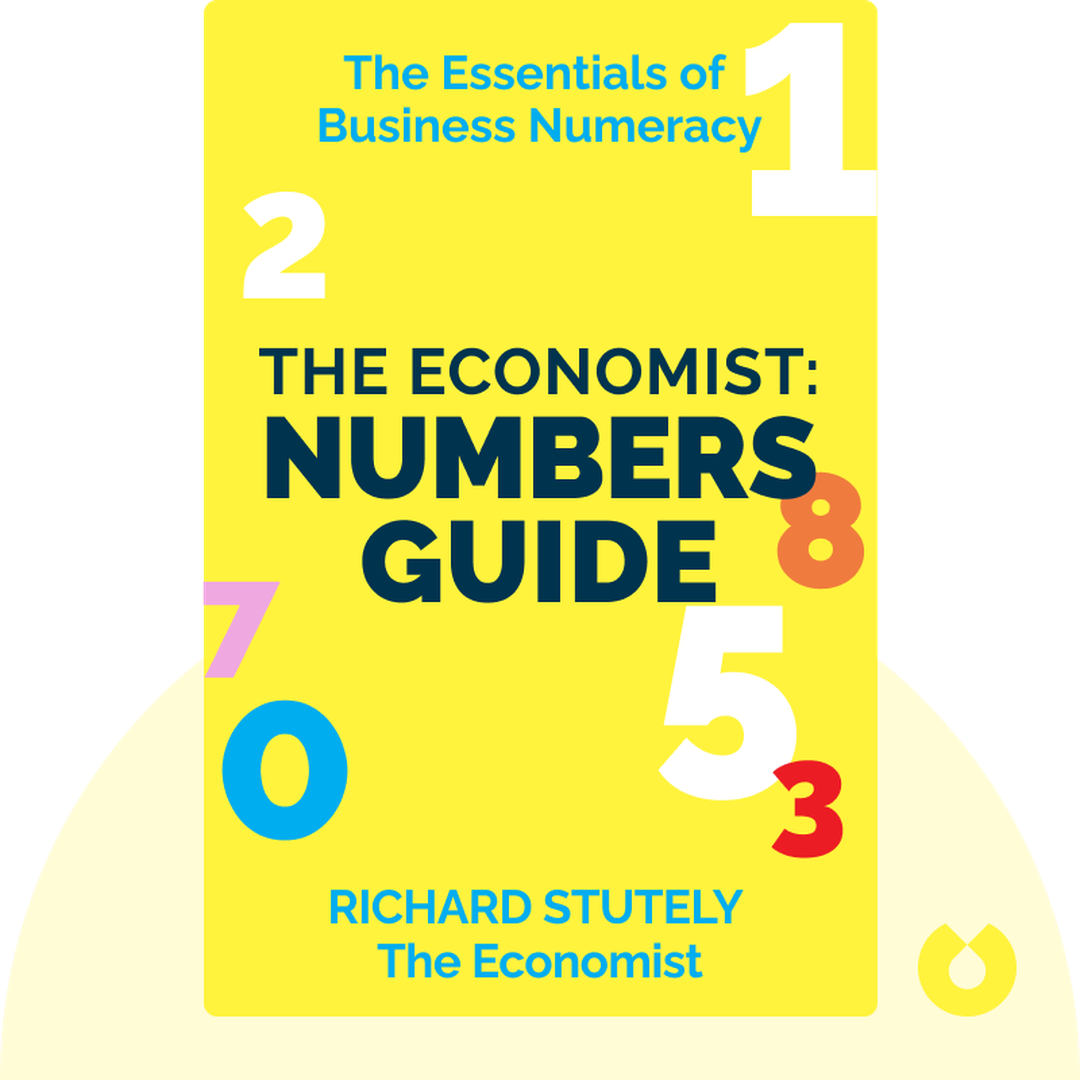
The Economist: Numbers Guide
Start ListeningDownload Try free on iPhoneScan to start in 5 seconds
Categories:
If You're Curious About These Questions...
You should listen to this audiobook
- Did you know that the secret to managing business risk isn't avoiding it, but learning how to transform uncertainty into a simple, manageable number?
- Have you ever wondered why some entrepreneurs consistently make better decisions in high-stakes situations while others struggle with the unknown?
- What if you could harness the same mathematical tools used by world-class economists to solve complex business problems—even if you haven't touched a math textbook in years?
Listen to The Economist: Numbers Guide — Free Audiobook
Loading player...
Key Takeaways from The Economist: Numbers Guide
- Understand the critical differences between percentage changes and percentage points, and discover why rounding numbers before making calculations can drastically skew your results.
- Learn how to calculate the true future value of an investment by balancing the exponential growth of compound interest against the devaluing effects of inflation.
- Master the evaluation of business data by combining three essential statistical measures: the mean, the standard deviation, and the shape of distribution.
- Apply the rule of three to your data tables to make them concise, highly informative, and logically ordered by size and importance for maximum impact.
- Discover how to transform complex numbers into visually compelling charts and graphs that reveal hidden trends and proportions at a single glance.
Learning Tools
Reinforce what you learned from The Economist: Numbers Guide
Mind Map
The Economist: Numbers Guide
Percentages & Rounding+
Interest Rates & Inflation+
Data Analysis+
Tables & Charts+
Forecasting+
Sampling & Hypothesis Testing+
Decision-Making Under Uncertainty+
Quiz — Test Your Understanding
Question 1 of 8
According to the text, what is a crucial rule to remember when using rounding to simplify numbers?
Question 2 of 8
What happens if an investment's value grows by a certain percentage, and then subsequently decreases by that exact same percentage?
Question 3 of 8
How does the text describe the relationship between interest and inflation when considering an investment?
Question 4 of 8
In data analysis, what does the standard deviation indicate about a set of numbers?
Question 5 of 8
What is a potential downside of using charts, such as line graphs, to present data?
Question 6 of 8
Which forecasting approach relies on establishing cause-and-effect relationships, such as how sales are influenced by taxes?
Question 7 of 8
What is the primary purpose of hypothesis testing in business decision-making?
Question 8 of 8
When making business decisions under uncertainty, how does the 'weighted average return' technique evaluate options?
The Economist: Numbers Guide — Full Chapter Overview
- 1Recommendation
- 2Percentages and Rounding Basics
- 3Interest Rates and Inflation
- 4Analyzing Data
- 5Using Tables and Charts
- 6Making Forecasts
- 7Sampling and Testing Hypotheses
- 8Making Decisions
- 9Final Summary
The Economist: Numbers Guide Summary & Overview
The Economist: Numbers Guide (1991) explores a variety of mathematical tools that are exceptionally useful across a range of business environments. These blinks reveal just how simple it is to manage risk by quantifying it, helping improve decision making in the process. The book’s mathematical notions are explained at a basic level, so no prior math knowledge is required.
Who Should Listen to The Economist: Numbers Guide?
- Entrepreneurs wondering how to apply mathematical ideas to their business
- Anyone seeking reliable tools for making decisions in uncertain business situations
Books Similar to The Economist: Numbers Guide
Readers who enjoyed this also liked these titles.