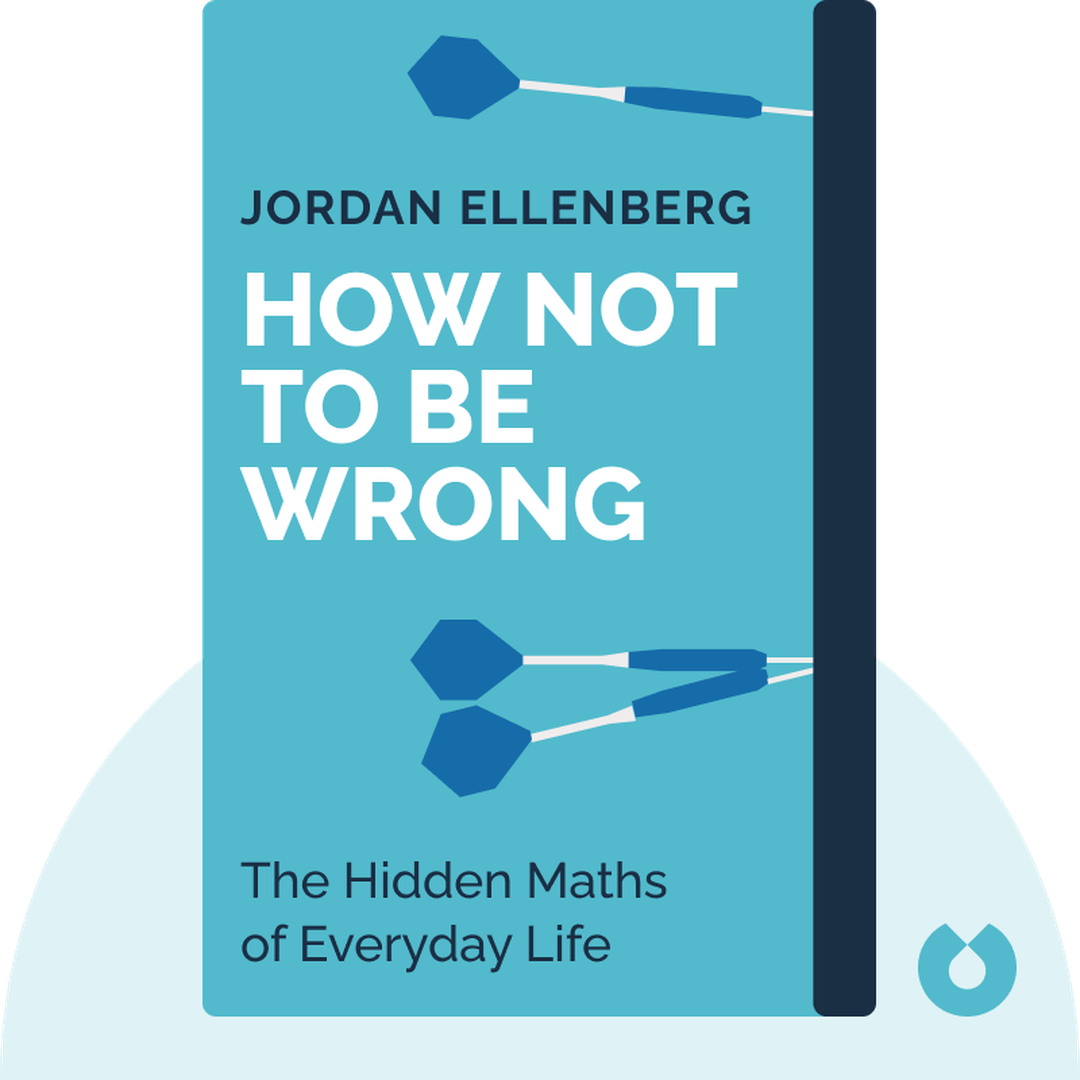
If You're Curious About These Questions...
You should listen to this audiobook
- Have you ever wondered why reinforcing the parts of a plane with the most bullet holes is actually the worst way to keep it from crashing?
- What if you could master a hidden way of thinking that allows you to spot logical errors and misconceptions that most people miss?
- Did you know that applying 'common sense' to complex problems often leads to the wrong answer, and there's a mathematical secret to finding the truth?
Listen to How Not to Be Wrong — Cinematic Audio Edition
Loading player...
Key Takeaways from How Not to Be Wrong
- Discover how everyday mathematics acts as a workout for your brain, helping you make smarter daily decisions like comparing prices or finding the fastest commute.
- Understand why small sample sizes create misleading noise in data, and learn to gather comprehensive information to make truly accurate assessments.
- Learn to stop seeing false patterns in random events by applying the null hypothesis and p-values to determine what is actually statistically significant.
- Find out why big data cannot perfectly predict human behavior or chaotic events, helping you recognize the true boundaries of algorithmic models.
- Master the crucial distinction between measurable risk and unpredictable uncertainty to better navigate and manage the complex choices you face.
Learning Tools
Reinforce what you learned from How Not to Be Wrong
Mind Map
How Not to Be Wrong
Nature of Mathematics+
Linearity & Simplification+
Probability & Risk+
Statistics & Research Flaws+
Flaws in Public Opinion+
Quiz — Test Your Understanding
Question 1 of 8
During WWII, why did a mathematician suggest reinforcing the engines of returning planes rather than the fuselage, which had the most bullet holes?
Question 2 of 8
What is the primary purpose of using linear regression in statistics?
Question 3 of 8
Why was the 2008 study published in Obesity, which claimed all Americans would be obese by 2048, mathematically flawed?
Question 4 of 8
What is the main limitation of relying solely on 'expected value' to make decisions about bets or investments?
Question 5 of 8
How does the 'regression effect' explain why a debut novelist's second book is often perceived as worse than their best-selling first book?
Question 6 of 8
In statistical testing, what does it mean if a result achieves a p-value of less than 0.05?
Question 7 of 8
According to John Ioannidis, why do published research findings often present a distorted view of reality?
Question 8 of 8
Why is the concept of a 'majority rules' public opinion often misleading when there are more than two options?
How Not to Be Wrong — Full Chapter Overview
- 1Recommendation
- 2Mathematics is the science of avoiding mistakes, and it’s rooted in common sense.
- 3Linearity helps us simplify mathematical problems.
- 4Drawing conclusions from observational data can be unreliable, but probability theory can help.
- 5Probability theory shows what to expect from a bet, but risks still matter.
- 6The regression effect appears everywhere, though it often goes unnoticed.
- 7Linear regression is useful, but assuming linearity where it doesn’t exist can lead to false conclusions.
- 8Many research findings are flawed because data is misused or probability is calculated incorrectly.
- 9Polls and elections that claim to reflect “public opinion” are often wrong.
- 10Final summary
How Not to Be Wrong Summary & Overview
How Not to Be Wrong gives us an intimate glimpse into how mathematicians think and how we can benefit from their way of thinking. It also explains how easily we can be mistaken when we apply mathematical tools incorrectly, and gives advice on how we can instead find correct solutions.
Who Should Listen to How Not to Be Wrong?
- Anyone interested in math
- Anyone interested in logic or philosophy
- Anyone interested in seeing the equations behind everyday situations
Books Similar to How Not to Be Wrong
Readers who enjoyed this also liked these titles.