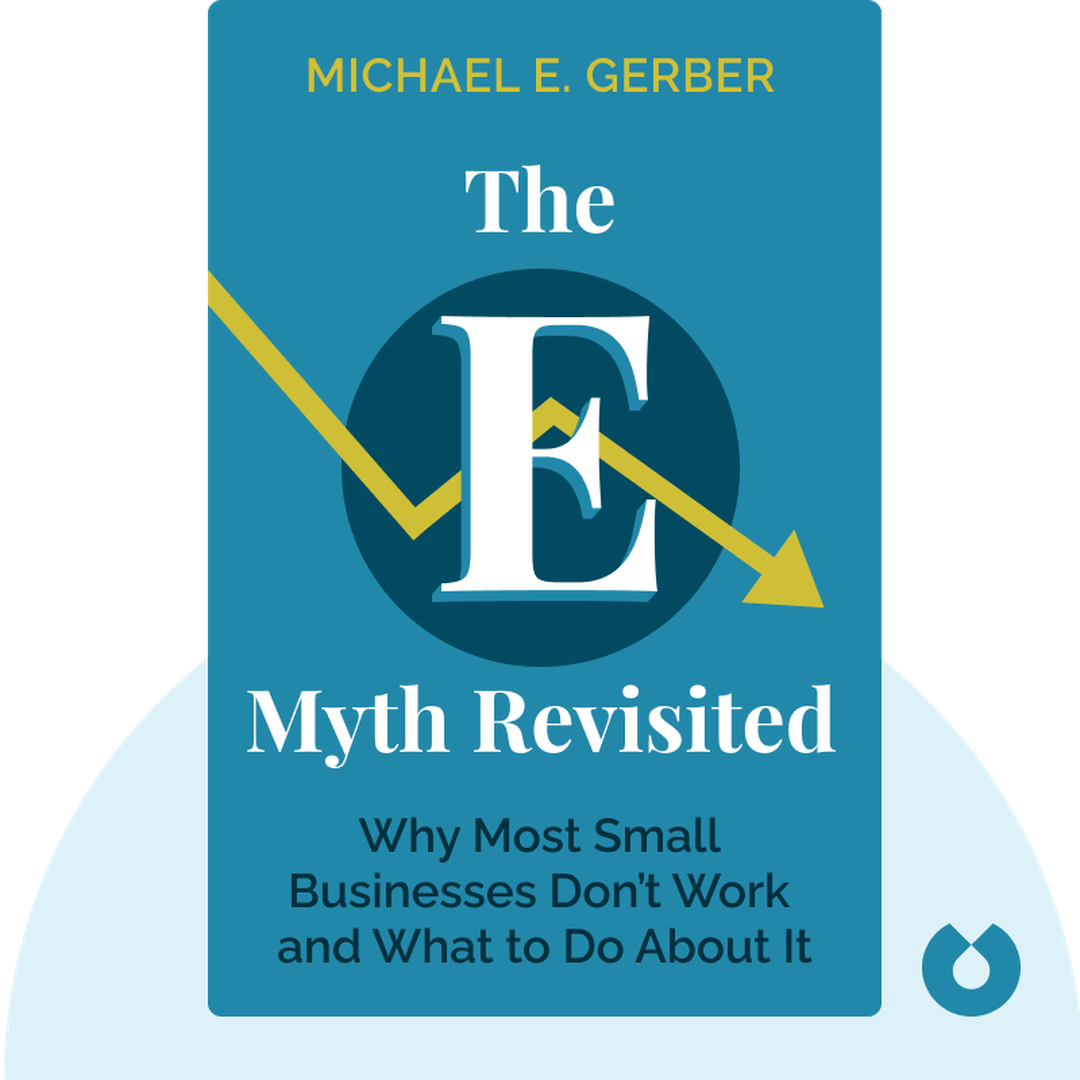
If You're Curious About These Questions...
You should listen to this audiobook
- Did you know that most people who start a business aren't actually entrepreneurs—and that this common misconception is the primary reason most small businesses fail?
- Have you ever wondered why working harder inside your business might actually be preventing it from growing, and what it really means to work "on" it instead?
- What if you could build a business that runs perfectly without you, using the same secret that makes the world's most successful franchises thrive?
Listen to The E-Myth Revisited — Cinematic Audio Edition
Loading player...
Key Takeaways from The E-Myth Revisited
- Understand why relying solely on your technical skills is a fatal assumption that turns your passion into an exhausting chore instead of a successful business.
- Discover the three internal personalities battling for control of your workflow—the Entrepreneur, the Manager, and the Technician—and why balancing them is crucial.
- Learn how to avoid the trap of the business infancy stage, where relying entirely on your own labor creates a stressful job rather than a sustainable enterprise.
- Find out how to successfully navigate the adolescence stage of your business by effectively managing growth and delegating tasks instead of simply abandoning responsibilities.
- Master the entrepreneurial model by focusing on how your business operates rather than what it sells, allowing you to build a mature, scalable system for the future.
Learning Tools
Reinforce what you learned from The E-Myth Revisited
Mind Map
The E-Myth Revisited
The E-Myth (The Problem)+
Business Lifecycle+
The Turn-Key Revolution+
Strategic Foundation+
Operational Strategies+
Continuous Development Process+
Core Philosophy+
Quiz — Test Your Understanding
Question 1 of 10
What is the 'E-Myth' (entrepreneurial myth) according to the book?
Question 2 of 10
What common trap do business owners fall into during the 'adolescent' stage of their business?
Question 3 of 10
According to the book, which of the three internal business personalities is described as the pragmatic one who craves order and sees problems to fix?
Question 4 of 10
What is the core concept behind the 'turn-key revolution'?
Question 5 of 10
How should a successful franchise prototype deliver value to its customers?
Question 6 of 10
What is the primary purpose of defining your 'primary aim' before starting a business?
Question 7 of 10
Why does the book argue that organizational charts and position contracts are crucial, even for a one-person business?
Question 8 of 10
What is the secret to a great management strategy according to the author?
Question 9 of 10
In a business's systems strategy, what do 'soft systems' refer to?
Question 10 of 10
What are the three continuous steps of the business development process?
The E-Myth Revisited — Full Chapter Overview
- 1Recommendation
- 2The notion that a skilled founder with a big idea quickly wins in business is mythical indeed.
- 3Often, an entrepreneur’s venture won’t survive beyond adolescence.
- 4To grow your venture beyond the adolescent stage, you must plan ahead from day one carefully.
- 5Within, everyone carries multiple distinct business personalities.
- 6An active revolution in small business now offers a reliable path to success.
- 7Imagine your small business will grow into a national chain; now, build the very first site today.
- 8Build a business that fulfills your personal aim in life.
- 9Organizational charts are vital to your business’s growth and establishing accountability.
- 10For managing employees, don’t depend on star talent – depend on a strong people-management system instead.
- 11Next, set aside everything and focus on the customer.
- 12In the end, you will own a business built of fully functional systems.
- 13This cycle of planning and implementation never ends.
The E-Myth Revisited Summary & Overview
In a revised and updated version of his famous book The E-Myth, author Michael Gerber cuts through various myths about what’s involved in starting a small business and how to make a business successful. Walking you through every stage of how to build a business, The E-Myth Revisited highlights the important difference between working in your business and working on your business.
Who Should Listen to The E-Myth Revisited?
- Anyone who owns or wants to own a small business
- Business owners trying to turn their struggling business into a successful one
- Anyone who thinks entrepreneurship is easy
Books Similar to The E-Myth Revisited
Readers who enjoyed this also liked these titles.