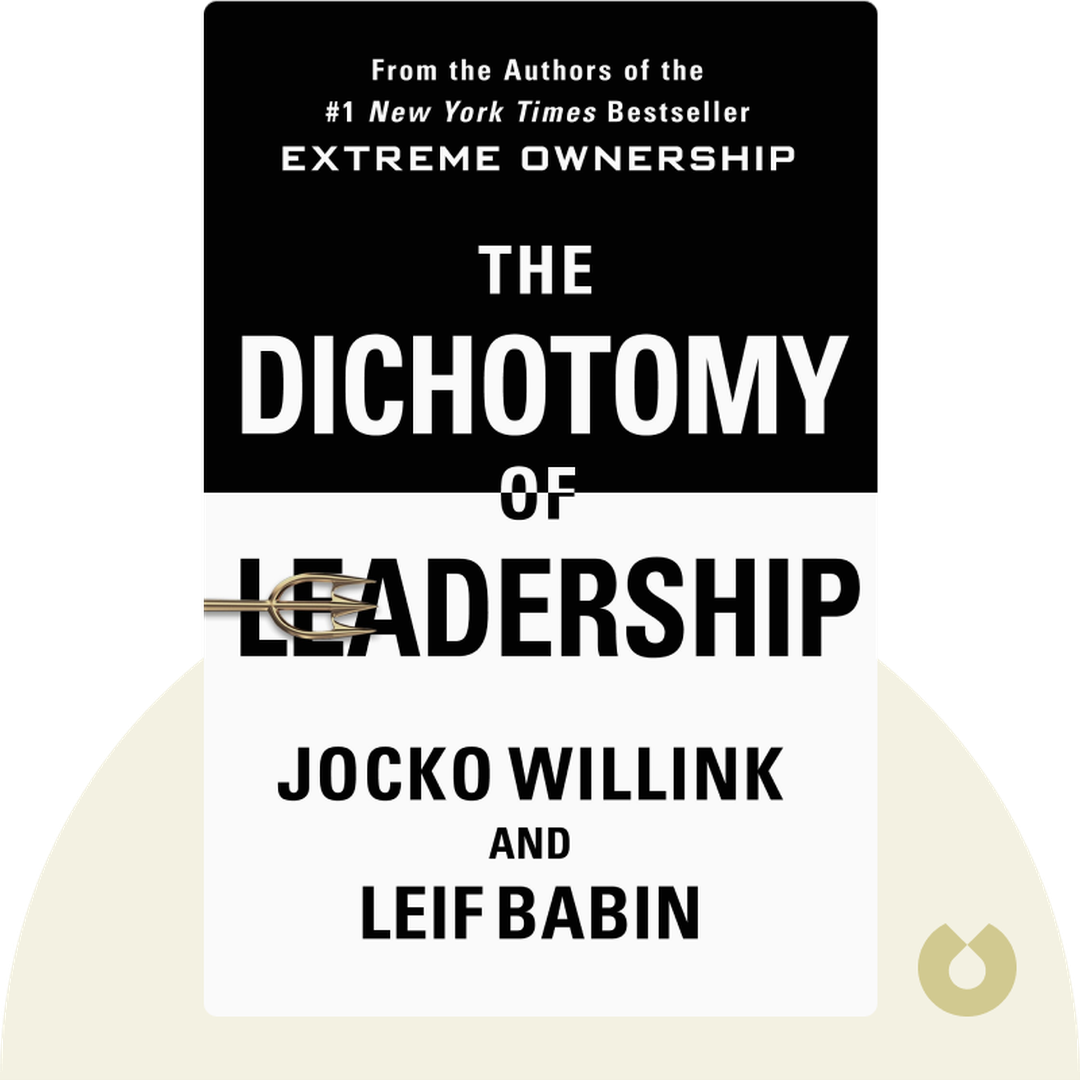
The Dichotomy of Leadership
Start ListeningDownload Try free on iPhoneScan to start in 5 seconds
Categories:
If You're Curious About These Questions...
You should listen to this audiobook
- What’s the secret to knowing exactly when to take charge and when to step back so your team can lead themselves?
- Have you ever wondered why the very leadership traits that make you successful can become your greatest weaknesses if taken to the extreme?
- Are you curious about how Navy SEAL commanders find the perfect balance between being aggressive enough to win and cautious enough to survive?
Listen to The Dichotomy of Leadership — Free Audiobook
Loading player...
Key Takeaways from The Dichotomy of Leadership
- Understand why strong leadership is rarely an extreme, but rather a constant tightrope walk balancing assertiveness with restraint and discipline with freedom.
- Discover how to use trust as your most potent leadership currency by giving your team the room to make decisions, act on instincts, and take real ownership of outcomes.
- Learn how to avoid becoming a bottleneck during chaotic moments by delegating effectively and trusting your team instead of trying to solve multiple problems personally.
- Master the practice of radical accountability by owning your outcomes and admitting mistakes out loud, creating a safe environment where teams can be honest and adapt faster.
- Find out how to strike a productive harmony in decision-making by making decisive, clear calls while still leaving open space for creativity and human judgment.
Learning Tools
Reinforce what you learned from The Dichotomy of Leadership
Mind Map
The Dichotomy of Leadership
Core Premise+
Care vs. Sacrifice+
Leadership Capital+
Direction vs. Empowerment+
Leading vs. Following+
Planning vs. Overplanning+
Details vs. Big Picture+
Humility vs. Firmness+
Quiz — Test Your Understanding
Question 1 of 7
What is described as the 'ultimate dichotomy of leadership' in the book?
Question 2 of 7
How does Jocko Willink recommend leaders handle their 'leadership capital'?
Question 3 of 7
When team members resist a new procedure, such as offsite technicians refusing to properly use data entry software, what is the recommended leadership approach?
Question 4 of 7
Why did Leif Babin ultimately defer to a lower-ranking officer, Kyle, during a mission to secure a building in Ramadi?
Question 5 of 7
What is the authors' recommended approach to planning a mission or business operation?
Question 6 of 7
How did Babin's 'big-picture' detachment prevent a tragedy during a room-clearing operation with an Iraqi army unit?
Question 7 of 7
According to the final summary, what is the dichotomy regarding a leader's humility?
The Dichotomy of Leadership — Full Chapter Overview
- 1Recommendation
- 2Care for every team member, yet accept you may sometimes have to sacrifice one to protect the entire team.
- 3Spend your leadership capital only on what truly matters most.
- 4Show your team the why instead of smothering them with directives.
- 5To become a good leader, first learn to be a good follower.
- 6While it is vital to plan, overplanning is often counterproductive.
- 7Know the mission’s specific details, yet remain detached enough that you can still see the big picture clearly.
The Dichotomy of Leadership Summary & Overview
The Dichotomy of Leadership (2018) chronicles the extraordinary experiences of two ex-Navy SEAL commanders. While stationed in Baghdad and Ramadi during the Iraq War, Jocko Willink and Leif Babin collected experiences which helped them become effective leaders. After returning to civilian life, they realized these leadership skills were equally effective in the business world. They figured out that, in both combat and non-combat contexts, you can only overcome the dichotomies of leadership and effectively run an organization by finding a sense of balance between opposing forces.
Who Should Listen to The Dichotomy of Leadership?
- Business leaders looking to up their leadership chops
- Anyone interested in the valuable lessons war can teach us
- Military buffs looking for riveting accounts of close combat and guerilla warfare
Books Similar to The Dichotomy of Leadership
Readers who enjoyed this also liked these titles.