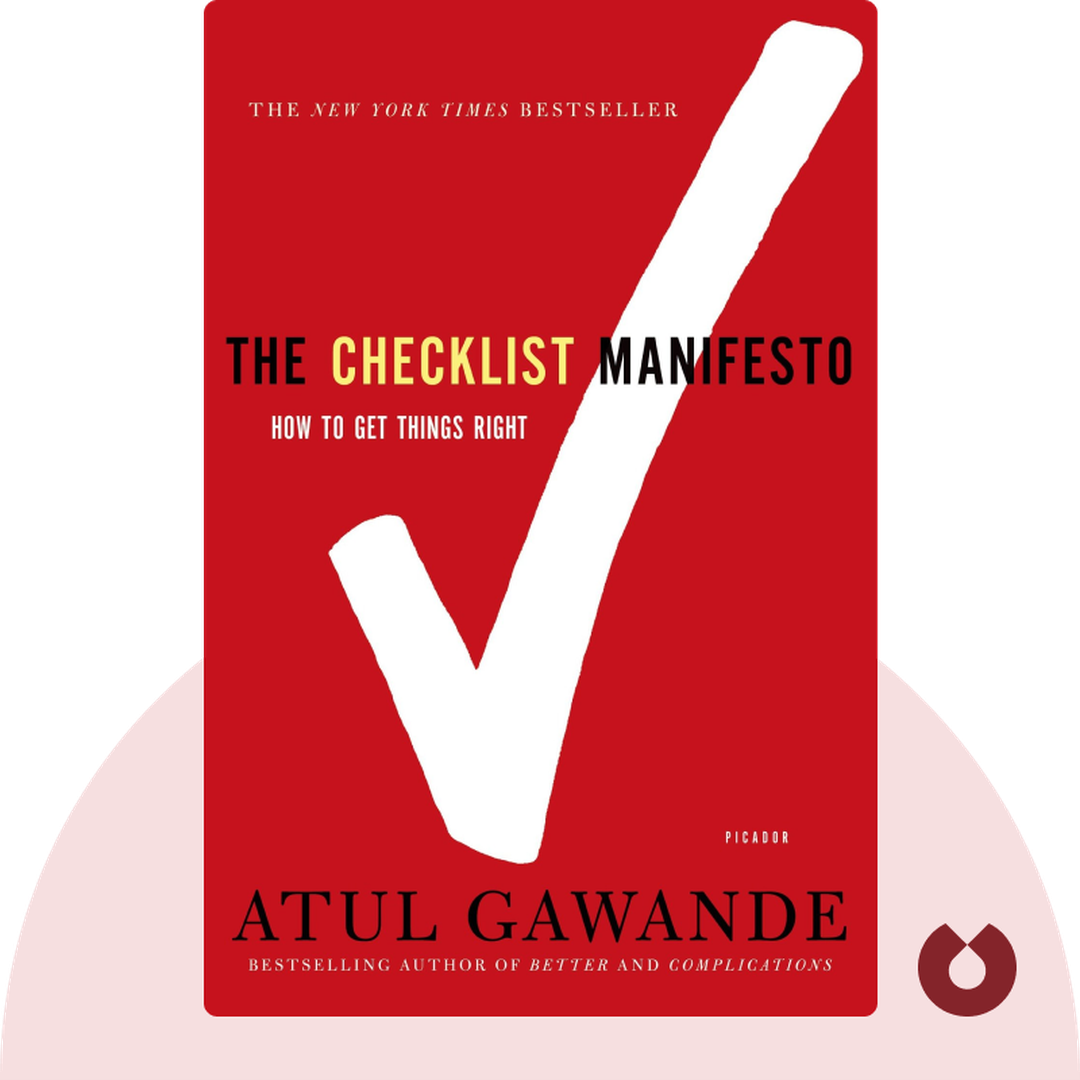
The Checklist Manifesto
Start ListeningDownload Try free on iPhoneScan to start in 5 seconds
Categories:
If You're Curious About These Questions...
You should listen to this audiobook
- Have you ever wondered why even the most elite experts, from world-class surgeons to veteran pilots, still make avoidable, high-stakes mistakes?
- What if the secret to mastering extreme complexity and reducing human error was a tool so simple you might be overlooking it?
- Are you curious about how a basic structural change in your workflow could prevent failure and revolutionize your professional success?
Listen to The Checklist Manifesto — Cinematic Audio Edition
Loading player...
Key Takeaways from The Checklist Manifesto
- Understand why 'necessary fallibility' and human ineptitude are the true culprits behind modern mistakes, even when you possess the right knowledge and skills.
- Discover how implementing a deceptively simple checklist can help you manage overwhelming complexity and ensure critical tasks are completed in the correct order.
- Learn from the aviation industry's history how simplifying processes with step-by-step lists is highly effective at preventing fatal human errors.
- Master the practice of using checklists to build essential discipline, forcing yourself to pause and think twice before executing high-stakes actions.
- Find out how something as basic as a checklist can drastically improve performance, just as it dropped intensive care unit infection rates by an astounding 66 percent.
Learning Tools
Reinforce what you learned from The Checklist Manifesto
Mind Map
The Checklist Manifesto
The Problem of Complexity+
The Power of Checklists+
Designing Effective Checklists+
Enhancing Team Communication+
Proven Results Across Industries+
Quiz — Test Your Understanding
Question 1 of 7
According to the text, why has the vast expansion of medical knowledge become a 'double-edged sword' for modern doctors?
Question 2 of 7
What is the primary psychological and practical benefit of using a checklist during a complex procedure?
Question 3 of 7
Based on the advice of aviation checklist creator Daniel Boorman, what is a key characteristic of an effective checklist?
Question 4 of 7
To avoid confusion during execution, the text suggests that checklist creators should clearly distinguish between which two types of checklists?
Question 5 of 7
Why was the team 'huddle' included as a mandatory step in the Safe Surgery Saves Lives program checklist?
Question 6 of 7
What was the result of the World Health Organization's 'Safe Surgery Saves Lives' program when tested in eight hospitals around the world?
Question 7 of 7
How does the anonymous investor 'Cook' utilize checklists in the field of finance?
The Checklist Manifesto — Full Chapter Overview
- 1Recommendation
- 2Checklists help prevent serious but avoidable mistakes.
- 3Checklists should be brief, cover every essential step, and avoid misunderstandings.
- 4Today’s complex tasks can’t rely on a lone expert hero; they require teams.
- 5Team communication is crucial in complex situations and can be strengthened by a checklist.
- 6Medical checklists have already saved many lives.
- 7Checklists can work effectively in many different settings.
- 8Final summary
The Checklist Manifesto Summary & Overview
Drawing from his experience as a general surgeon, Atul Gawande’s The Checklist Manifesto (2009) reveals startling evidence on how using a simple checklist can significantly reduce human error in complex professions such as aviation, engineering and medicine.
Who Should Listen to The Checklist Manifesto?
- Anyone who is looking for a simple, effective method for doing things correctly
- Anyone who works in complex or high-pressure environments
- Surgeons and medical professionals
Books Similar to The Checklist Manifesto
Readers who enjoyed this also liked these titles.