If You're Curious About These Questions...
You should listen to this audiobook
- What casino-style psychological trick do social media platforms intentionally use to hijack our dopamine systems and keep us endlessly scrolling?
- How did Facebook's decision to push users beyond their natural cognitive capacity for relationships—known as the Dunbar limit—inadvertently turn the internet into a hostile and radicalized 'outrage machine'?
- Why does our deep-rooted evolutionary instinct for moral outrage, which once kept small ancient communities safe, now fuel disproportionate viral shaming and real-world chaos online?
Listen to The Chaos Machine — Free Audiobook
Loading player...
Key Takeaways from The Chaos Machine
- Social media addiction is not a personal failure, but the result of intentional design using intermittent variable reinforcement, much like casino slot machines.
- By algorithmically forcing users past the cognitive 'Dunbar limit' of 150 social connections, platforms trigger evolutionary instincts that increase aggression and distrust.
- Algorithms exploit our natural inclination for moral outrage, turning a psychological mechanism meant for maintaining local social order into a viral tool for disproportionate public punishment.
- The unchecked amplification of extreme content and misinformation to maximize engagement has directly fueled severe real-world consequences, from the January 6 Capitol siege to global violence.
- Internal leaks confirm that tech giants are fully aware of the harm their platforms cause but consistently prioritize profit over safety, suggesting that disabling algorithmic feeds may be the only viable solution.
Learning Tools
Reinforce what you learned from The Chaos Machine
Mind Map
The Chaos Machine
Psychological Exploitation+
Breaking Cognitive Limits+
Weaponizing Moral Outrage+
Real-World Consequences+
Corporate Complicity & Solutions+
Quiz — Test Your Understanding
Question 1 of 6
According to the text, what specific psychological technique do social media platforms use to keep users addicted, similar to how slot machines work?
Question 2 of 6
What is the 'Dunbar limit' mentioned in the context of Facebook's 2013 strategy to boost user engagement?
Question 3 of 6
Why do social media algorithms often lead users from benign groups (like parenting forums) into extreme conspiracies?
Question 4 of 6
How does the text explain the intense 'moral outrage' frequently seen on social media platforms?
Question 5 of 6
What did the internal documents shared by Facebook whistleblower Frances Haugen reveal about the company?
Question 6 of 6
Why does the author compare social media to the computer HAL from the film '2001: A Space Odyssey'?
The Chaos Machine — Full Chapter Overview
- 1Recommendation
- 2Exploiting our psychological vulnerabilities
- 3Pushing beyond our social boundaries
- 4Outrage and retribution
- 5Tangible consequences in the real world
- 6Is it time to shut down the machine?
The Chaos Machine Summary & Overview
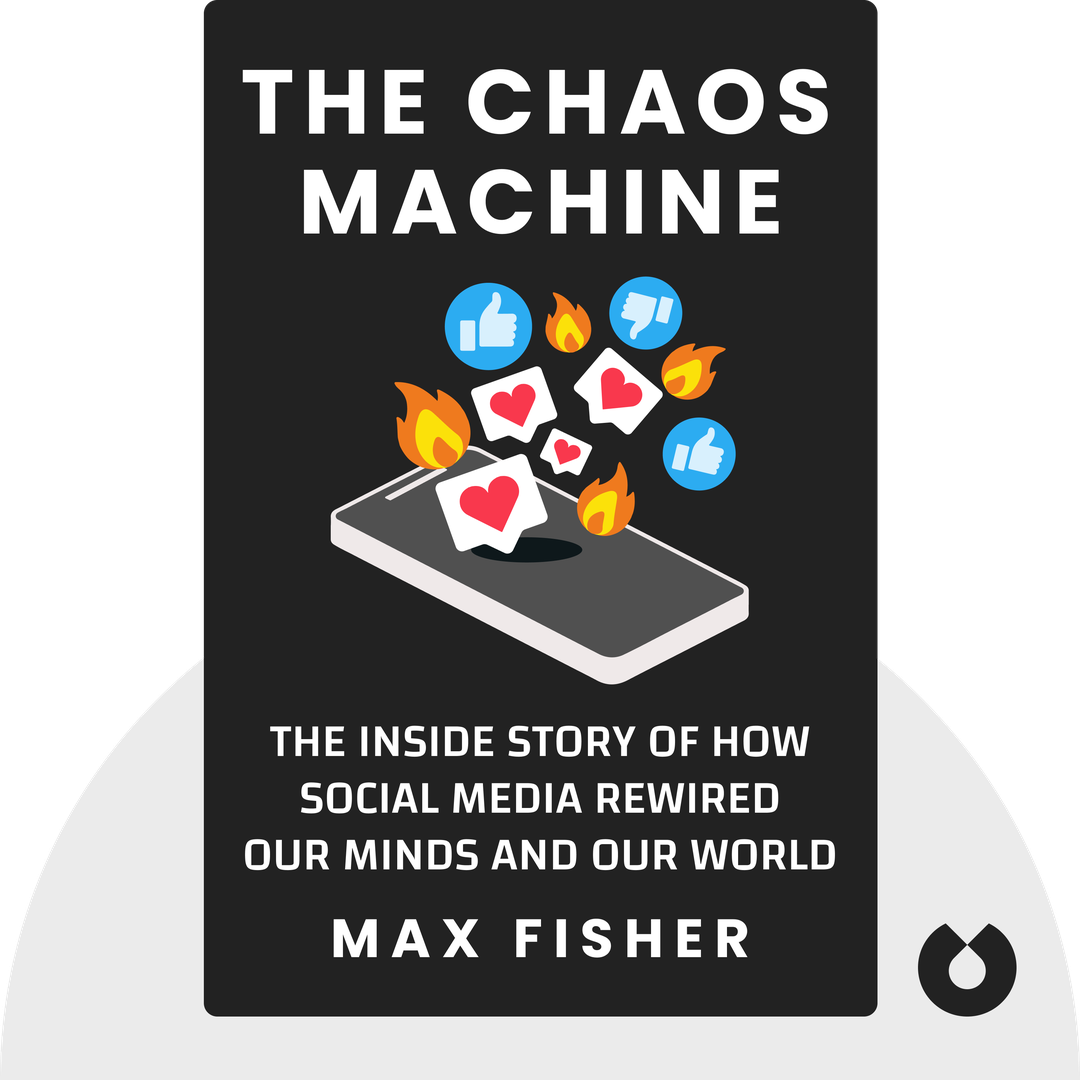
The Chaos Machine (2022) explores the dark side of social media. The design of apps like Facebook and Twitter, combined with the nature of human psychology, often make social media bring out the worst in us.
Who Should Listen to The Chaos Machine?
- Social media addicts
- People concerned about the negative effects of social media
- Anyone interested in psychology
Books Similar to The Chaos Machine
Readers who enjoyed this also liked these titles.