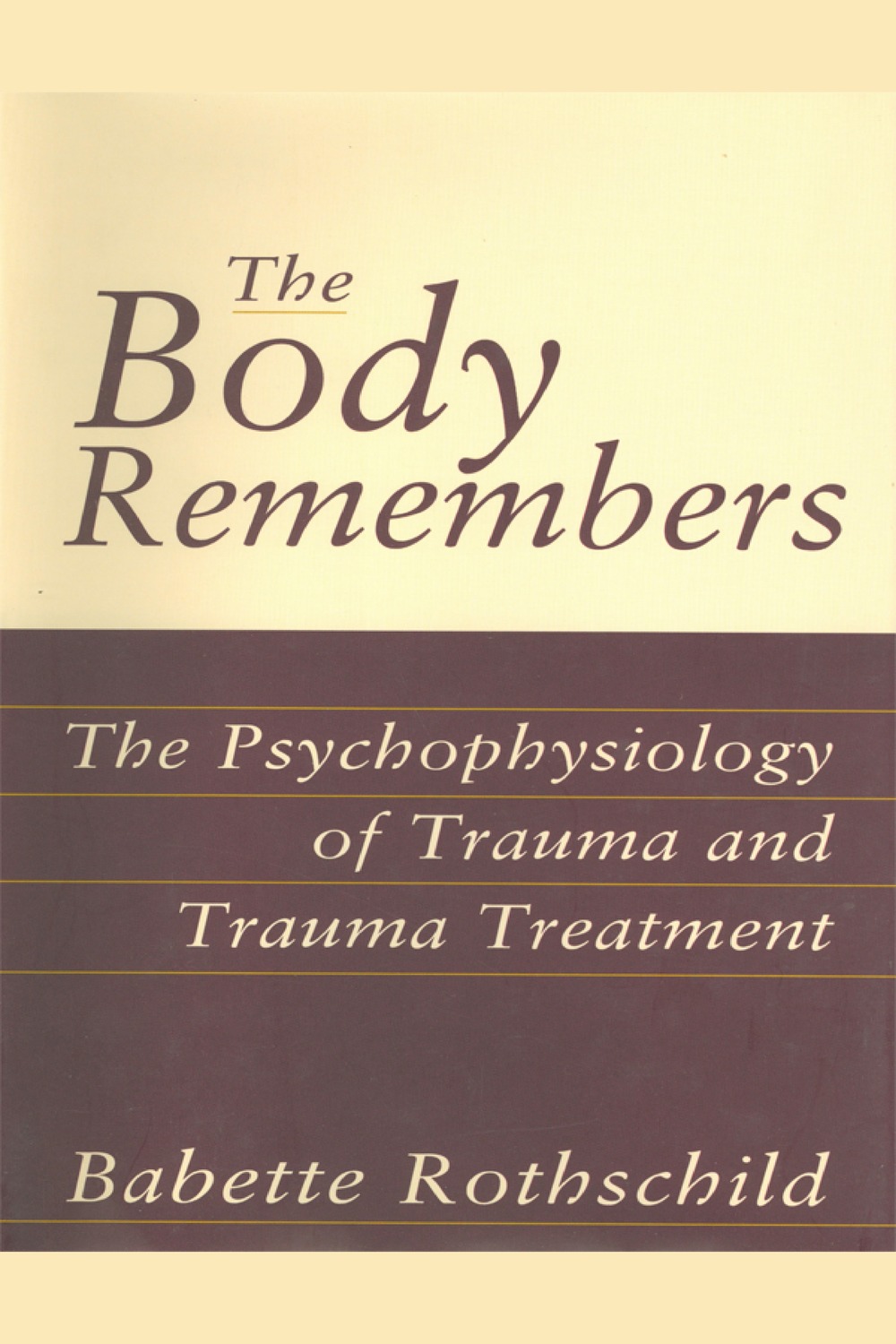
The Body Remembers: The Psychophysiology of Trauma and Trauma Treatment audiobook cover - Trauma can persist as a racing heart, frozen muscles, or inexplicable panic long after danger has passed. Babette Rothschild connects these bodily reactions to memory and shows why safe recovery begins with stability, awareness, and control rather than forced recollection.
Theme Song

The Body Remembers: The Psychophysiology of Trauma and Trauma Treatment

Trauma can persist as a racing heart, frozen muscles, or inexplicable panic long after danger has passed. Babette Rothschild connects these bodily reactions to memory and shows why safe recovery begins with stability, awareness, and control rather than forced recollection.

Babette Rothschild

★ 4.3 / 5(2,541 ratings on Goodreads)
Start Listening

If You're Curious About These Questions...

You should listen to this audiobook

Listen to The Body Remembers: The Psychophysiology of Trauma and Trauma Treatment — Cinematic Audio Edition

Loading player...

Key Takeaways from The Body Remembers: The Psychophysiology of Trauma and Trauma Treatment

Learning Tools

Reinforce what you learned from The Body Remembers: The Psychophysiology of Trauma and Trauma Treatment

Mind Map

The Body Remembers
Trauma as a Mind-Body Experience+
When the Alarm Outlives Danger+
Two Kinds of Memory+
The Language of Sensation+
Safety Before Memory Work+
Turning the Body into an Ally+
Careful Meaning-Making and Integration+

Quiz — Test Your Understanding

Question 1 of 13
What central question does the book propose asking instead of why a traumatized person cannot simply move on?
  • A. Which forgotten event must the person recover?
  • B. What is the nervous system still trying to accomplish?
  • C. Which diagnosis best explains the person's behavior?
  • D. Why is the person unwilling to confront the past?
Question 2 of 13
What does Charlie's reaction to the gentle dog Ruff primarily demonstrate?
  • A. Rational knowledge of safety always overrides conditioned fear
  • B. Avoidance occurs only when a person consciously remembers every detail of a trauma
  • C. The body can react as if mortal danger is present even when the mind recognizes safety
  • D. A trauma response necessarily indicates severe dysfunction in every area of life
Question 3 of 13
How does Rothschild interpret freezing or tonic immobility during an overwhelming threat?
  • A. As an automatic survival response when fighting or escaping seems unavailable
  • B. As evidence that the person silently consented to what happened
  • C. As a deliberate strategy chosen after careful reasoning
  • D. As a response caused mainly by an unwillingness to act
Question 4 of 13
According to the book's working model, how can overwhelming stress affect traumatic memory?
  • A. It prevents both emotional and sensory information from being encoded
  • B. It strengthens chronological memory while weakening emotional learning
  • C. It permanently erases the event from every memory system
  • D. It may disrupt context and sequence while emotional and sensory encoding continues
Question 5 of 13
Which example best illustrates state-dependent recall?
  • A. A person deliberately reviews a written timeline of an event
  • B. A rapid heartbeat during exercise activates sensations connected with an earlier trauma
  • C. A person learns to ride a bicycle through repeated practice
  • D. A witness recalls a fact after seeing a photograph of the location
Question 6 of 13
In Rothschild's framework, why is PTSD partly considered a disorder of memory integration?
  • A. All factual memories of trauma are necessarily lost
  • B. Explicit and implicit memories always become identical after trauma
  • C. Facts may remain disconnected from emotional resolution, or sensations may arise without context
  • D. Recovery requires replacing implicit memory with a completely new narrative
Question 7 of 13
What is the proper therapeutic response to a bodily sensation such as a rapid heartbeat?
  • A. Treat it as definitive proof that a traumatic memory is emerging
  • B. Assume it has the same emotional meaning for every person
  • C. Ignore it because bodily sensations are clinically unreliable
  • D. Investigate its meaning in context rather than assigning a fixed interpretation
Question 8 of 13
What does Rothschild mean by teaching the 'brake before the accelerator' in trauma therapy?
  • A. Clients should learn how to stop and regulate trauma work before pursuing intense memories
  • B. Therapists should suppress every sign of arousal before discussing emotions
  • C. Detailed memory recovery should occur before practical coping skills are taught
  • D. Treatment should move quickly so avoidance cannot become established
Question 9 of 13
How should therapy generally approach defenses such as withdrawal, dissociation, or anger?
  • A. Eliminate them immediately because they prevent all recovery
  • B. Respect their former protective role while adding safer alternatives
  • C. Reinforce them as the client's only reliable means of protection
  • D. Interpret them as proof that the client is resisting treatment
Question 10 of 13
When can an anchor function as a therapeutic brake?
  • A. When it directs the client to analyze the trauma's worst moment in greater detail
  • B. When it distracts the client permanently from all difficult emotions
  • C. When attention shifts to a concrete source of safety or strength until arousal decreases
  • D. When it proves that bodily awareness works equally well for every client
Question 11 of 13
What is the main purpose of dual awareness during trauma work?
  • A. To deny trauma-related fear whenever no external threat is visible
  • B. To hold awareness of trauma-related experience and present-day safety at the same time
  • C. To become completely absorbed in the past so the memory can be discharged
  • D. To replace bodily sensations with an exclusively intellectual account
Question 12 of 13
Why does Rothschild caution therapists against treating somatic memory as proof of a specific event?
  • A. Bodily sensations occur only in response to current medical conditions
  • B. Somatic memories are always less accurate than verbal memories
  • C. A sensation may be genuine even though the interpretation attached to it is mistaken
  • D. Trauma cannot be represented through pain, posture, or bodily impulses
Question 13 of 13
What ultimately helped Charlie place the dog attack in the past?
  • A. Exhaustively reliving every detail of the original attack
  • B. Avoiding all dogs until his physiological reactions disappeared
  • C. Accepting that his frozen response could never change
  • D. Regulating arousal, accurately perceiving Ruff, and discovering new defensive choices

The Body Remembers: The Psychophysiology of Trauma and Trauma Treatment — Full Chapter Overview

The Body Remembers: The Psychophysiology of Trauma and Trauma Treatment Summary & Overview

The Body Remembers connects the psychology of trauma with its physical effects. Babette Rothschild explains how the brain, autonomic nervous system, muscles, senses, and memory systems participate in posttraumatic stress. Through clinical cases, she shows why a harmless present-day cue can provoke sweating, paralysis, panic, or a flashback that feels like an immediate threat.

The book then turns from theory to clinical practice. Its central principle is safety: trauma work should never proceed faster than a client can remain oriented, functional, and emotionally contained. Rothschild presents non-touch methods involving body awareness, anchors, dual awareness, boundaries, muscle toning, and careful pacing. She also warns against suggestive memory work and one-size-fits-all techniques. Written primarily for clinicians, the book offers a practical framework for integrating bodily experience with verbal psychotherapy while respecting uncertainty, individual differences, and the client’s control over treatment.

Who Should Listen to The Body Remembers: The Psychophysiology of Trauma and Trauma Treatment?

  • Psychotherapists, counselors, and other clinicians who work with trauma or posttraumatic stress
  • Students seeking an accessible bridge between trauma neuroscience and clinical practice
  • Informed readers interested in how traumatic memory can appear through bodily sensations and behavior

About the Author: Babette Rothschild

Babette Rothschild is a psychotherapist, educator, and trauma specialist. At the time of this book’s publication, she drew on nearly three decades in psychotherapy and acknowledged the influence of clinicians and researchers including Lisbeth Marcher, Peter Levine, and Bessel van der Kolk. Her work emphasizes practical, body-aware trauma treatment that can be integrated with established therapeutic approaches.

🎧
Listen in the AppOffline playback & background play
Get App
The Body Remembers: The Psychophysiology of Trauma and Trauma TreatmentTheme Song
NOW PLAYING
The Body Remembers: The Psychophysiology of Trauma and Trauma Treatment

The Body Remembers: The Psychophysiology of Trauma and Trauma Treatment

Theme Song
0:000:00