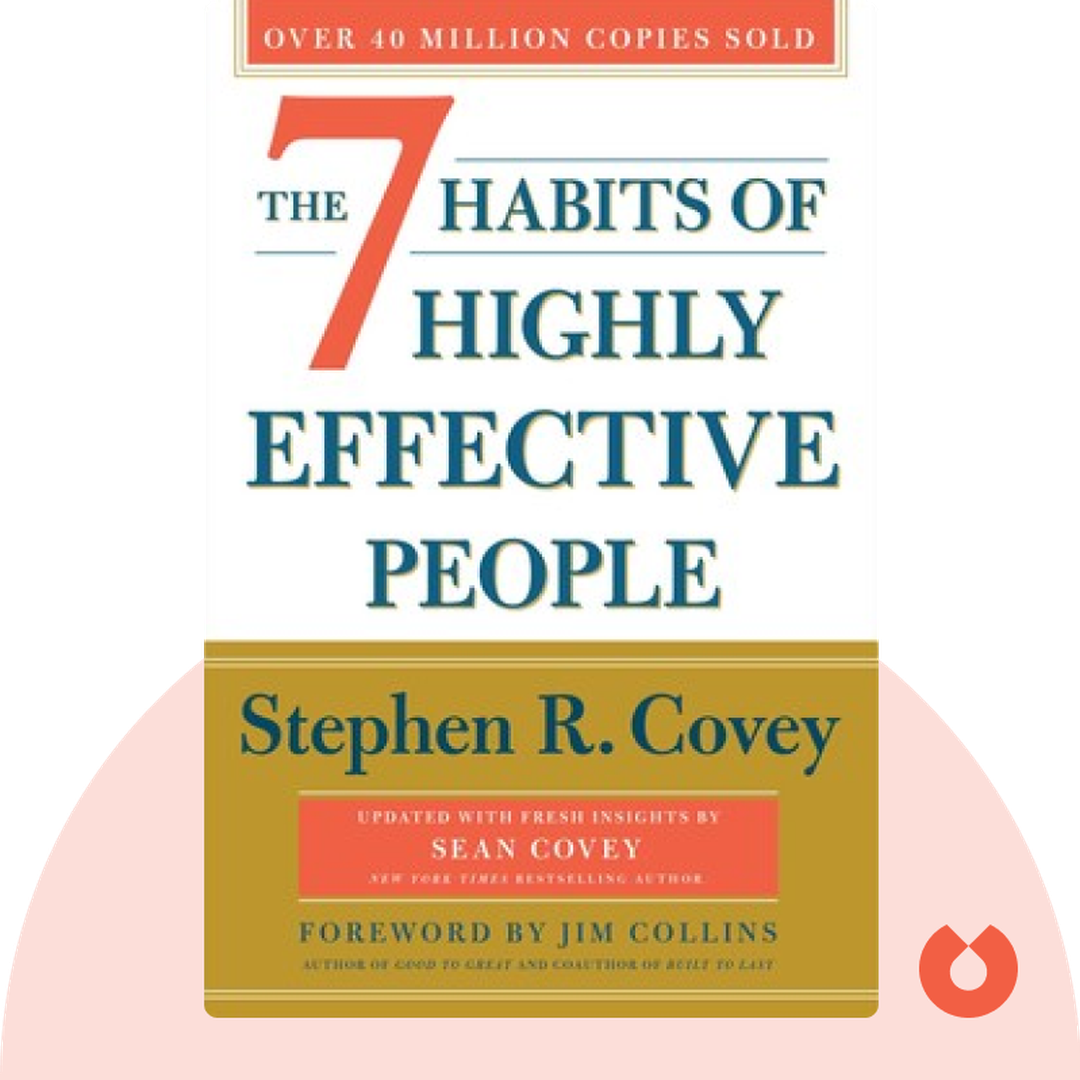
The 7 Habits of Highly Effective People
Start ListeningDownload Try free on iPhoneScan to start in 5 seconds
Categories:
If You're Curious About These Questions...
You should listen to this audiobook
- What's the secret to achieving a perfect balance between personal and professional life?
- Are you curious about the one habit that can revolutionize your relationships?
- What if you could identify and break free from the limiting patterns that hold you back from success?
Listen to The 7 Habits of Highly Effective People — Cinematic Audio Edition
Loading player...
Key Takeaways from The 7 Habits of Highly Effective People
- Understand why lasting change requires a shift from surface-level 'personality ethics' to deeper 'character ethics.' Discover how building habits based on your core values creates sustainable success from the inside out.
- Discover the power of paradigms and how your mental filters shape your reality, attitudes, and relationships. Learn to deliberately shift your perspective to transform your daily experiences and interactions.
- Master the 'power of the pause' between what happens to you and how you respond to it. Realize that true freedom lies in choosing your reaction rather than being controlled by external circumstances.
- Learn how to distinguish between your 'circle of concern' and your 'circle of influence.' Find out why focusing your energy only on what you can control naturally expands your power and effectiveness.
- Explore the seven core areas that shape a highly effective life, including prioritizing true goals, seeking mutual benefit, and maintaining renewal. Understand how practicing these skills slowly transforms your character and long-term outcomes.
Learning Tools
Reinforce what you learned from The 7 Habits of Highly Effective People
Mind Map
The 7 Habits of Highly Effective People
Foundational Paradigms+
Habit 1: Be Proactive+
Habit 2: Begin with the End in Mind+
Habit 3: Put First Things First+
Habit 4: Think Win-Win+
Habit 5: Seek First to Understand+
Habit 6: Synergize+
Habit 7: Sharpen the Saw+
Continuous Improvement+
Quiz — Test Your Understanding
Question 1 of 9
What is the primary difference between the 'Personality Ethic' and the 'Character Ethic' as described by Covey?
Question 2 of 9
How do highly effective people approach their response to the world, according to the first habit?
Question 3 of 9
What is the purpose of the 'funeral eulogy' mental exercise mentioned in the text?
Question 4 of 9
In the time management matrix, which quadrant deserves special attention because it yields the biggest efficiency payoffs over time?
Question 5 of 9
What mindset is essential for successfully cultivating a 'win-win' scenario?
Question 6 of 9
What does the optometrist metaphor illustrate about human communication?
Question 7 of 9
How does the text define 'synergy' in the context of human relations?
Question 8 of 9
What is the core message of the 'industrious lumberjack' parable?
Question 9 of 9
According to the seventh habit, which of the following is NOT one of the four dimensions of self-renewal?
The 7 Habits of Highly Effective People — Full Chapter Overview
- 1Recommendation
- 2To achieve success, we must adopt habits firmly rooted in sound principles.
- 3Proactively control your responses to the world around you.
- 4Start each task with a clear outcome.
- 5Prioritize first things first.
- 6Always seek out the win-win scenario.
- 7Strengthen relationships by genuinely understanding other people.
- 8Create powerful synergy by encouraging the free exchange of ideas.
- 9Make time to properly take care of yourself.
The 7 Habits of Highly Effective People Summary & Overview
The 7 Habits of Highly Effective People (1989) is perhaps one of the most celebrated self-help books of all time. This enormously influential guide presents a series of practical principles that will help you succeed in your personal and professional lives.
Who Should Listen to The 7 Habits of Highly Effective People?
- Professionals aspiring to fulfill their potential
- People looking to build stronger relationships
- Anyone seeking to understand a self-help classic
Books Similar to The 7 Habits of Highly Effective People
Readers who enjoyed this also liked these titles.