If You're Curious About These Questions...
You should listen to this audiobook
- Have you ever wondered why a single well-told story can be more persuasive than a mountain of data and spreadsheets?
- What’s the secret to uncovering the hidden stories in your daily life that can transform how you lead and motivate your team?
- What if you could master a simple framework to turn any business message into a compelling narrative that clients and colleagues will never forget?
Listen to Stories for Work — Free Audiobook
Loading player...
Key Takeaways from Stories for Work
- Discover why storytelling is the ultimate antidote to dull corporate presentations and the most authentic method to deliver your business message.
- Understand the neuroscience behind a great story, including how it triggers the 'trust hormone' oxytocin to build immediate rapport and security with your audience.
- Learn why human emotion drives decision-making, making emotionally driven pitches and campaigns almost twice as effective as those based on pure logic.
- Master the art of sharing 'tragedy' stories in the workplace to effectively communicate crucial lessons and reframe mundane topics like corporate safety.
- Find out how to strategically use 'triumph' stories to celebrate collective success, instill core company values, and highlight the achievements of your team.
Learning Tools
Reinforce what you learned from Stories for Work
Mind Map
Stories for Work
The Power of Storytelling+
Four Essential Story Types+
Finding Your Stories+
Structuring the Narrative+
Delivery and Content Principles+
Business Scenarios & Adaptability+
Quiz — Test Your Understanding
Question 1 of 10
According to the text, why is storytelling a more effective influencing technique than logical arguments?
Question 2 of 10
In a business context, what is the primary purpose of sharing a 'tragedy' story, such as the example of a manager's wife crashing her bike?
Question 3 of 10
Which of the four essential types of business stories focuses on major life changes and is best used to communicate skills like bravery, flexibility, or resilience?
Question 4 of 10
What does the author suggest is a key strategy for finding your own authentic stories?
Question 5 of 10
According to the book's adaptation of Aristotle's framework, what are the three essential sections of an impressive ending to a story?
Question 6 of 10
Why is embracing vulnerability considered a powerful storytelling device in business?
Question 7 of 10
How does the author characterize the use of humor in business storytelling?
Question 8 of 10
How can a company effectively utilize the 'grapevine' to its advantage?
Question 9 of 10
Why does the author warn against perfecting just one or two stories and becoming complacent?
Question 10 of 10
What is a recommended technique for cultivating emotional connections during the 'middle' of your story?
Stories for Work — Full Chapter Overview
- 1Recommendation
- 2Storytelling is ancient, yet companies are only now grasping its full potential and value.
- 3Powerful stories stir emotion, and science supports this claim.
- 4You must master four kinds of stories for business, with the first two being both tragedies and triumphs.
- 5Tension and transition are crucial to your storytelling toolkit.
- 6You possess many stories, hidden like treasure beneath the sea of your memory.
- 7Aristotle’s three-part structure remains the most effective framework for storytelling today.
- 8Powerful stories are concise, well practiced, embrace vulnerability, and use humor wisely.
- 9Stories suit many different scenarios in business well.
- 10It’s vital to pivot and adapt your stories for every scenario possible.
Stories for Work Summary & Overview
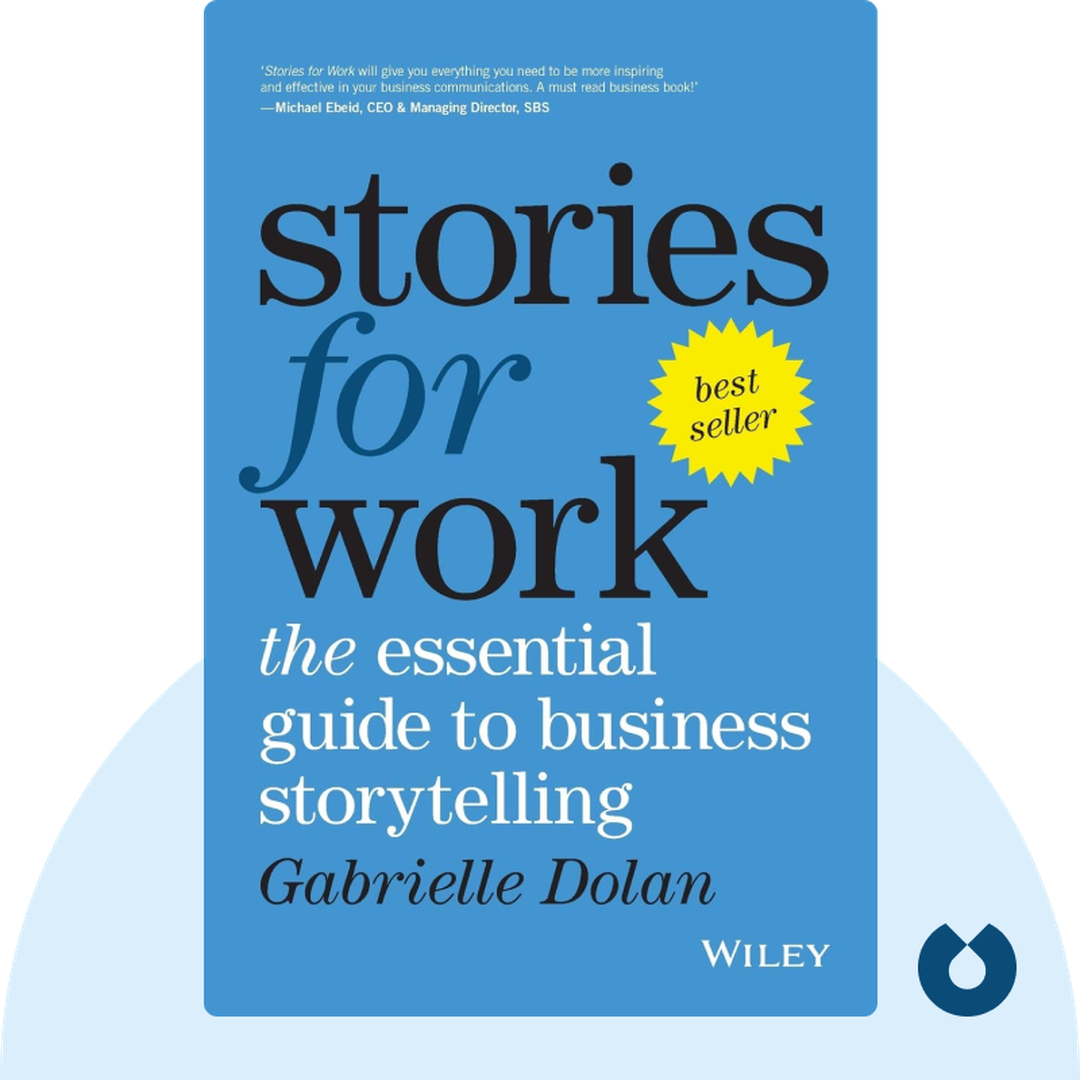
In Stories for Work (2017), Gabrielle Dolan explains the effectiveness of a powerful story, and how business professionals can harness this tool to communicate ideas, motivate employees, persuade clients and achieve goals. Dolan walks you through practical advice on coming up with your own stories, and how to apply them to a range of business scenarios.
Who Should Listen to Stories for Work?
- Anyone who wants to sharpen their communication skills
- People curious about the power of storytelling
- Professionals in “people-facing” roles
Books Similar to Stories for Work
Readers who enjoyed this also liked these titles.