If You're Curious About These Questions...
You should listen to this audiobook
- What's the secret to reprogramming your brain to default to happiness?
- Are you curious about the surprising formula that can guarantee a life of joy and fulfillment?
- Can you really engineer your own happiness by applying principles from the world's religions and science?
Listen to Solve for Happy — Cinematic Audio Edition
Loading player...
Key Takeaways from Solve for Happy
- Discover the ultimate Happiness Equation, which reveals that lasting joy relies on keeping your perception of events equal to or greater than your expectations of life.
- Understand why happiness is actually your default human state and how you can reclaim it by minimizing the mental interference caused by societal conditioning.
- Learn how to detach from the constant, fear-based chatter of your inner voice by recognizing that you are the observer of your thoughts, not the thoughts themselves.
- Master the ability to navigate life's unpredictability by letting go of the illusion of control and focusing instead on how you respond to chaotic outcomes.
- Find out how your brain's evolutionary negativity bias prioritizes survival over joy, and discover how to override these mental blind spots to prevent unnecessary suffering.
Learning Tools
Reinforce what you learned from Solve for Happy
Mind Map
Solve for Happy
The Happiness Equation+
The Six Grand Illusions+
The Seven Mental Blind Spots+
The Five Ultimate Truths+
Quiz — Test Your Understanding
Question 1 of 10
According to Mo Gawdat's happiness equation, when does happiness naturally arise?
Question 2 of 10
How does Gawdat view the fundamental nature of human happiness?
Question 3 of 10
Which of the following best describes Gawdat's perspective on the 'illusion of thought'?
Question 4 of 10
Why do our brains have built-in 'blind spots' that often sabotage our happiness today?
Question 5 of 10
What does Gawdat identify as the mental blind spot regarding how we use emotions and logic?
Question 6 of 10
Based on the study by Matt Killingsworth cited in the book, when are people generally the happiest?
Question 7 of 10
How does Gawdat apply the Taoist concept of 'wu wei' to the ultimate truth of change?
Question 8 of 10
Why does Gawdat consider unconditional love to be an 'engine for happiness'?
Question 9 of 10
What profound realization did Gawdat reach following the tragic death of his son, Ali?
Question 10 of 10
How does Gawdat approach the idea of 'design' in the universe as his fifth ultimate truth?
Solve for Happy — Full Chapter Overview
- 1Recommendation
- 2The Happiness Formula and the Power of Perception
- 3Six Grand Illusions That Distort How We See
- 4Mental Blind Spots: How Our Minds Mislead Us
- 5Anchoring Happiness Within the Present Moment
- 6Embracing Life’s Flow and the Strength of Unconditional Love
- 7Mortality, Meaning, and the Enigma of Design
Solve for Happy Summary & Overview
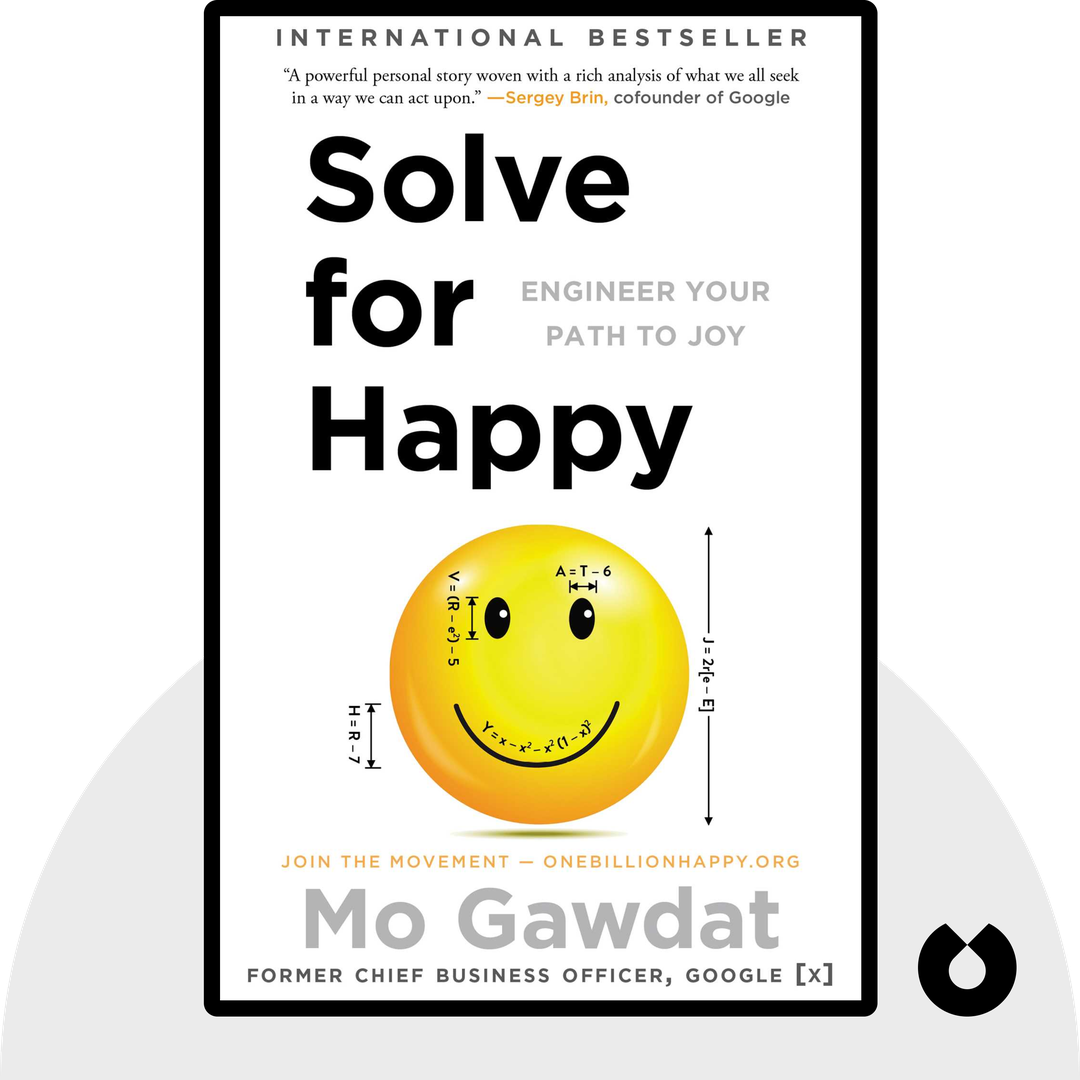
Solve for Happy (2017) is the result of former Chief Business Officer at Google X, Mo Gawdat’s highly personal journey to understand the nature of happiness and how to achieve it. By borrowing ideas from many of the world’s religions and applying his own analytical mind to the problem, Gawdat arrives at a formula for happiness.
Who Should Listen to Solve for Happy?
- Those trying to find a happiness deeper than simple success
- Anyone who wants to understand why reality can be so confusing
- People looking for a life-affirming example of strength in the face of tragedy
Books Similar to Solve for Happy
Readers who enjoyed this also liked these titles.