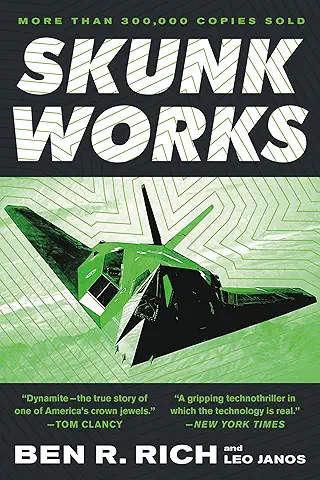
Skunk Works: A Personal Memoir of My Years at Lockheed audiobook cover - From a blistering Nevada missile test where a “stealth” jet refuses to appear on radar, to secret CIA airfields and Mach 3 spy planes, Ben Rich recounts how a small band of engineers repeatedly bent physics—and bureaucracy—to change modern warfare.

Skunk Works: A Personal Memoir of My Years at Lockheed

From a blistering Nevada missile test where a “stealth” jet refuses to appear on radar, to secret CIA airfields and Mach 3 spy planes, Ben Rich recounts how a small band of engineers repeatedly bent physics—and bureaucracy—to change modern warfare.

Ben R. Rich (with Leo Janos)

4.5 / 5(6 ratings)
Start ListeningDownloadQR code that opens AudiobookHub on the App StoreTry free on iPhoneScan to start in 5 seconds

If You're Curious About These Questions...

You should listen to this audiobook

Listen to Skunk Works: A Personal Memoir of My Years at Lockheed — Free Audiobook

Loading player...

Key Takeaways from Skunk Works: A Personal Memoir of My Years at Lockheed

Learning Tools

Reinforce what you learned from Skunk Works: A Personal Memoir of My Years at Lockheed

Mind Map

Oceanofpdf.Com Skunk Works A Personal Memoir Of My Years Ben R Rich
Leadership & Skunk Works Culture+
Early Cold War Miracles+
The Genesis of Stealth+
Proving the Concept (Have Blue)+
Developing the F-117 Weapon+
Operations and Combat+
Beyond Aircraft+

Quiz — Test Your Understanding

Question 1 of 9
What was the result of the test involving Marine Hawk missiles trying to track the experimental airplane 'Have Blue'?
  • A. The radar locked on quickly, proving the initial stealth concepts required a major redesign.
  • B. The radar dish didn't move and failed to lock onto the target, even though the flight plan was provided.
  • C. The radar identified it as a commercial airliner due to its massive radar cross-section.
  • D. The missiles fired automatically but lost track of the aircraft mid-flight.
Question 2 of 9
When Ben Rich took over the Skunk Works from Kelly Johnson in 1975, how did his leadership approach differ from Johnson's?
  • A. He ruled strictly by intimidation and insisted on making every technical decision himself.
  • B. He immediately opened the facilities to public tours to secure better funding.
  • C. He delegated hard decisions to department heads and protected them from outside politics.
  • D. He integrated the Skunk Works with Lockheed's commercial L-1011 division.
Question 3 of 9
What mathematical and computational breakthrough enabled Denys Overholser to design the 'Hopeless Diamond'?
  • A. Developing AI algorithms to continuously calculate perfectly smooth aerodynamic 3D curves.
  • B. Breaking shapes into flat triangles, a process known as 'faceting,' to predict radar reflection.
  • C. Using Soviet wind-tunnel data to create stealthy heat-resistant curves.
  • D. Developing a formula for a new radar-absorbing paint that completely negated radar pulses.
Question 4 of 9
What surprising problem did Lockheed face while testing their faceted stealth model at the White Sands test range?
  • A. The model generated so much electronic interference that it jammed the range's sensors.
  • B. The supposedly 'invisible' pole holding the model was actually more detectable than the stealth model itself.
  • C. The radar operators refused to conduct the test because the design looked aerodynamically unsafe.
  • D. The model reflected radar waves so intensely that it damaged the testing equipment.
Question 5 of 9
What technology was critical for keeping the highly unstable 'Hopeless Diamond' airframe flying straight?
  • A. Massive vertical stabilizing fins borrowed from bombers.
  • B. An advanced gyroscope system mounted in the nose.
  • C. Fly-by-wire computer controls that constantly corrected the airframe.
  • D. Symmetrical thrust-vectoring engines.
Question 6 of 9
Which standard Pentagon procurement rule was abandoned to quickly develop the F-117 stealth fighter?
  • A. Fixed-price contracts
  • B. Fly before you buy
  • C. Lowest bidder wins
  • D. Cost-plus accounting
Question 7 of 9
How did F-117 pilots and crews adapt to the extreme secrecy requirements at the Tonopah Test Range?
  • A. They lived like nocturnal creatures, sleeping during the day and flying strictly at night with minimal emissions.
  • B. They disguised the F-117s as commercial airliners during the day.
  • C. They conducted all flights exclusively underground in large subterranean tunnels.
  • D. They relocated to remote bases in Antarctica for testing.
Question 8 of 9
Before leading the Skunk Works, what was Ben Rich's primary role during the development of the Mach 3 Blackbird?
  • A. He was the chief test pilot for extreme altitude flights.
  • B. He managed the CIA funding and congressional oversight.
  • C. He was the propulsion lead, fighting problems like inlet shock management and engine 'unstarts'.
  • D. He designed the titanium wings and fuselage structure.
Question 9 of 9
According to Ben Rich in the closing chapters, what does he believe can crush innovation and inflate costs in aerospace development?
  • A. Over-reliance on small, rapid-prototyping teams.
  • B. Excessive regulation, audits, and paperwork.
  • C. Trusting shop workers to push back on engineering designs.
  • D. Ignoring the commercial aviation market.

Skunk Works: A Personal Memoir of My Years at Lockheed — Full Chapter Overview

Skunk Works: A Personal Memoir of My Years at Lockheed Summary & Overview

Skunk Works is Ben R. Rich’s inside account of Lockheed’s legendary Advanced Development Projects—an intensely secret, small-team engineering shop that built some of America’s most consequential aircraft: the U-2, the SR-71 Blackbird, and the F-117 stealth fighter.

Rich traces the Skunk Works culture created by Clarence “Kelly” Johnson—fast schedules, minimal bureaucracy, hard honesty, and relentless problem-solving—and shows how those principles collided with politics, security restrictions, and shifting Pentagon priorities. Along the way, the book explains (in plain language) the breakthroughs behind stealth shaping, radar cross section, fly-by-wire stability, and the tradeoffs that decide whether a revolutionary idea becomes an operational weapon.

It’s both an innovation memoir and a case study in high-stakes research-and-development: building prototypes under extreme secrecy, winning (and losing) billion-dollar programs, and learning which management rules actually work when the mission is “do the impossible—quickly.”

Who Should Listen to Skunk Works: A Personal Memoir of My Years at Lockheed?

  • Listeners who love aviation, Cold War history, and the behind-the-scenes story of the U-2, SR-71, and stealth.
  • Engineers, product leaders, and founders looking for real-world lessons on building breakthrough technology under constraints.
  • Anyone curious how government secrecy, budgets, and bureaucracy shape what gets built—and what never does.

About the Author: Ben R. Rich (with Leo Janos)

Ben R. Rich (1925–1995) was an engineer and longtime Lockheed executive who succeeded Clarence “Kelly” Johnson as head of Lockheed’s Skunk Works. With co-author Leo Janos, he documented the Skunk Works’ secret development programs and management culture, including the development of early stealth aircraft.

🎧
Listen in the AppOffline playback & background play
Get App