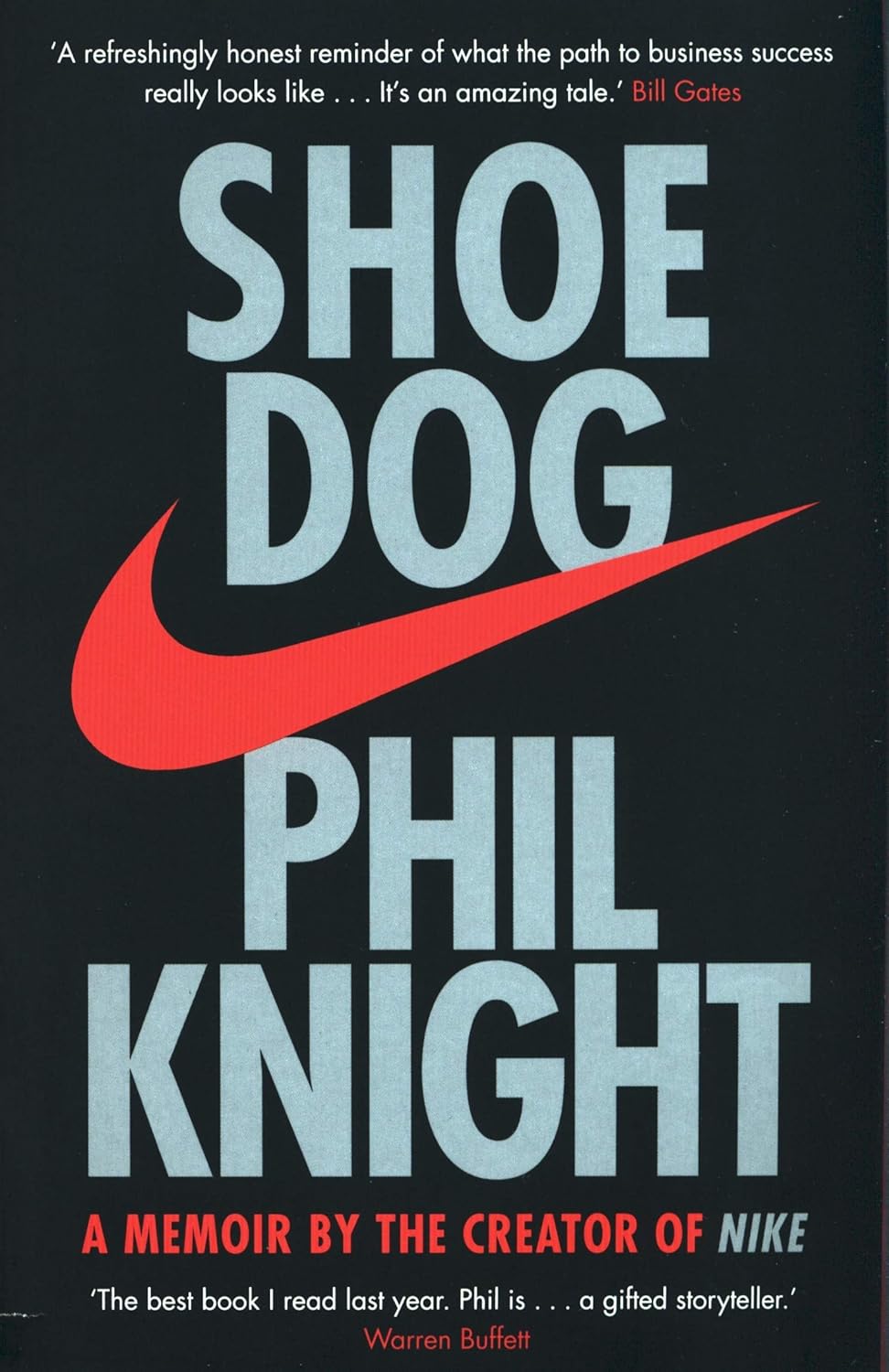
Shoe Dog: A Memoir by the Creator of Nike audiobook cover - A shy Oregon runner with a “crazy idea” bets everything on Japanese shoes, nearly loses it all to banks, rivals, and the U.S. government, and builds Nike through grit, friendships, and an obsession with never stopping.

Shoe Dog: A Memoir by the Creator of Nike

A shy Oregon runner with a “crazy idea” bets everything on Japanese shoes, nearly loses it all to banks, rivals, and the U.S. government, and builds Nike through grit, friendships, and an obsession with never stopping.

Phil Knight

4.1 / 5(7 ratings)
Start ListeningDownloadQR code that opens AudiobookHub on the App StoreTry free on iPhoneScan to start in 5 seconds

If You're Curious About These Questions...

You should listen to this audiobook

Listen to Shoe Dog: A Memoir by the Creator of Nike — Free Audiobook

Loading player...

Key Takeaways from Shoe Dog: A Memoir by the Creator of Nike

Learning Tools

Reinforce what you learned from Shoe Dog: A Memoir by the Creator of Nike

Mind Map

Shoe Dog: A Memoir by the Creator of Nike
Genesis (1962): The Crazy Idea+
Inception (1962-63): Blue Ribbon Sports+
Foundations (1964): Partnership & Early Sales+
The Grind: Growth vs. Cash Flow+
Expansion (Late 1960s): Team & Culture+
The Break (1970-72): Freedom from Onitsuka+
Survival (1972-76): Building Nike+
The Big Fights (1977-80): Government & Innovation+
The Finish Line (1980): Going Public & Legacy+
Core Philosophies+

Quiz — Test Your Understanding

Question 1 of 10
What was the central 'Crazy Idea' that Phil Knight conceived at Stanford and decided to pursue in 1962?
  • A. To create a new, high-performance running shoe from scratch in Oregon.
  • B. To compete with Adidas by importing and selling lower-cost, high-quality Japanese running shoes in the U.S.
  • C. To open a chain of retail stores dedicated exclusively to track and field athletes.
  • D. To partner with German shoe companies to improve their manufacturing processes.
Question 2 of 10
When first meeting with the Onitsuka Tiger executives in Japan, what company name did Phil Knight invent on the spot?
  • A. Oregon Track Co.
  • B. Pacific Shoe Imports
  • C. Blue Ribbon Sports
  • D. Tiger USA
Question 3 of 10
How did track coach Bill Bowerman initially become involved with Blue Ribbon Sports?
  • A. He introduced Knight to the executives at Onitsuka.
  • B. He tested Knight's sample shoes and then proposed a 51/49 partnership to be 'in on the deal.'
  • C. He was hired as the first full-time employee to manage mail orders.
  • D. He loaned Knight the initial capital to travel to Japan.
Question 4 of 10
As Blue Ribbon's sales grew rapidly in the early days, what became the company's most persistent and dangerous enemy?
  • A. Competition from other American shoe importers.
  • B. Poor product quality from Onitsuka's factories.
  • C. A constant lack of cash flow to finance growth.
  • D. A lack of interested customers and runners.
Question 5 of 10
What was the philosophy behind Blue Ribbon's first retail store, opened by Jeff Johnson in Santa Monica?
  • A. To maximize sales per square foot with a high-volume, low-margin model.
  • B. To function as a runner's sanctuary and community hub, not just a place to sell shoes.
  • C. To exclusively sell custom-modified shoes designed by Johnson himself.
  • D. To serve as a secret office for spying on West Coast competitors.
Question 6 of 10
What definitive proof did Phil Knight obtain that confirmed Onitsuka was planning to betray Blue Ribbon and find a new U.S. distributor?
  • A. An intercepted letter from Onitsuka's CEO to a competitor.
  • B. A public announcement in a Japanese newspaper about Onitsuka's new American partner.
  • C. A list of potential U.S. distributors found in a folder he stole from executive Kitami's briefcase.
  • D. A secret recording of a meeting where Kitami discussed replacing Blue Ribbon.
Question 7 of 10
What everyday object inspired Bill Bowerman's breakthrough invention, the waffle sole?
  • A. The tread pattern on a new type of car tire.
  • B. The design of a new synthetic track surface in Oregon.
  • C. His wife's waffle iron, which gave him the idea for a new traction pattern.
  • D. A honeycomb he found while hiking.
Question 8 of 10
Which athlete came to symbolize the rebellious, defiant, and all-out effort spirit of Nike in its early years?
  • A. Frank Shorter
  • B. Jeff Johnson
  • C. Steve Prefontaine
  • D. Geoff Hollister
Question 9 of 10
What was the 'American Selling Price' (ASP) rule, and why did it pose a $25 million existential threat to Nike?
  • A. It was a tax on profits that Nike had to pay for selling goods made in Japan.
  • B. It was a law that required Nike to sell its shoes at the same price as its American competitors.
  • C. It was a government fine for antitrust violations against Converse and Keds.
  • D. It was a customs rule that calculated import duties based on the price of a similar American-made product, resulting in a huge retroactive bill.
Question 10 of 10
When Nike went public in 1980, how did the founders ensure they would retain control of the company?
  • A. They only sold 49% of the company's shares to the public.
  • B. They created a dual-class stock structure that gave founders superior voting rights.
  • C. They required all new shareholders to sign a loyalty agreement.
  • D. They sold the company to Nissho Iwai, which then took it public on their behalf.

Shoe Dog: A Memoir by the Creator of Nike — Full Chapter Overview

Shoe Dog: A Memoir by the Creator of Nike Summary & Overview

Shoe Dog follows Phil Knight from a restless post-Stanford, post-Army twenty-four-year-old to the founder of Nike. What begins as a hunch—Japanese running shoes could undercut German dominance—turns into a years-long struggle against cash shortages, skeptical bankers, supplier betrayals, product failures, and legal battles. Along the way, Knight forms the core team that powers Nike: Bill Bowerman’s relentless innovation, Jeff Johnson’s obsessive runner-first evangelism, Bob Woodell’s operational grit, Del Hayes’s financial wizardry, and later key allies like Nissho Iwai and in-house counsel Rob Strasser.

The memoir dramatizes entrepreneurship as endurance sport: constant reinvestment, supply-chain chaos, improvised marketing, and life-or-death negotiations. It also traces the brand’s identity—innovation (waffle sole, air cushioning), athlete relationships (especially Steve Prefontaine), and culture (“Buttface” meetings)—culminating in Nike’s IPO and Knight’s later reflections on family, loss, purpose, and gratitude.

Who Should Listen to Shoe Dog: A Memoir by the Creator of Nike?

  • Entrepreneurs and founders who want a realistic, high-stakes view of building a company under relentless cash-flow pressure.
  • Sports, running, and Nike fans curious about how iconic products, endorsements, and the brand culture actually formed.
  • Listeners interested in leadership, perseverance, negotiation, and how teams carry a vision through repeated near-failures.

About the Author: Phil Knight

Phil Knight (1938–2024) was an American businessman and philanthropist, best known as the cofounder of Nike, Inc. He served as CEO (1964–2004) and later as chairman, and he supported major philanthropic efforts in education, health, and athletics, including at the University of Oregon and Stanford.

🎧
Listen in the AppOffline playback & background play
Get App