If You're Curious About These Questions...
You should listen to this audiobook
- Have you ever wondered why some of the world’s most influential decision-makers never seem to pay the price when their advice goes wrong?
- Did you know that it only takes a tiny, uncompromising minority to dictate the choices and behaviors of an entire society?
- What’s the secret to distinguishing a true expert from a high-functioning 'intellectual yet idiot' before you follow their lead?
Listen to Skin in the Game — Free Audiobook
Loading player...
Key Takeaways from Skin in the Game
- Understand the concept of 'skin in the game' by evaluating the hidden risks, information balance, and personal stakes behind every human interaction.
- Discover why information asymmetry between buyers and sellers is ethically flawed, and how to spot when self-serving sales pitches are disguised as objective advice.
- Learn the surprising mechanics of 'minority rule,' where an inflexible minority of just three percent can dictate the preferences and behaviors of the entire majority.
- Find out why large corporations often fail to change consumer habits because they mistakenly target the flexible majority instead of the uncompromising minority.
- Recognize how the modern corporate structure relies on buying obedience, psychologically conditioning employees to trade their personal freedom for predictable security.
Learning Tools
Reinforce what you learned from Skin in the Game
Mind Map
Skin in the Game
Core Principles+
Information Asymmetry+
Minority Rule+
Employment & Freedom+
Wealth Inequality+
Competence vs. Image+
Exploitation of the Wealthy+
Actionable Advice+
Quiz — Test Your Understanding
Question 1 of 7
According to the text, how does the Islamic legal concept of 'Gharar' relate to modern sales transactions?
Question 2 of 7
Why does the 'minority rule' phenomenon occur in consumer markets, such as the widespread prevalence of halal meat or non-GM foods?
Question 3 of 7
What is the primary reason organizations prefer to hire full-time employees rather than relying solely on freelancers or contractors?
Question 4 of 7
According to the author, why does society generally resent wealthy bureaucrats and CEOs but accept the wealth of entrepreneurs and celebrities?
Question 5 of 7
If you have to choose between a surgeon who looks the part and one who looks like a butcher, why does the author suggest choosing the latter?
Question 6 of 7
In professions where individuals have very little 'skin in the game,' such as CEOs or politicians, how is success primarily determined?
Question 7 of 7
Why are wealthy individuals often easily exploited into buying disappointing, overpriced products or experiences?
Skin in the Game — Full Chapter Overview
- 1Recommendation
- 2Any imbalance of information between buyer and seller is morally wrong.
- 3Many people don’t realize that the minority controls the majority.
- 4Companies train their employees to accept a loss of freedom.
- 5Society admires rich entrepreneurs and dislikes wealthy bureaucrats.
- 6Your success depends on competence or image, depending on your job.
- 7Wealthy people care less about spending and get exploited for it.
Skin in the Game Summary & Overview
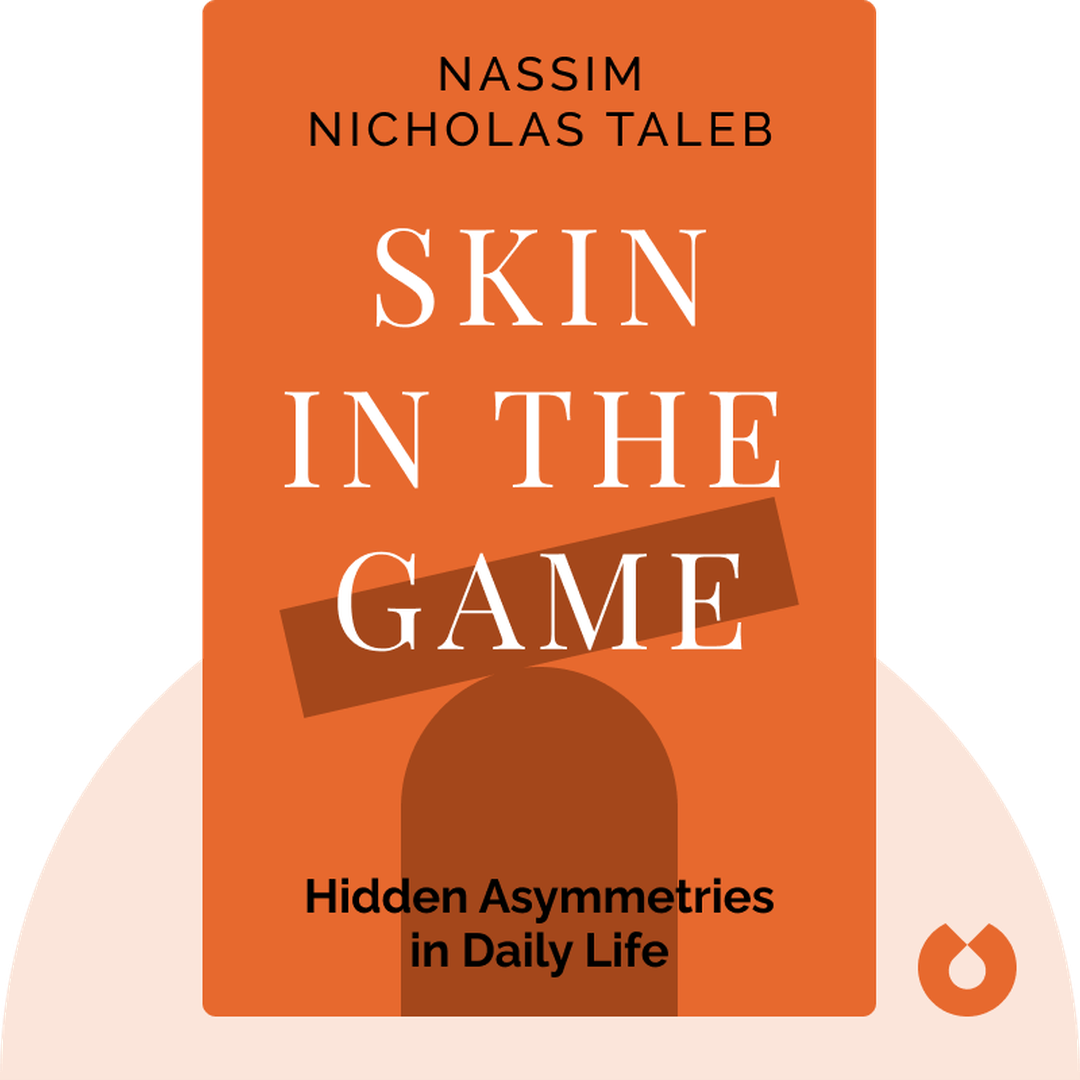
Skin in the Game (2018) explores the ways in which our interactions with others are secretly influenced by risk and symmetry. By drawing on ideas from the field of probability, and applying them to everyday scenarios, Taleb reveals unexpected and often dazzling insights about what really makes society tick.
Who Should Listen to Skin in the Game?
- Anyone interested in risk analysis
- Anyone looking for fresh insights into economics
- Social psychology students and enthusiasts
Books Similar to Skin in the Game
Readers who enjoyed this also liked these titles.