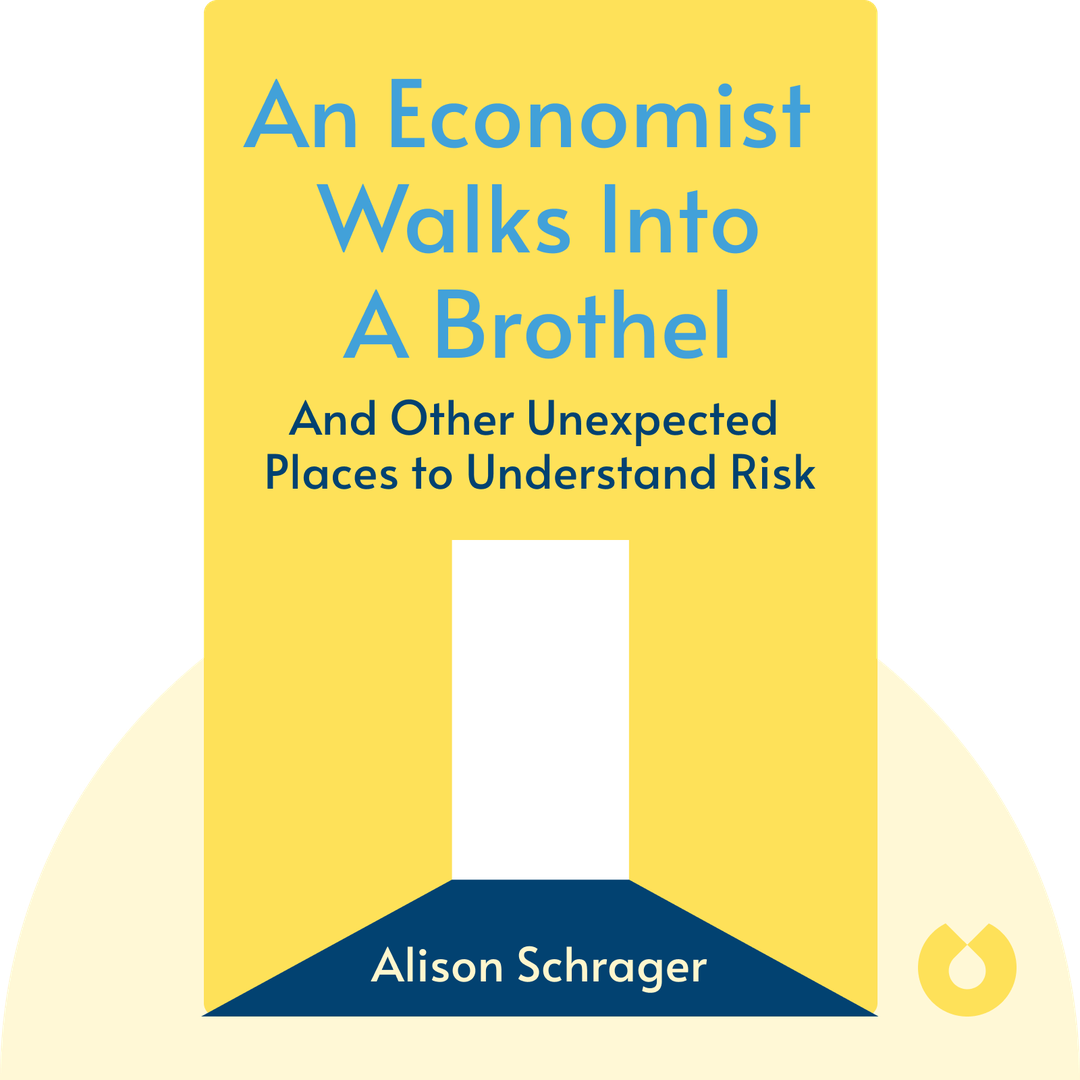
An Economist Walks into a Brothel
Start ListeningDownload Try free on iPhoneScan to start in 5 seconds
Categories:
If You're Curious About These Questions...
You should listen to this audiobook
- Did you know that the secret to making smarter career and financial moves might be hidden in the business strategies of a legal brothel?
- Have you ever wondered what professional poker players and elite soldiers can teach you about the science of taking a perfect risk?
- What if you could stop fearing uncertainty and learn the exact formula for weighing life's biggest gambles against their potential rewards?
Listen to An Economist Walks into a Brothel — Free Audiobook
Loading player...
Key Takeaways from An Economist Walks into a Brothel
- Understand why viewing risk as a simple cause-and-effect scenario is flawed, and learn to evaluate the full range of potential outcomes in your everyday decisions.
- Learn to clearly define your ultimate goal before taking any risk, recognizing that you should only take chances when the cost of a risk-free alternative is simply too high.
- Discover how extreme industries, like legal brothels, mitigate severe hazards, revealing how much of a premium we must often pay to secure a risk-free outcome.
- Recognize why relying on past results and stale data is a dangerous way to calculate future risk, as demonstrated by the unpredictable, skewed distribution of Hollywood box-office hits.
- Grasp the economic concept of 'utility' to understand why human risk perception is driven by emotional value, explaining why multi-millionaires make such dangerous poker opponents.
Learning Tools
Reinforce what you learned from An Economist Walks into a Brothel
Mind Map
An Economist Walks into a Brothel
Rethinking Risk+
1. Good Planning (Goals)+
2. Current Data & Rationality+
3. Diversification+
4. Hedging+
5. Insurance+
6. Flexibility (Uncertainty)+
Quiz — Test Your Understanding
Question 1 of 6
According to the text, what is the primary reason sex workers in Nevada choose to work in legal brothels despite having to give up about half their earnings?
Question 2 of 6
Why is it difficult for Hollywood studios to simply replicate the formula of past blockbuster movies to guarantee future success?
Question 3 of 6
In the high-stakes poker tournament example, why might a multi-millionaire opponent refuse a guaranteed deal to split the prize money?
Question 4 of 6
What is a major downside of using diversification to manage your risk?
Question 5 of 6
Based on the book's definitions, how does 'hedging' differ from buying 'insurance'?
Question 6 of 6
According to the text, what is a crucial strategy for dealing with 'uncertainty'—outcomes that you completely failed to imagine or predict?
An Economist Walks into a Brothel — Full Chapter Overview
- 1Recommendation
- 2Every risk should serve a clearly defined goal.
- 3Past results are a weak guide for calculating future risk.
- 4Our perceptions of risk aren’t always fully rational.
- 5Diversification helps lower unnecessary risk.
- 6Hedging and insurance can protect you from potential losses.
- 7It’s important to guard against uncertainty as well as risk.
- 8Final summary
An Economist Walks into a Brothel Summary & Overview
An Economist Walks Into A Brothel (2019) explains how every decision we make carries an element of risk. It can’t be avoided but we can learn to examine those risks, weigh them against the possible rewards and make smarter decisions in our careers, finances and life. Life lessons from high-risk professions like professional poker and the armed forces illustrate the fine art of taking a risk.
Who Should Listen to An Economist Walks into a Brothel?
- Anyone weighing an important, potentially risky life choice
- People who look but don’t leap
- Anyone who has seen a risky decision backfire
Books Similar to An Economist Walks into a Brothel
Readers who enjoyed this also liked these titles.