Theme Song
If You're Curious About These Questions...
You should listen to this audiobook
- What's the secret to distinguishing between luck and skill in business and life?
- Are you curious about why some people consistently make poor decisions despite having access to the same information as others?
- Can you really trust your own judgment, or are you just a victim of your own cognitive biases and random events?
Listen to Fooled by Randomness — Cinematic Audio Edition
Loading player...
Key Takeaways from Fooled by Randomness
- Understand why stock market success is often just sheer luck disguised as competence, and how the long run eventually exposes poor, random choices.
- Discover why predicting the future based on past events leads to catastrophe, and how the problem of induction proves your assumptions can be invalidated at any time.
- Learn how unpredictable tipping points and path dependent outcomes often cause suboptimal products and solutions to dominate the market.
- Master the crucial skill of contradicting your own views to overcome cognitive biases and avoid clinging to stale opinions when new information arises.
- Recognize how emotions secretly drive your reasoning and why hindsight bias tricks people into believing they can predict random future market events.
Learning Tools
Reinforce what you learned from Fooled by Randomness
Mind Map
Fooled by Randomness
How Randomness Dominates+
Why We Misunderstand Randomness+
How to Deal with Randomness+
Quiz — Test Your Understanding
Question 1 of 9
Why might a totally unskilled investor boast a flawless 5-year track record in the stock market?
Question 2 of 9
What does the 'black swan' example illustrate about empirical science and theories?
Question 3 of 9
What does the widespread use of the QWERTY keyboard layout demonstrate about market dominance?
Question 4 of 9
How does 'attribution bias' affect the way we perceive success and failure?
Question 5 of 9
According to the text, what is a primary function of emotions in decision-making, as illustrated by 'Buridan’s donkey'?
Question 6 of 9
Why is it dangerous for traders to rely heavily on 'backtesters' and historical patterns to predict the market?
Question 7 of 9
What flaw is common in the way humans and risk management models handle rare events?
Question 8 of 9
How does the author suggest we should deal with harmful randomness, such as an unexpected illness?
Question 9 of 9
Why is it emotionally draining for an investor to check their portfolio every minute instead of annually?
Fooled by Randomness — Full Chapter Overview
- 1Recommendation
- 2We can never know for sure that a theory is right – things keep changing, and the next observation may prove us wrong.
- 3Life is unfair and nonlinear: the best do not always win.
- 4Our reasoning depends on context and relies mostly on simple heuristics.
- 5Emotions can help us decide, but they can also overwhelm rational thinking.
- 6In hindsight, we always find patterns, causes, and explanations in past events, but they are mostly useless for predicting the future.
- 7We are naturally bad at understanding the impact of rare events.
- 8Enjoy harmless randomness, and use stoicism to handle the harmful kind.
- 9In both the media and stock markets, random noise is not worth listening to.
- 10Final summary
Fooled by Randomness Summary & Overview
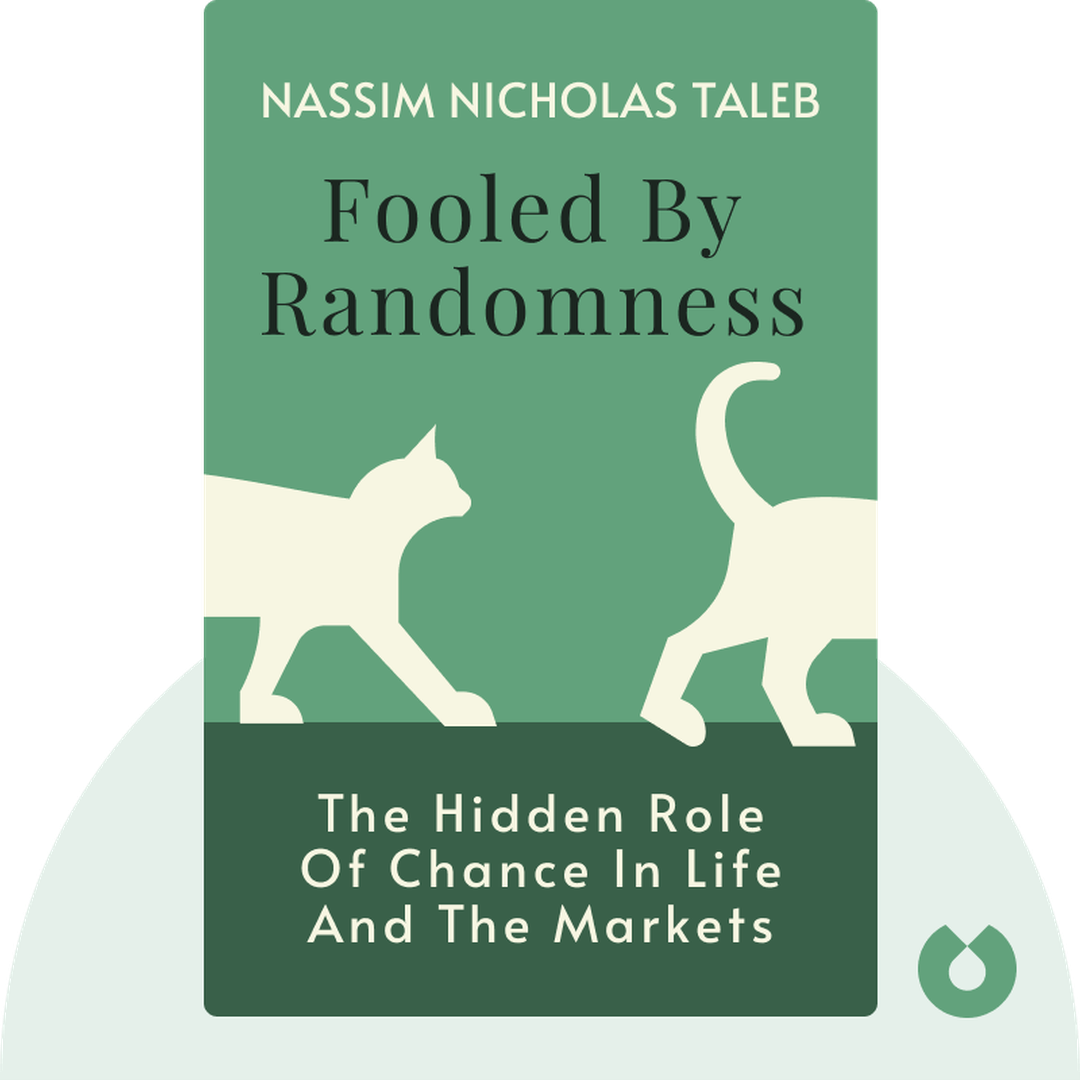
Fooled by Randomness (2001) is a collection of essays on the impact of randomness on financial markets and life itself. Through a mixture of statistics, psychology and philosophical reflection, the author outlines how randomness dominates the world.
Who Should Listen to Fooled by Randomness?
- Investors and financial professionals who think they understand the nature of risk and performance
- Anyone interested in human decision-making
- Anyone who reads the newspaper every day to gain valuable information
Books Similar to Fooled by Randomness
Readers who enjoyed this also liked these titles.