If You're Curious About These Questions...
You should listen to this audiobook
- Have you ever wondered why even the most brilliant teams often get stuck in unproductive arguments instead of finding solutions?
- What if you could master a simple mental framework that allows you to view any problem from six completely different perspectives?
- Are you curious about how 'compartmentalizing' your thoughts can lead to faster, more effective decision-making in both your career and personal life?
Listen to Six Thinking Hats — Free Audiobook
Loading player...
Key Takeaways from Six Thinking Hats
- Discover how to untangle the mental traffic jam of overlapping thoughts by sorting your thinking into six distinct, single-focus modes.
- Learn to replace traditional argumentative debates with parallel thinking, a collaborative approach that explores multiple perspectives together without forcing them to compete.
- Understand why treating thinking as a deliberate, practiced skill can drastically shorten meetings and make complex decisions feel as though they make themselves.
- Master White Hat thinking to gather facts, figures, and missing information objectively, stripping away personal interpretation and persuasion.
- Find out how distinguishing between verified checked facts and assumed believed facts helps teams build a shared vision from common ground rather than arguing over pre-formed ideas.
Learning Tools
Reinforce what you learned from Six Thinking Hats
Mind Map
Six Thinking Hats
Core Concept+
Rules of Application+
White Hat (Data)+
Red Hat (Emotions)+
Black Hat (Caution)+
Yellow Hat (Optimism)+
Green Hat (Creativity)+
Blue Hat (Process Control)+
Real-World Benefits+
Quiz — Test Your Understanding
Question 1 of 9
What is the primary purpose of the Six Hats method?
Question 2 of 9
What is the recommended time-management rule when a group puts on a specific hat?
Question 3 of 9
When a group is using the White Hat, what is their primary focus?
Question 4 of 9
Which of the following is a crucial rule when engaging in Red-Hat thinking?
Question 5 of 9
What is the primary function of the Black Hat, and what is its associated danger?
Question 6 of 9
How does Yellow-Hat thinking differ from simply having a wild imagination?
Question 7 of 9
According to the text, what is a common misconception about creativity that the Green Hat helps to overcome?
Question 8 of 9
Who typically wears the Blue Hat, and what is its main purpose?
Question 9 of 9
What main benefits did companies like ABB and Statoil experience by implementing the Six Hats method?
Six Thinking Hats — Full Chapter Overview
- 1Recommendation
- 2The six hats are tools that help us generate ideas and enhance our overall thinking.
- 3When using six hats, keep several key rules in mind.
- 4The white hat means thinking like a computer: seek only data and information.
- 5Be candid with your emotions when you wear the red hat.
- 6The black hat warns you about looming dangers and negative outcomes.
- 7The yellow hat invites you to play the role of eternal optimist.
- 8The green hat creates room for the wildest ideas.
- 9The blue hat concerns process control at any given time.
- 10The Six Hats method will save you time, money, and headaches.
Six Thinking Hats Summary & Overview
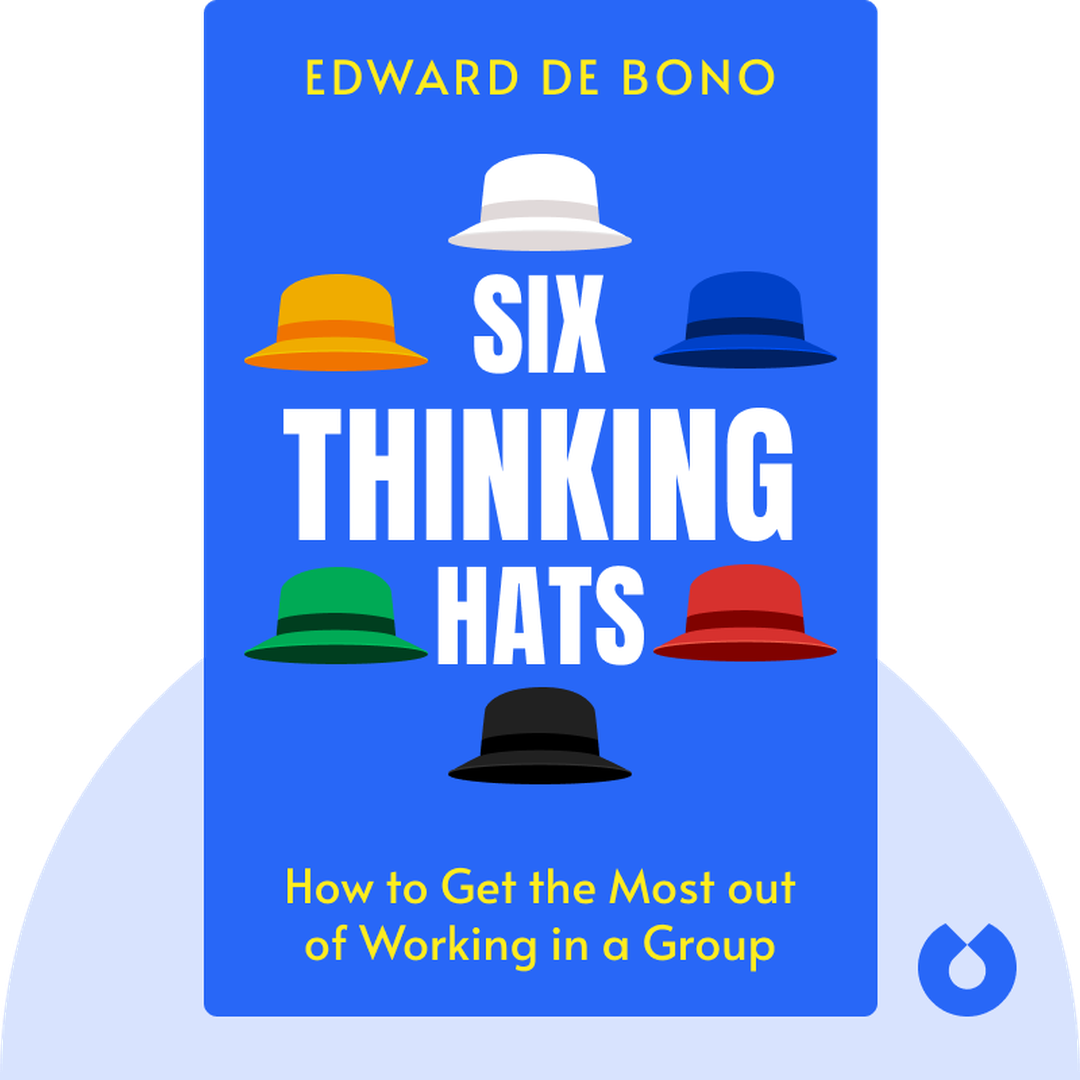
Six Thinking Hats offers you valuable tools for group discussions and individual decision making. The book shows ways to compartmentalize different ways of thinking to help you and your group use your brains in a more detailed, cohesive and effective way.
Who Should Listen to Six Thinking Hats?
- Anyone in a position of leadership
- Anyone responsible for facilitating effective communication
- Anyone who wants to make better decisions and improve their thinking
Books Similar to Six Thinking Hats
Readers who enjoyed this also liked these titles.