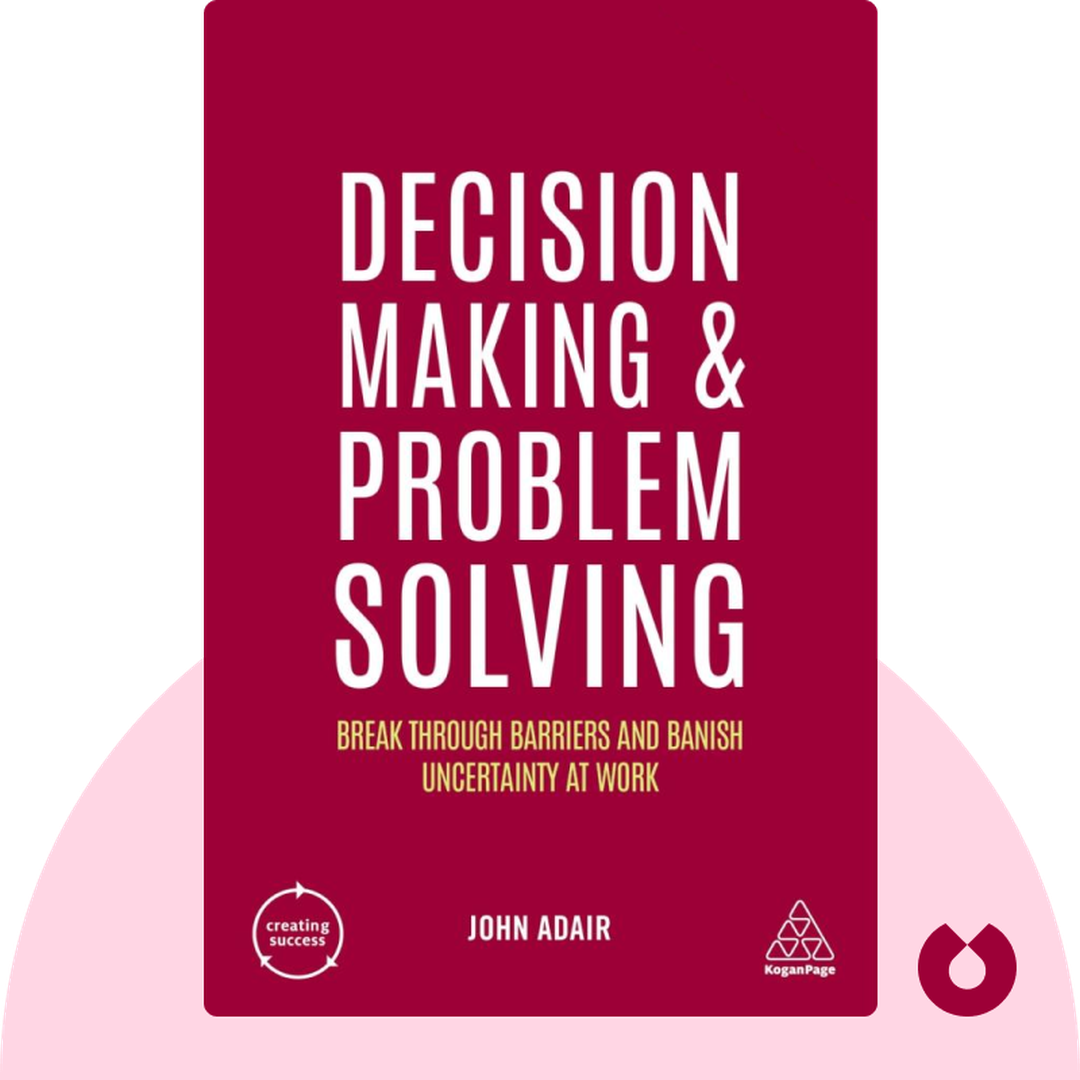
Decision Making and Problem Solving
Start ListeningDownload Try free on iPhoneScan to start in 5 seconds
Categories:
If You're Curious About These Questions...
You should listen to this audiobook
- What if you could master a single mental framework that transforms complex problems into clear, actionable decisions?
- Have you ever wondered why some leaders consistently make better choices under pressure while others falter?
- What’s the secret to unlocking the perfect balance between logical analysis and creative thinking in your professional life?
Listen to Decision Making and Problem Solving — Free Audiobook
Loading player...
Key Takeaways from Decision Making and Problem Solving
- Discover why logic and creativity are not mutually exclusive, and learn how to actively strengthen both mindsets to tackle any challenge.
- Understand the three distinct types of applied thinking—decision-making, problem-solving, and creative thinking—to better navigate unfamiliar and unexpected situations.
- Learn how to utilize your mind's core metafunctions of analyzing, synthesizing, and valuing to break down complex issues, assemble new ideas, and judge the best options.
- Master the power of your 'Depth Mind' by intentionally stepping away from problems, giving your subconscious the time and space to process details and generate powerful solutions.
- Apply a flexible, five-step decision-making framework to systematically define your objectives, generate viable options, and evaluate your final results without missing crucial details.
Learning Tools
Reinforce what you learned from Decision Making and Problem Solving
Mind Map
Decision Making and Problem Solving
Core Mind Mechanics+
The Depth Mind+
Decision-Making+
Problem-Solving+
Creative Thinking+
Quiz — Test Your Understanding
Question 1 of 7
According to John Adair, what are the three metafunctions of the mind used during conscious thought?
Question 2 of 7
How does the author suggest you actively utilize and strengthen your 'Depth Mind'?
Question 3 of 7
What is the fundamental difference between a 'wrong' decision and a 'bad' decision according to the text?
Question 4 of 7
According to the text, what is the primary difference between the three-step problem-solving process and the five-step decision-making process?
Question 5 of 7
Which of the following represents the correct four-step process for activating creative thinking?
Question 6 of 7
The example of Jethro Tull using his knowledge of pipe organs to invent a farming tool illustrates what key aspect of creative thinking?
Question 7 of 7
When using the mind's metafunction of 'synthesizing,' what are you primarily doing?
Decision Making and Problem Solving — Full Chapter Overview
- 1Recommendation
- 2Practical Thinking Types and Your Mind’s Metafunctions
- 3The Deep Mind
- 4Improving Your Decision-Making Skills
- 5Enhancing Your Problem-Solving Ability
- 6Strengthening Your Creative Thinking
- 7Final summary
Decision Making and Problem Solving Summary & Overview
Decision Making and Problem Solving (2019) explains decision-making, problem-solving, and creative thinking. It provides instructions for building and improving these skills and explores the importance of these abilities enabling you to expand your practical thinking capacity.
Who Should Listen to Decision Making and Problem Solving?
- Business leaders who want to improve their teams’ decision-making and problem-solving.
- Employees seeking to polish their practical thinking skills
- Anyone interested in elevating their capacity for creative and critical thinking
Books Similar to Decision Making and Problem Solving
Readers who enjoyed this also liked these titles.