If You're Curious About These Questions...
You should listen to this audiobook
- Have you ever wondered why some people seem to cut through complex problems effortlessly while others remain stuck in indecision?
- What if you could master a universal 'toolkit' of mental models to make better choices in everything from your career to your personal life?
- Did you know that using simple frameworks from fields like physics and economics can help you spot hidden patterns and avoid the mental traps that lead to failure?
Listen to Super Thinking — Free Audiobook
Loading player...
Key Takeaways from Super Thinking
- Discover how to build worldly wisdom by applying theoretical mental models from physics, economics, and philosophy to solve everyday problems.
- Understand how the physics concept of critical mass dictates technological success and drives the growth of modern network-based businesses.
- Learn to make better decisions through the mathematical principle of inversion, which focuses on avoiding unforced errors rather than strictly trying to be right.
- Master the art of bottom-up reasoning by arguing from first principles, a powerful method used by innovators like Elon Musk to strip complex problems down to fundamental truths.
- Find out how applying Ockham's razor can simplify your personal life, such as dating, by eliminating overly complex criteria and helping you stick to the basics.
Learning Tools
Reinforce what you learned from Super Thinking
Mind Map
Super Thinking
Mental Models+
Reasoning & Problem Solving+
Simplicity & Logic+
Perspective & Fairness+
Adaptability+
Evaluating Data+
Behavioral Norms+
Actionable Tools+
Quiz — Test Your Understanding
Question 1 of 9
According to the text, how does investor Charlie Munger define having facts in a 'useable form'?
Question 2 of 9
How does the concept of 'critical mass' apply to the history of fax machines and modern ride-sharing apps?
Question 3 of 9
What is the main idea behind the mental model of 'inversion' as championed by mathematician Carl Jacobi?
Question 4 of 9
How did Elon Musk use 'first principles' thinking to solve the problem of expensive battery packs?
Question 5 of 9
Which logical trap explains why people mistakenly assume Linda is more likely to be a 'feminist bank teller' than just a 'bank teller'?
Question 6 of 9
If a colleague sends you a curt, one-line email, what does 'Hanlon’s razor' suggest you should do?
Question 7 of 9
What is the primary lesson drawn from the story of the peppered moth during the Industrial Revolution?
Question 8 of 9
Why do people often mistakenly blame the flu shot for causing a cold?
Question 9 of 9
Why did introducing tardiness fines at an Israeli kindergarten actually increase the number of late parents?
Super Thinking — Full Chapter Overview
- 1Recommendation
- 2Super thinking applies proven concepts to help us clarify the world and make better decisions.
- 3Avoiding unforced errors and reasoning from first principles can help you be wrong less often.
- 4Ockham’s razor might well unlock the secret to your love life.
- 5Stepping into others’ shoes is difficult, but the veil of ignorance can help you make even fairer decisions.
- 6If you don’t want to get left behind amid social change, you need to become adaptable.
- 7Anecdotal evidence and the fallacy that correlation equals causation distort our grasp of statistical data.
- 8Mixing social and market norms undermines reciprocity.
Super Thinking Summary & Overview
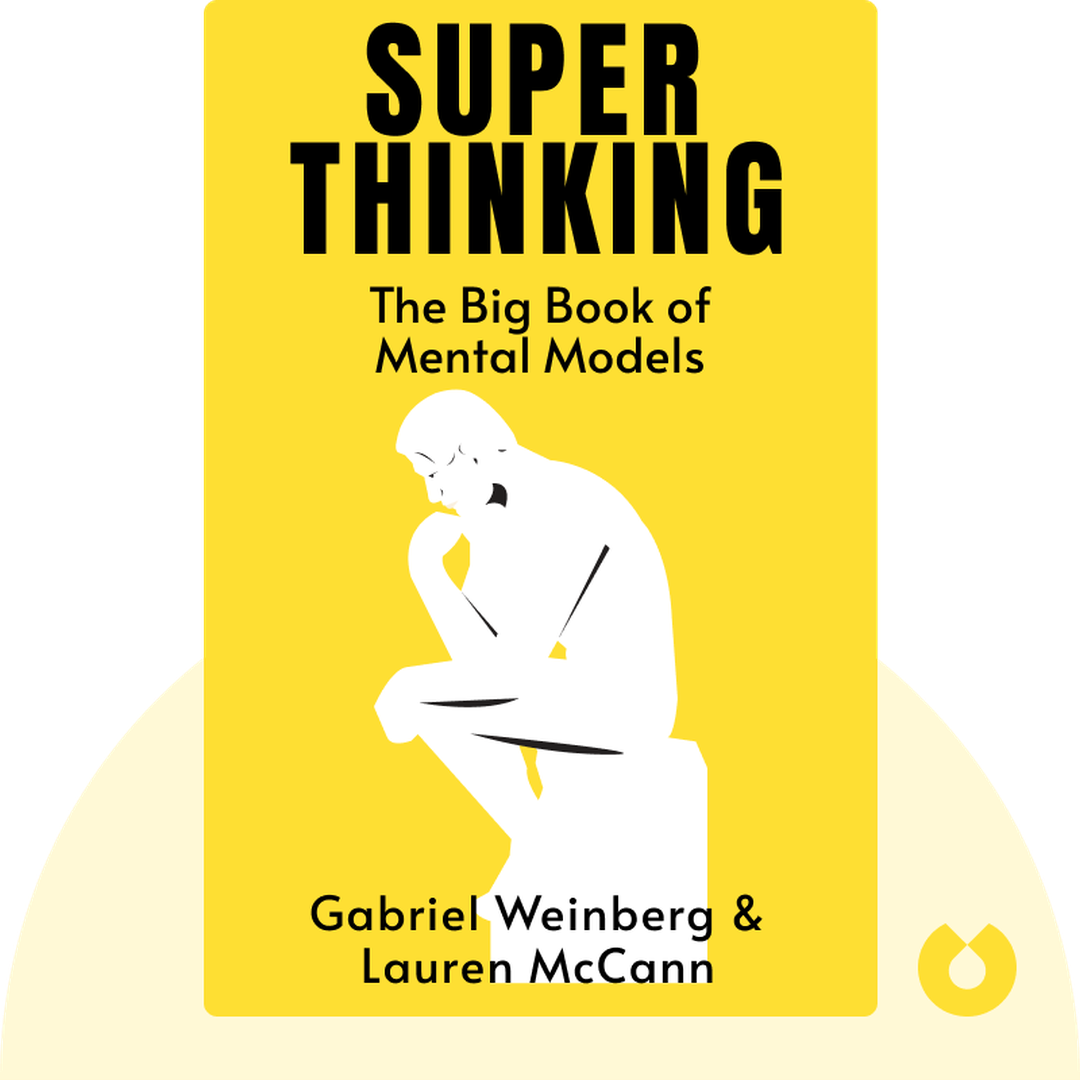
Super Thinking (2019) is a conceptual toolkit designed to help you cut through complexity and make better decisions. Drawing on insights from fields as varied as biology and economics, entrepreneur Gabriel Weinberg and statistician Lauren McCann present the “mental models” used by today’s top problem-solvers and decision-makers. But this isn’t a dry academic treatise on logic: apply these models to your personal and professional conundrums and you’ll be well on your way to becoming a super thinker in your own right!
Who Should Listen to Super Thinking?
- Thinkers and logicians
- Science buffs
- Self-optimizers
Books Similar to Super Thinking
Readers who enjoyed this also liked these titles.