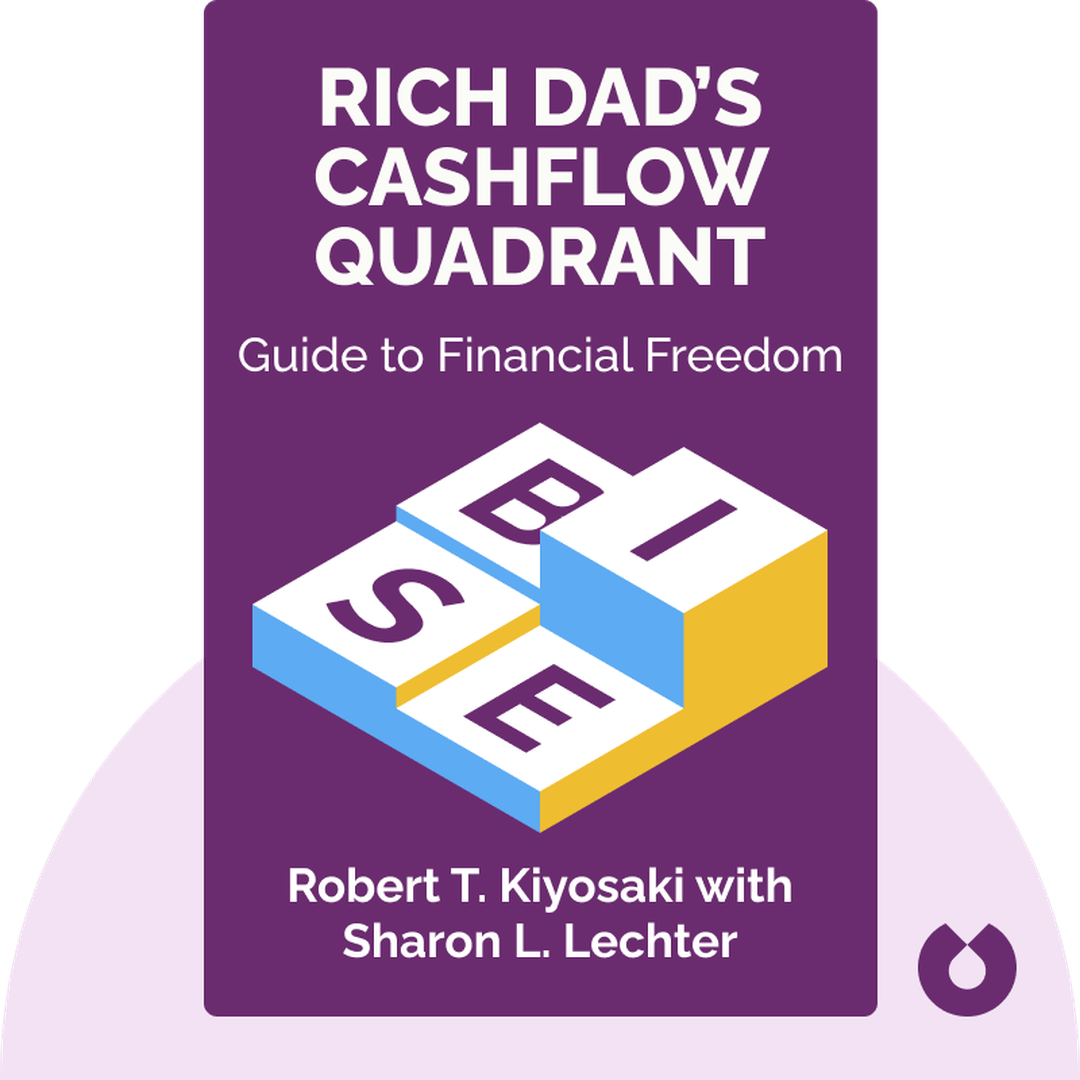
Rich Dad’s Cashflow Quadrant
Start ListeningDownload Try free on iPhoneScan to start in 5 seconds
Categories:
If You're Curious About These Questions...
You should listen to this audiobook
- Did you know that there are four distinct ways to earn income, and most people are trapped in the two that make financial freedom almost impossible?
- Have you ever wondered why some of the smartest, most hardworking people never get rich, while others seem to find success with ease?
- What’s the secret to shifting from a life of trading hours for dollars to building a system that generates wealth even while you sleep?
Listen to Rich Dad’s Cashflow Quadrant — Cinematic Audio Edition
Loading player...
Key Takeaways from Rich Dad’s Cashflow Quadrant
- Discover the four Cashflow Quadrants—Employee, Self-Employed, Business Owner, and Investor—and learn how to strategically transition between them to achieve absolute financial security.
- Understand why chasing job security and higher salaries often leads to a cycle of debt, and how to break free by viewing money as a resource to expand your capital.
- Explore the three distinct models of the Business Owner quadrant—traditional, franchise, and network marketing—to choose the most lucrative path that aligns with your personal skills.
- Navigate the different stages of investment mastery, moving past the fear of losing money to achieve true financial wisdom and portfolio diversification.
- Master the mindset of the wealthy by overcoming psychological barriers like fear and self-doubt, treating money as a tool, and embracing calculated risks to build lasting wealth.
Learning Tools
Reinforce what you learned from Rich Dad’s Cashflow Quadrant
Mind Map
Rich Dad’s Cashflow Quadrant
The Four Quadrants+
Working Hard vs. Working Smart+
The Information Age Reality+
The Path to Financial Freedom+
Mindset and Emotional Control+
Quiz — Test Your Understanding
Question 1 of 10
According to the book, what do the letters E, S, B, and I stand for in the Cashflow Quadrant?
Question 2 of 10
To achieve true financial freedom, which transition does Robert Kiyosaki recommend making within the Cashflow Quadrant?
Question 3 of 10
In the story of the two water contractors, Ed and Bill, what is the fundamental lesson about wealth creation?
Question 4 of 10
How does the text describe the impact of the 'Information Age' on personal finance?
Question 5 of 10
Which of the following best describes the core mindset of someone in the 'S' (Self-employed/Small business) quadrant?
Question 6 of 10
Why does Kiyosaki suggest that becoming a successful Big Business owner (B quadrant) is the best stepping stone to becoming an Investor (I quadrant)?
Question 7 of 10
What is the primary flaw of the 'I’m-Too-Busy-Investor' level?
Question 8 of 10
Why does the book refer to one of the financially illiterate investor levels as 'Savers-Are-Losers'?
Question 9 of 10
According to the author, how should a person handle the emotional aspect of money and investing?
Question 10 of 10
What does the book recommend as a powerful strategy for long-term financial success?
Rich Dad’s Cashflow Quadrant — Full Chapter Overview
- 1Recommendation
- 2The different ways in which we earn money can be divided into four quadrants.
- 3Studying and working hard won’t get you to financial freedom.
- 4Working hard and working smart are two different things.
- 5In today’s economy, we can’t rely on the government to look after us. We need to take our financial security into our own hands.
- 6The four quadrants attract different types of people.
- 7The surest way to achieve financial freedom is to move into business ownership so you can invest.
- 8There are five different classes of investor.
- 9Money provokes irrational feelings which we must overcome.
- 10To achieve financial success, take baby steps and keep the long-term in mind.
Rich Dad’s Cashflow Quadrant Summary & Overview
Rich Dad’s Cashflow Quadrant (1998) is a guide to financial freedom. In the second book of the Rich Dad Poor Dad series, authors Robert T. Kiyosaki and Sharon L. Lechter describe how some people achieve financial success without working as hard as the rest of us. In this blend of instruction and autobiography, they explain how you might have the wrong idea about attaining financial freedom and set out ways in which you can turn that around.
Who Should Listen to Rich Dad’s Cashflow Quadrant?
- Anyone looking to escape the nine-to-five slog
- Warren Buffet and Bill Gates wannabes
- Those with dreams bigger than their wallets
Books Similar to Rich Dad’s Cashflow Quadrant
Readers who enjoyed this also liked these titles.