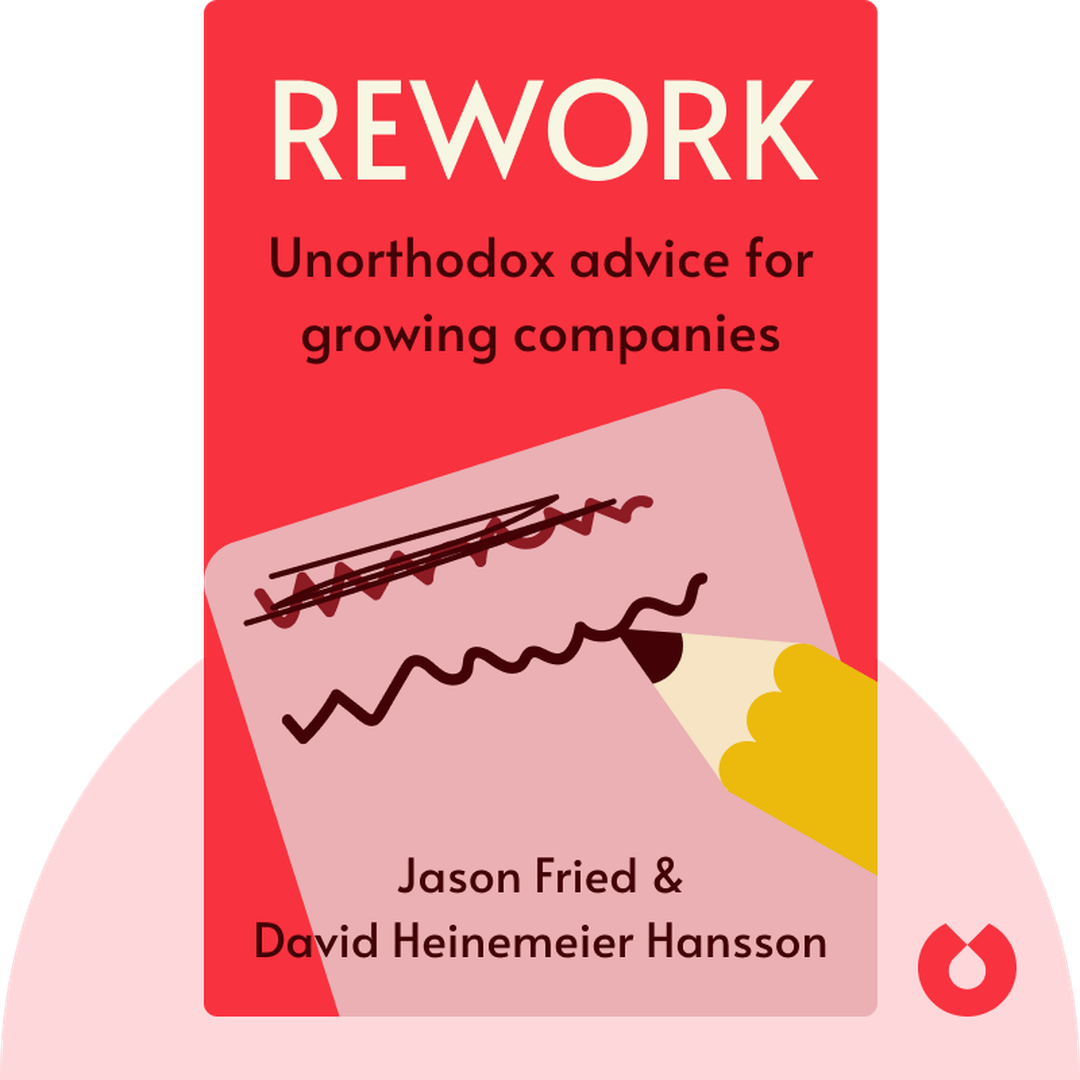
If You're Curious About These Questions...
You should listen to this audiobook
- Have you ever wondered why your long-term business plans might actually be sabotaging your success?
- Did you know that 'workaholism' is often a sign of inefficiency rather than a badge of honor?
- What if you could grow a multi-million dollar business by intentionally doing less than your competition?
Listen to ReWork — Cinematic Audio Edition
Loading player...
Key Takeaways from ReWork
- Learn how to launch your business without quitting your day job by identifying a core problem and embracing the freedom of starting small.
- Discover why the most commercially successful ideas come from solving your own personal problems, naturally fueling the passion needed to grow.
- Understand the importance of acting like a 'starter' rather than a startup, allowing you to perfect one core product before expanding your focus.
- Find out how to protect your team's productivity by eliminating mundane meetings and ditching abstract charts for real, working product demonstrations.
- Master the art of avoiding 'heroism' by sharing incremental progress for external feedback instead of wasting time trying to perfect ideas in isolation.
Learning Tools
Reinforce what you learned from ReWork
Mind Map
ReWork
Starting Out+
Leveraging Smallness+
Operations & Culture+
Quiz — Test Your Understanding
Question 1 of 10
According to the authors, when is the best time to launch your new business?
Question 2 of 10
How do the authors view the idea of starting a business with an 'exit strategy' in mind from day one?
Question 3 of 10
What strategy do the authors recommend for promoting your company once you have a unique product?
Question 4 of 10
What is highlighted as a major advantage of keeping your company small in the beginning?
Question 5 of 10
How should you handle an increasing number of feature requests from customers as your business grows?
Question 6 of 10
When dealing with bad news or company shortcomings, how should a small business communicate with its customers?
Question 7 of 10
Why do the authors advise against using the word 'ASAP' in workplace communication?
Question 8 of 10
What is the authors' stance on long-term business planning and estimating?
Question 9 of 10
According to the book, what is considered the worst kind of interruption to workplace productivity?
Question 10 of 10
When recruiting new employees, what approach do the authors recommend over analyzing resumes and GPAs?
ReWork — Full Chapter Overview
- 1Recommendation
- 2Take a stand for what you care about.
- 3Make your product unique so you can openly share all you know.
- 4Enjoy the advantages of being small, yet remember that you’re still running a real business.
- 5Less is more – begin saying no and keep your product lean.
- 6Don’t copy big corporations in your marketing and communications – be honest, personal, and nimble.
- 7Build an environment where people self-manage and communicate openly with each other honestly.
- 8Don’t overplan – remain agile with fast and flexible decisions.
- 9Productivity doesn’t come from long hours, but rather from focused work and quick wins.
- 10Hire people only when truly necessary, and forget about resumes – trust your instincts.
ReWork Summary & Overview
Rework (2010) throws out the traditional notions of what it takes to run a business and offers a collection of unorthodox advice, ranging from productivity to communication and product development.
These lessons are based on the authors’ own experiences in building, running and growing their company to a point where it generates millions of dollars in profits annually.
Who Should Listen to ReWork?
- Anyone who has ever considered starting their own company
- Anyone interested in what work should be like in the 21st century
- Anyone trying to create an environment of productivity
Books Similar to ReWork
Readers who enjoyed this also liked these titles.