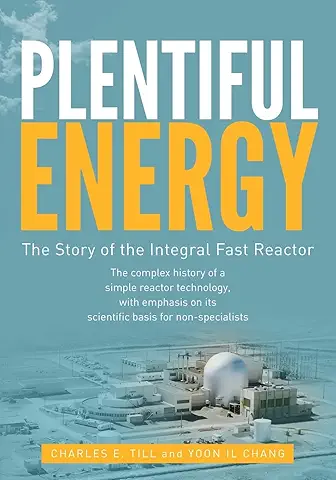
Plentiful Energy: The Story of the Integral Fast Reactor audiobook cover - At Argonne National Laboratory, a small team proved a bold idea: a sodium-cooled fast reactor with metal fuel and on-site recycling could be safer, cleaner, and vastly more fuel-efficient—until politics shut it down just as the finish line came into view.

Plentiful Energy: The Story of the Integral Fast Reactor

At Argonne National Laboratory, a small team proved a bold idea: a sodium-cooled fast reactor with metal fuel and on-site recycling could be safer, cleaner, and vastly more fuel-efficient—until politics shut it down just as the finish line came into view.

Charles E. Till and Yoon Il Chang

4.0 / 5(3 ratings)
Start ListeningDownloadQR code that opens AudiobookHub on the App StoreTry free on iPhoneScan to start in 5 seconds

If You're Curious About These Questions...

You should listen to this audiobook

Listen to Plentiful Energy: The Story of the Integral Fast Reactor — Free Audiobook

Loading player...

Key Takeaways from Plentiful Energy: The Story of the Integral Fast Reactor

Learning Tools

Reinforce what you learned from Plentiful Energy: The Story of the Integral Fast Reactor

Mind Map

Oceanofpdf.Com Plentiful Energy Charles E Till
Introduction & Passive Safety Proof+
History and Origins+
The IFR Concept & Design Choices+
Metal Fuel Technology+
Walk-Away Safety Mechanics+
Pyroprocessing & Recycling+
Impact, Economics & Cancellation+

Quiz — Test Your Understanding

Question 1 of 10
What was the primary outcome of the 1986 tests conducted on the Experimental Breeder Reactor-II (EBR-II)?
  • A. The reactor successfully relied on active, automated safety systems to prevent a core meltdown.
  • B. The reactor demonstrated that oxide fuels provide better safety margins than metal fuels in loss-of-flow scenarios.
  • C. The reactor passively shut itself down using its inherent physics without the need for operator intervention.
  • D. The reactor proved that sodium coolant was too unstable and dangerous for future commercial use.
Question 2 of 10
Which early experimental reactor is noted for proving nuclear breeding and producing the world's first electricity from nuclear fission, despite experiencing a partial core melt?
  • A. Chicago Pile-1
  • B. Experimental Breeder Reactor-I (EBR-I)
  • C. Experimental Breeder Reactor-II (EBR-II)
  • D. Clinch River Breeder Reactor (CRBR)
Question 3 of 10
According to the book, what political event paradoxically created the opportunity for Argonne to propose the Integral Fast Reactor (IFR) approach in 1984?
  • A. The signing of a comprehensive nuclear non-proliferation treaty.
  • B. The cancellation of the Clinch River Breeder Reactor (CRBR).
  • C. The successful commercialization of PUREX reprocessing.
  • D. The partial core melt of EBR-I.
Question 4 of 10
How do the authors define the 'integral' aspect of the Integral Fast Reactor (IFR)?
  • A. The use of a single type of coolant continuously circulating through both the primary and secondary loops.
  • B. The integration of civilian nuclear power generation with military plutonium production.
  • C. The combination of the reactor, fuel recycling, remote fabrication, and waste forms into a single on-site system.
  • D. The holistic mathematical modeling used to predict the reactor's lifetime burnup and efficiency.
Question 5 of 10
Which of the following correctly identifies the three core technological choices that form the foundation of the IFR design?
  • A. Oxide fuel, water coolant, and loop-type configuration.
  • B. Metal fuel, sodium coolant, and pool-type configuration.
  • C. Metal fuel, sodium coolant, and loop-type configuration.
  • D. Oxide fuel, sodium coolant, and pool-type configuration.
Question 6 of 10
How did Argonne researchers solve the historical problem of metal fuel swelling and bursting its cladding?
  • A. By developing a rigid titanium alloy cladding designed to physically constrain the expanding fuel.
  • B. By operating the reactor at much lower temperatures to entirely prevent thermal expansion.
  • C. By switching to oxide-based fuels that inherently do not swell under irradiation.
  • D. By using a lower smear density to leave room for swelling, using a sodium bond, and allowing fission gas to escape through interconnected porosity.
Question 7 of 10
What characteristic of metal fuel allows the IFR to achieve 'walk-away' safety during an Anticipated Transient Without Scram (ATWS)?
  • A. It instantly melts upon a loss of coolant flow, safely draining into a catchment basin below the reactor core.
  • B. It runs at a much lower internal temperature and stores less Doppler reactivity than oxide fuel, allowing negative feedbacks to quickly shut down power.
  • C. It has a higher Doppler reactivity than oxide fuel, which rapidly expands the reactor's structural materials to halt the reaction.
  • D. It dynamically absorbs excess sodium coolant to automatically lower its own temperature during thermal spikes.
Question 8 of 10
Why is the IFR's pyroprocessing method considered more proliferation-resistant than conventional aqueous PUREX reprocessing?
  • A. It completely destroys all plutonium during the high-temperature chemical dissolution phase.
  • B. It yields a highly radioactive mixed actinide product that is difficult to handle, rather than separated, high-purity plutonium.
  • C. It strictly relies on heavy water, which is heavily regulated and easily tracked internationally.
  • D. It produces a final fuel form that is chemically incapable of sustaining a fast-neutron chain reaction.
Question 9 of 10
According to the authors, how does the IFR's fuel cycle change the fundamental timeline of nuclear waste management?
  • A. It shifts the waste burden from managing actinides for geological times to managing mostly fission products for a few centuries.
  • B. It converts all long-lived fission products into non-radioactive stable isotopes, requiring no long-term storage.
  • C. It completely eliminates all solid radioactive waste, negating the need for any geological or surface repository.
  • D. It reduces the half-life of uranium isotopes to less than a decade through high-energy neutron bombardment.
Question 10 of 10
Why was the Integral Fast Reactor program ultimately terminated in 1994?
  • A. The U-Pu-Zr metal fuel failed catastrophic irradiation tests, proving the design unsafe for long-term use.
  • B. The Clinton administration labeled advanced reactor development 'unnecessary,' leading to a loss of congressional funding.
  • C. A major accident occurred during the electrorefining process that permanently contaminated the testing facility.
  • D. A federal review determined that pyroprocessing was significantly more expensive than building traditional light-water reactors.

Plentiful Energy: The Story of the Integral Fast Reactor — Full Chapter Overview

Plentiful Energy: The Story of the Integral Fast Reactor Summary & Overview

Plentiful Energy is a technical-and-historical account of the Integral Fast Reactor (IFR), a nuclear power system developed at Argonne National Laboratory between 1984 and 1994. Charles Till and Yoon Il Chang—two leaders of the program—reconstruct how decades of earlier fast reactor work (EBR-I and EBR-II) converged into a “whole system” concept: a sodium-cooled fast reactor, metal fuel, pyroprocessing-based recycling, and durable waste forms, all designed to work together on a single site.

The book aims at non-specialists who can tolerate light technical detail. It walks through the engineering choices (fuel, coolant, reactor configuration), the safety logic behind “inherent/passive safety,” the electrorefining chemistry that enables recycling without producing pure plutonium, and the implications for waste longevity and energy security. It also documents the political rise and abrupt cancellation of the IFR program in 1994, arguing that a near-complete technology was halted primarily by policy, not technical failure.

Who Should Listen to Plentiful Energy: The Story of the Integral Fast Reactor?

  • Engineers and scientifically literate readers who want an accessible explanation of fast reactors, metal fuel behavior, and pyroprocessing.
  • Energy and climate policy readers curious why a major U.S. advanced nuclear program was canceled despite successful demonstrations.
  • Anyone interested in nuclear waste, proliferation debates, and how fuel-cycle design changes the “waste problem.”

About the Author: Charles E. Till and Yoon Il Chang

Charles E. Till (Ph.D., Imperial College London) led Argonne’s reactor R&D as Associate Laboratory Director and originated the IFR initiative. Yoon Il Chang (Ph.D., University of Michigan) joined Argonne in 1974 and served as IFR General Manager through its development decade, later becoming Associate Laboratory Director for Engineering Research. Both were central figures in the EBR-II/IFR program and wrote from first-hand experience.

🎧
Listen in the AppOffline playback & background play
Get App