If You're Curious About These Questions...
You should listen to this audiobook
- Did you know that some of your most productive habits might actually be the hidden triggers keeping your imposter syndrome alive?
- Have you ever wondered why even your greatest achievements can leave you feeling like a total fraud who's about to be found out?
- What if you could identify the specific psychological patterns that fuel your self-doubt and finally learn how to silence your inner critic for good?
Listen to Own Your Greatness — Free Audiobook
Loading player...
Key Takeaways from Own Your Greatness
- Build personalized 'coping cards' through targeted reflection exercises to create a concrete action plan against feeling like a fraud.
- Identify your imposter origin story by examining childhood and family dynamics to uncover the deep-rooted causes of your self-doubt.
- Recognize your specific imposter triggers, such as receiving compliments or starting a new job, to anticipate and break the cycle of automatic negative responses.
- Master the technique of 'thickening' your internal narrative by using 'both-and' thinking to replace simplistic self-criticism with an accurate, balanced view of your skills.
- Understand why you must share your imposter experiences with trusted confidants, as speaking your truth weakens the syndrome's power and opens the door to vital support.
Learning Tools
Reinforce what you learned from Own Your Greatness
Mind Map
Own Your Greatness
Understanding Imposter Syndrome+
Step 1: Identify Origin Story+
Step 2: Know Your Triggers+
Step 3: Change Your Narrative+
Step 4: Speak Your Truth+
Step 5: Silence ANTs+
Step 6: Experiment with New Roles+
Step 7: Build Your Dream Team+
Final Action Plan & Self-Care+
Quiz — Test Your Understanding
Question 1 of 9
What is the primary purpose of the 'coping cards' developed throughout the book's exercises?
Question 2 of 9
According to the authors, where do the feelings associated with imposter syndrome most commonly originate?
Question 3 of 9
In the context of imposter syndrome, why is it crucial to identify your 'triggers'?
Question 4 of 9
What does it mean to 'thicken' your imposter narrative?
Question 5 of 9
Why do the authors recommend 'speaking your truth' by sharing your imposter feelings with trusted confidants?
Question 6 of 9
Which of the following is an example of the 'Catastrophizing' Automatic Negative Thought (ANT)?
Question 7 of 9
If a person with imposter syndrome typically plays the role of the 'Superperson,' what alternative role should they experiment with?
Question 8 of 9
When building a 'dream team' for support, what is the specific role of the 'Grounder'?
Question 9 of 9
Why is prioritizing self-care heavily emphasized for individuals overcoming imposter syndrome?
Own Your Greatness — Full Chapter Overview
- 1Recommendation
- 2Step 1: Pinpoint your imposter origin story.
- 3Step 2: Recognize your triggers.
- 4Step 3: Rewrite your narrative.
- 5Step 4: Speak your truth.
- 6Step 5: Quiet your ANTs, or Automatic Negative Thoughts.
- 7Step 6: Try out new roles.
- 8Step 7: Create your dream team.
- 9Final summary
Own Your Greatness Summary & Overview
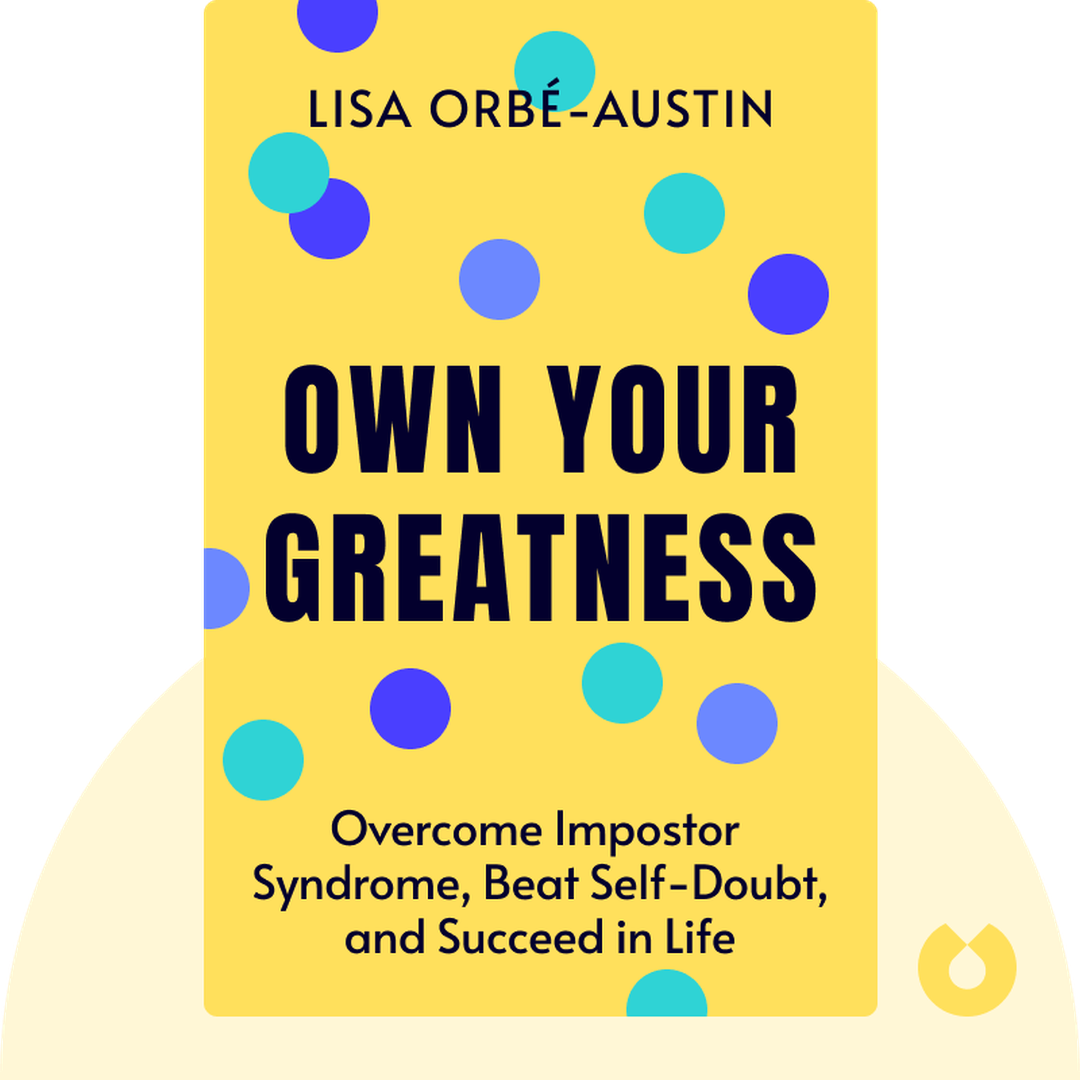
Own Your Greatness (2020) is a guided workbook for people who constantly feel like imposters. Drawing on Drs. Lisa and Richard Orbé-Austin’s expertise, it helps you identify and overcome the tiggers, habits and thoughts that activate your imposter syndrome, so you can beat self-doubt and succeed in life.
Who Should Listen to Own Your Greatness?
- People with a penchant for self-doubt
- Counselors searching for new strategies
- Imposter syndrome sufferers ready to take action
Books Similar to Own Your Greatness
Readers who enjoyed this also liked these titles.